
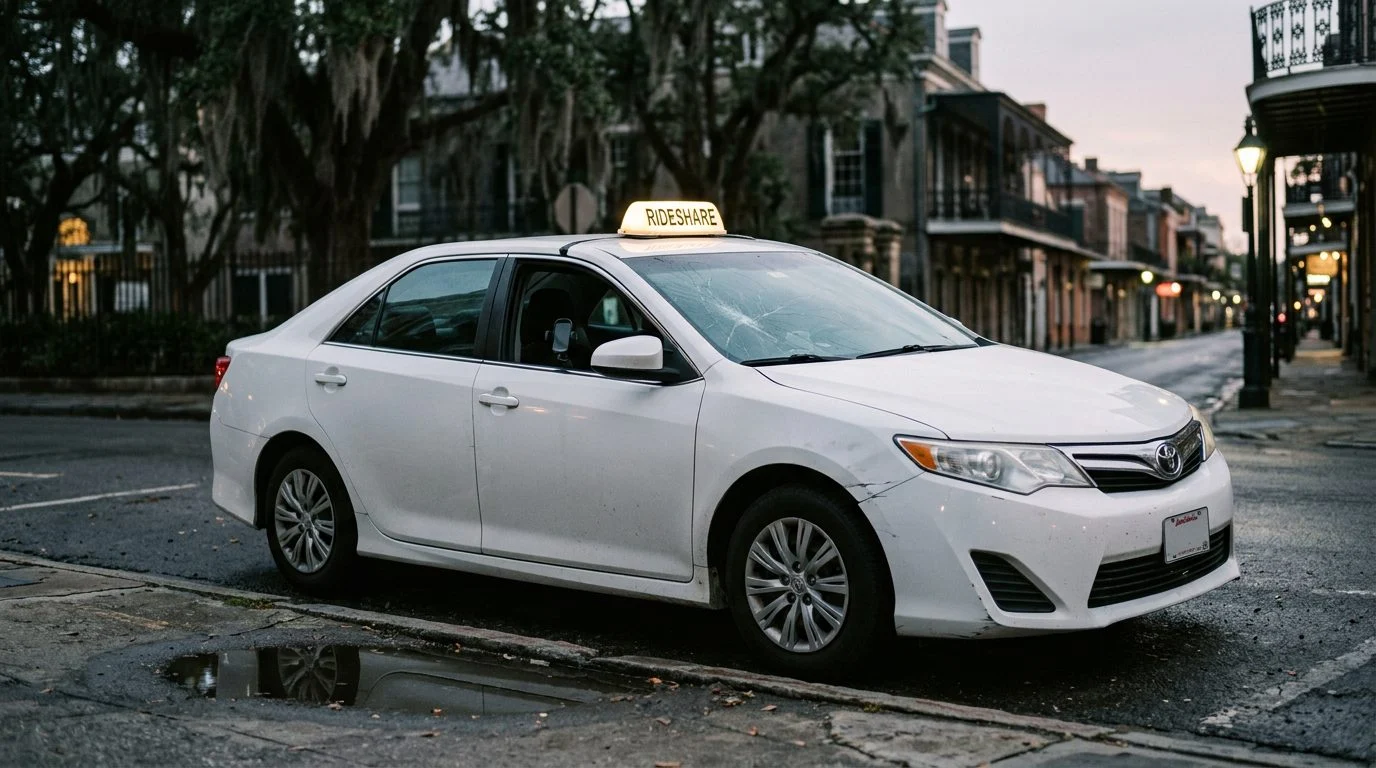
Rideshare Accidents | New Orleans, Louisiana
Hurt in a Rideshare Crash? Start With Clear Answers.
Przemek Lubecki represents people seriously injured in Uber and Lyft crashes, and families in wrongful death cases, across Orleans Parish, the New Orleans metro and Louisiana.
By Przemek Lubecki · Published October 14, 2026
Rideshare accidents involve a car or truck being used for Uber or Lyft. People hurt in these crashes may have claims against the at-fault driver, another motorist, or a company, depending on the facts. Louisiana’s fault rules and filing deadlines shape how any claim works, so it helps to understand them early. This guide is general information for people in New Orleans and across Louisiana. It is not advice about your specific case.
What Is a Rideshare Accident and Who Can Be Hurt?
A rideshare accident is any crash involving a vehicle a driver is using for Uber or Lyft. That includes time when the app is on and the driver waits for a request, drives to a pickup, or carries a rider. Drivers often switch the app on and off during a shift, so the timing can matter later.
Four groups are hurt most often. Passengers have little control over how the car is driven. Drivers face the same road risks as any motorist. Pedestrians and cyclists can be struck when a rideshare car turns, backs up, or pulls in near a pickup or drop-off spot.
The other vehicle may belong to a private motorist, a commercial truck, a delivery van, or another rideshare driver. Each possibility can change who may be responsible and which insurance may apply. A passenger hurt by another car may have more than one possible source of recovery. If your crash fits this description, the questions below can help you sort out what comes next.
If an Uber or Lyft crash has left you with medical bills, missed work, or questions about who pays, we can talk through your options with you. You do not have to face it alone.

What to Do Right After a Lyft or Uber Crash in New Orleans
Your first job is safety. Move to a safe spot if you can, and call 911 so police respond and a report is made. Ask for a medical evaluation even if you feel fine, because some injuries show up hours or days later.
Under La. R.S. 32:398, drivers involved in a crash have a duty to exchange information with the other people involved. You can read the rules in Louisiana crash report law.
Document the scene when it is safe. Take photos of the vehicles, the damage, road signs, signals, and license plates. Note the driver’s app name and any company markings on the car. Write down the time, the weather, and what people said.
Save digital records too. Keep trip details, app screenshots, texts, and call logs. Start a written log of symptoms, appointments, and missed work.
Be careful with statements and paperwork. An insurer may ask for a recorded statement early, and you can say you want time to think first. See Louisiana statement copy law.
Why Rideshare Claims Differ From Ordinary Car Accident Claims
Rideshare claims often involve more insurance questions than a typical two-car crash. One crash can involve the driver’s personal auto policy, a policy tied to the rideshare platform, and the other motorist’s policy. Each may respond differently.
Coverage can also depend on what the app was doing at the moment of the crash. A driver who is offline, waiting for a request, or carrying a passenger may fall under different rules. Those rules can change which policy applies, so don’t assume one answer fits every trip. The app-status question is covered in more depth on our Uber and Lyft app-status coverage page.
Companies may run their own investigations and keep trip data. That data can matter to how a claim is evaluated. Keep the copies you already have, and don’t delete app history.
Personal auto policies sometimes exclude vehicles used for hire. Many people don’t know this until they file a claim. That gap is one reason to read policy language carefully instead of guessing.
Insurance Coverage After an Uber or Lyft Crash: The Layers Explained
Coverage after an Uber or Lyft crash depends on the policy terms and the facts of the trip. Here is how the layers generally work.
A company’s published coverage information describes protection under specific conditions. It does not promise money for every claim, and this guide does not state an amount.
Louisiana’s official compulsory insurance information is published by the Office of Motor Vehicles.
Your own uninsured and underinsured motorist coverage may matter when the at-fault driver has too little insurance. Louisiana law sets how this coverage is offered. It must be provided in not less than the policy’s bodily injury limits unless the insured rejects it, selects lower limits, or selects economic-only coverage. See Louisiana uninsured motorist law.
Economic-only coverage can exclude noneconomic loss, such as pain and suffering. Check which version you carry. Policy language is easy to misread, so a careful review of which coverage may apply can save confusion later.
What Happens If an Uber Gets in a Crash?
After an Uber crash, the usual path is a police report, insurance notice, investigation, medical care, and evidence review. Each step takes time. No two crashes move the same way.
The crash report matters early. Under Louisiana law, crash reports are confidential but may be made available to the parties, their insurers, their healthcare providers, and their attorneys. See La. R.S. 32:398.
Expect calls. The company may open its own claim file. Adjusters from the driver’s insurer, the company’s insurer, or your own insurer may contact you. Adjusters work for insurers. A call is normal, but you don’t have to answer every question on the spot.
Early offers can arrive before the full picture is known. Medical care may continue for months, and an early offer may not reflect later treatment. Read any offer carefully before you respond. For a fuller walk-through, see what happens if an Uber gets in a crash.
Can You Sue Uber or Lyft Directly in Louisiana?
A claim may be brought against the driver, the rideshare company, or another at-fault party, depending on the facts. Whether a company can be held responsible is a fact-specific question; see negligent entrustment for one route.
Louisiana’s general rule is that every act of man that causes damage obliges the person by whose fault it happened to repair it. See La. Civ. Code art. 2315.
Employers can also answer for damage caused by employees while doing their jobs. Under Civil Code article 2320, employers may be responsible for harm caused by employees acting within the course and scope of their employment. See La. Civ. Code art. 2320. How that rule applies to a particular driver turns on the facts of the driver’s working relationship with the company, and Louisiana’s transportation network company statutes (La. R.S. 45:201.1 et seq.) also address driver status.
When more than one party is at fault, each is generally liable only for its own share. See La. Civ. Code art. 2324. That is why recovery can depend on how fault is divided.
No one can predict how an insurer or court would treat your claim. For more on this question, read suing Uber or Lyft in Louisiana and suing Uber after an accident.
Not sure what your next step is?
Louisiana Fault Rules, Comparative Fault and Filing Deadlines
Louisiana reduces a recovery by the injured person’s share of fault. Under La. Civ. Code art. 2323, for causes of action arising on or after January 1, 2026, a person whose share of fault is equal to or greater than fifty-one percent generally may not recover damages, and exceptions apply, including for intentional torts. See La. Civ. Code art. 2323.
The law looks at everyone whose fault contributed to the injury. Under Article 2323, the fault of all persons causing or contributing to an injury is determined, whether or not they are parties to the suit. That matters in rideshare accidents with several drivers or companies involved. Under La. Civ. Code art. 2323, for causes of action arising on or after January 1, 2026, a person whose share of fault is less than fifty-one percent may recover damages reduced in proportion to that share, and the same exceptions apply.
Deadlines are the part people most often get wrong. For delictual actions arising after July 1, 2024, Louisiana generally sets a two-year prescription period under La. Civ. Code art. 3493.1, which generally begins running from the day injury or damage is sustained. Injuries that occurred earlier may be subject to a one-year period, and other periods and exceptions can apply. See La. Civ. Code art. 3493.1. Wrongful death claims follow their own timing rules, which can differ from the general periods described above.
Don’t assume time remains. The right period depends on the type of claim, and deadlines are strict. Checking your specific deadline early keeps your choices open. More on fault issues appears on our Louisiana comparative fault rideshare crash page (La. Civ. Code art. 2323).
Common Injuries in Rideshare Crashes, Including Brain Injury
Rideshare crashes can cause neck and back injuries, broken bones, soft tissue injuries, and head trauma. Some symptoms appear days after the crash, so medical follow-up matters.
Soft tissue injuries include sprains and strains of muscles and ligaments. They can cause stiffness and pain that builds over the following days. Some people also feel body aches the day after a crash. Report those aches to a doctor, along with any new symptoms. For more, see body aches after a car accident.
Headaches, dizziness, memory trouble, sensitivity to light, or changes in sleep can signal a head injury. A brain injury may need a detailed medical evaluation and follow-up over time. Because symptoms can change, a written symptom journal helps. Learn more on our brain injury page.
Passengers, drivers, pedestrians, and cyclists can all suffer these injuries. The type and severity shape what records you’ll need later.
Wrongful Death After a Rideshare Crash: What Families Should Know
Louisiana allows certain surviving family members to bring a wrongful death claim after a fatal crash. The law sets an order for who may sue. See La. Civ. Code art. 2315.2.
Under Article 2315.2, a surviving spouse and children come first. If none survive, the surviving father and mother may sue. Brothers and sisters come next, then grandparents, depending on which relatives survive. Adoptive relationships count under the statute.
A separate survival action may allow recovery for injuries the deceased person suffered before death. See La. Civ. Code art. 2315.1. The same classes of survivors generally apply. If none exists, the succession representative may urge the claim.
Practical records help. Keep funeral receipts, the crash report, medical records, and any trip data together. Grief is real, and families move through it at their own pace. Learn more on our rideshare wrongful death in Louisiana page.
How a Rideshare Injury Claim Typically Progresses
A rideshare injury claim usually moves through evaluation, evidence gathering, medical documentation, insurer communication, a settlement demand, negotiation, and, if needed, a lawsuit. Each stage builds on the one before it.
Evaluation comes first. The lawyer reviews the crash facts, injuries, insurance questions, and the filing deadline. Evidence gathering follows. That means securing the crash report, photos, app data, and witness information. Medical documentation then shows the injuries and treatment over time.
Insurer communication is where many claims slow down. Insurers may dispute fault, dispute injuries, or ask for more records. A demand letter sets out the claim. Negotiation may follow. If a fair resolution is not reached, a lawsuit may be filed.
Timing varies with how serious the injuries are, how long treatment lasts, how the investigation goes, and where each insurer stands. No outcome or timeline can be promised.
The firm may associate or refer a case to other law firms. If a case is referred or associated with another firm, you will be told.
Fees and Costs in a Rideshare Accident Case
You can request a free case evaluation, and you may be responsible for case costs and expenses in addition to any fee. Ask about both before you decide anything.
If a case is taken on a contingency basis, the fee is a percentage of any recovery. The written fee agreement sets that percentage and explains how costs are handled. Read it closely before you sign. For a general explanation of percentages, see what percentage an accident lawyer takes.
Case costs and expenses are separate from the fee. You may be responsible for them in addition to the fee. The written agreement will state how they work. Clear answers now prevent surprises later.
If an Uber or Lyft crash has left you with medical bills, missed work, or questions about who pays, we can talk through your options with you. You do not have to face it alone.
Rideshare Accident Help from New Orleans and Across Louisiana
American Trial Lawyer is based in New Orleans, Louisiana. Przemek Lubecki is the responsible lawyer for this page. The firm’s office is in New Orleans.
The firm serves people in Orleans Parish, Metairie, Jefferson Parish, Kenner, St. Bernard Parish, Slidell, and across Louisiana. Serving these areas does not mean the firm has an office in each one. The firm’s office is in New Orleans.
Przemek Lubecki is licensed to practice law in Louisiana. The firm handles car accidents, truck accidents, commercial vehicle accidents, motorcycle accidents, and negligent security matters, along with wrongful death and brain injury cases. You can also learn about Przemek Lubecki.
Frequently asked questions
Can you sue Uber or Lyft in Louisiana?
Sometimes. Whether a claim can reach the company depends on the facts, including the app status at the time of the crash.
How long do I have to file a claim?
Louisiana’s general deadline for injury claims is two years from the day of injury (La. Civ. Code art. 3493.1). Wrongful death claims have their own timing rules.
Can I get a copy of the crash report?
Parties to the crash, their insurers, and their attorneys can request it. Under Louisiana law, it must be made available within seven working days after the investigation is completed.
Does this page say how much insurance applies?
No. Coverage depends on policy terms and the facts of each trip.
If a rideshare crash has left you or someone you love hurt or grieving, call 855-LUBECKI or request a free case evaluation. You may be responsible for case costs and expenses in addition to any fee.
Before you speak with an insurer
Insurance companies, including those tied to rideshare companies, may contact you soon after a crash. Talk with a lawyer before giving a recorded statement or signing any paperwork.
Why people bring their rideshare cases to our office
Focused on serious injuries
Przemek Lubecki handles rideshare, truck, commercial vehicle, car and motorcycle crash cases, along with wrongful death and brain injury claims, for people who have been seriously hurt.
Office in New Orleans
Our office is in New Orleans. We serve people in Orleans Parish, Metairie, Jefferson Parish, Kenner, St. Bernard Parish, Slidell and across Louisiana.
Plain-language guidance
We explain your options in everyday terms so you can decide what comes next with the facts in front of you.
Careful review of the facts
We look at the app status at the time of the crash, the insurance involved and your medical records.
Support for families
When a rideshare crash causes a death, we work with surviving family members through a difficult time and the legal process that follows.
Licensed in Louisiana
Przemek Lubecki is licensed to practice law in Louisiana. The firm is American Trial Lawyer, LLC, with its office in New Orleans.
Steps that can help protect your health and your claim
Get medical care
Seek medical attention even if your injuries seem minor at first. Some injuries, including brain injuries, may not show symptoms right away.
Record what you can
If you are able, note the date, time and location, photograph the vehicles and scene, and write down the names and contact details of the people involved.
Note the app status
Write down whether the driver was logged into the app, waiting for a ride, or on the way to a pickup or drop-off. This detail can matter in a rideshare claim.
Speak with a lawyer
A free, confidential first consultation with Przemek Lubecki can help you understand your situation. You may owe case costs and expenses in addition to any fee.
How referrals may work in your case
Possible association with other firms
American Trial Lawyer, LLC may associate or refer a case to other law firms when that is in the client's interest. We will explain this before any decision is made.
Your questions come first
You can ask about who will work on your case, how it may be handled, and what costs may apply before you decide anything.