
Rideshare Accidents | New Orleans
Does Uber Insurance Cover Your Accident?
Rideshare crashes can involve several insurance policies, and the answer depends on what the app was doing at the time. Here is how to think through the coverage questions after a crash.
By Przemek Lubecki · Published November 19, 2026
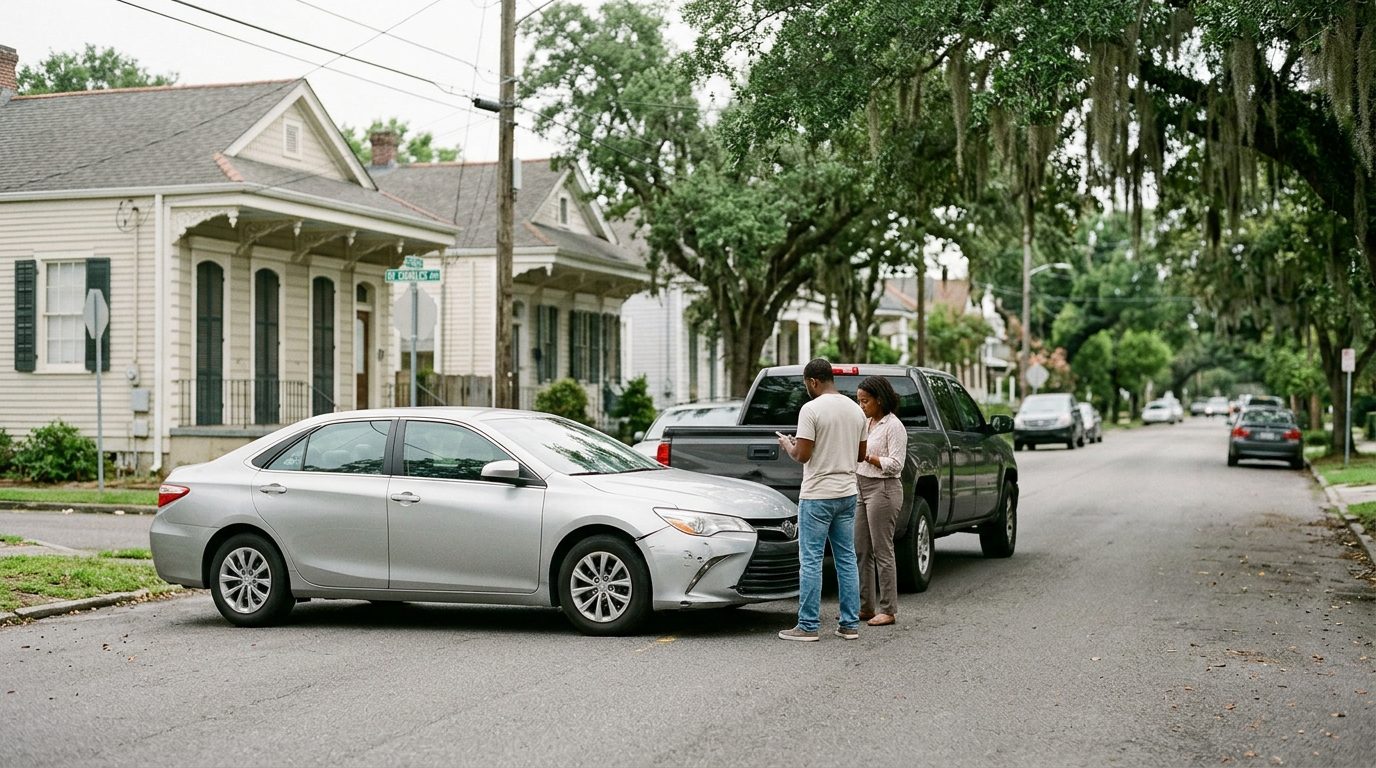
After a crash, many people ask the same thing first: whose insurance is going to pay? If your crash happened during an Uber trip, the answer isn’t always obvious, and you may be sorting it out while still hurting.
Uber insurance can cover injuries and property damage from a crash on an Uber trip. How much applies depends on what the driver’s app was doing at the moment of the crash. This guide explains the basics in plain language for riders, drivers and families in New Orleans and across Louisiana.
Uber insurance can cover a crash, but coverage is not automatic
Louisiana law requires insurance for rideshare trips, so the real question is which policy applies to your crash.
A transportation network company (TNC) is the legal term for a company like Uber. The driver, or the company on the driver’s behalf, must keep primary automobile insurance. La. R.S. 45:201.6 sets out those requirements, including amounts that change with the app period.
Coverage also differs from person to person. Riders, other drivers and people on foot each have different routes to recovery. The app’s status, the policy wording and the facts of the crash all matter.
Your personal auto policy is a separate question. La. R.S. 45:201.7 covers this, so a driver should not assume a personal policy will respond.
For a broader view of these claims in the New Orleans area, read our rideshare accident claims guide.
If a crash on an Uber trip has you sorting out which insurance applies, our team can talk it through with you at no cost. Talk it through with our team — the first consultation is free, confidential, and carries no obligation.
Uber’s coverage changes with the app status
Automobile insurance requirements for transportation network company drivers differ depending on whether the driver is in the pre-trip acceptance period or on a prearranged ride, under La. R.S. 45:201.6. One applies before a trip is accepted. The other applies during a prearranged ride.
The first tier is the pre-trip acceptance period, when the driver is logged on and available for a request. Under La. R.S. 45:201.6, automobile insurance during the pre-trip acceptance period shall be in the amount of not less than fifty thousand dollars for death and bodily injury per person, not less than one hundred thousand dollars for death and bodily injury per incident, and not less than twenty-five thousand dollars for property damage. La. R.S. 45:201.6 states these amounts.
The second tier applies while a driver is engaged in a prearranged ride. Under La. R.S. 45:201.6, automobile insurance during a prearranged ride must be in the amount of not less than one million dollars for death, bodily injury, and property damage, and a transportation network company may meet that obligation through a driver’s policy only if the company verifies that the policy is maintained by the driver and is specifically written to cover the driver’s use of a vehicle related to its digital network. A company may satisfy this through a driver’s policy only if it verifies that the policy is maintained by the driver and is specifically written to cover the driver’s use of a vehicle related to a transportation network company’s digital network. The same section requires uninsured and underinsured motorist coverage to the extent state law requires it.
These figures are legal minimums for the insurance that the driver or the company on the driver’s behalf must maintain. They are not a measure of what any claim is worth. They also don’t show what a specific policy pays. Uber’s own coverage terms for each period set out what the company provides.
Timing matters. A crash before a trip is accepted can fall under different rules than one during a trip. Knowing the app’s status at the moment of impact helps show which coverage to look at first.
Riders, other drivers and people on foot can have claims
Injured passengers and other people hurt in the crash can have claims against the at-fault driver. Those claims may reach the driver’s liability coverage.
Louisiana’s general rule is short. Every act of a person that causes damage to another obliges the person whose fault caused it to repair it. La. Civ. Code art. 2315 states that rule.
Liability coverage pays for harm the driver causes to others, within policy limits. Injury claims and property damage claims are handled under different parts of a policy.
Fault is often shared. Under La. Civ. Code art. 2323, for crashes on or after January 1, 2026, a person whose share of fault is 51 percent or more cannot recover damages. If the share is less than 51 percent, damages are reduced in proportion to that share. Fault is weighed for everyone involved, including people who are not parties to the case.
Injury protection is a separate question for drivers
Uber injury protection is coverage for drivers, and it works differently from the liability coverage that protects others.
A driver hurt while logged into the app may look to Uber’s injury protection for medical costs. The conditions, limits and exclusions are set in Uber’s own terms. Injury protection is not the same as a personal auto policy, and it may not cover every expense or every loss.
Under La. R.S. 45:201.7, a personal policy may exclude losses during logged-on time and trips. A driver should check that question early.
A driver hurt by someone else’s fault may still have a claim under the general rule in La. Civ. Code art. 2315. Injury protection and that claim are separate paths, and they can both matter.
Uninsured and underinsured coverage can help when the other driver has too little
Uninsured and underinsured motorist coverage can pay an injured person who is legally entitled to recover nonpunitive damages from an uninsured or underinsured driver when the at-fault driver has no insurance or not enough, but the coverage does not apply when an insured named in the policy rejects coverage, selects lower limits, or selects economic-only coverage.
Under La. R.S. 22:1295, this coverage, unless an insured named in the policy rejects it, selects lower limits, or selects economic-only coverage, protects people insured under the policy who are legally entitled to recover nonpunitive damages from an uninsured or underinsured driver. For an injured passenger, the coverage on the vehicle they were riding in is primary.
Some policies offer economic-only coverage at a lower price. That option excludes noneconomic loss, such as pain and suffering. Check which option the policy holds, because it changes what the coverage pays.
Time limits also matter. Under La. R.S. 9:5629, actions under uninsured motorist provisions are prescribed by two years from the accident date. Delictual, or tort, actions generally have a two-year period that starts on the day the injury is sustained, under La. Civ. Code art. 3493.1.
For more on these claims, see uninsured motorist claims in Louisiana.
Uber Eats delivery work raises its own coverage questions
Delivery work through Uber Eats raises coverage questions that differ from a passenger ride. The minimums above are written around ride periods, so a delivery trip needs its own review.
Start with the facts. Was the app on? Had a delivery been accepted? What does the personal auto policy say about losses while the driver is logged on to a network? Under La. R.S. 45:201.7, an insurer may exclude coverage under a personal auto policy for any loss or injury that occurs while a driver is logged on to a transportation network company’s digital network during the pre-trip acceptance period or while a driver is engaged in a prearranged ride.
Couriers should save the app screens, the order details and the time of the crash. Those records help show what the app was doing.
Whether these rules reach a particular delivery depends on the facts.
Not sure what your next step is?
Talk it through with our team — the first consultation is free, confidential, and carries no obligation.
Gather evidence early and keep your statements straight
The most useful steps right after a crash are to write down insurance details and request the crash report.
When an officer investigates a crash resulting in injury to or death of any person or property damage in excess of five hundred dollars, Louisiana law requires the officer to instruct each driver to report to all parties suffering injury or property damage as an apparent result of the crash the name and address of the owner and the driver, the vehicle’s license number, the liability carrier’s name, and the insurance agent’s name, address and phone number. La. R.S. 32:398 sets out these steps. Write that information down at the scene. La. R.S. 32:398 sets out these steps. Write that information down at the scene.
Under La. R.S. 32:398(C), the investigating agency must forward the crash report within 48 hours after completing its investigation.
If you give a written, recorded or transcribed statement about the crash, La. R.S. 13:3732 says the person who took it must give you a true and complete copy within twenty days after written demand. Ask for it in writing.
Other useful evidence includes the trip record from the app, photos of the vehicles and scene, medical records, and names of witnesses.
American Trial Lawyer may associate or refer a case to other law firms when a rideshare matter calls for it.
Quick answers
Does Uber insurance cover accidents in Louisiana?
It can, for crashes on Uber trips, and Louisiana sets minimum coverage by app period. Coverage is not automatic, so the crash facts matter.
Can a personal auto policy cover an Uber crash?
It may not. Louisiana law lets insurers exclude losses under a personal vehicle policy while a driver is logged on to a transportation network company’s digital network during the pre-trip acceptance period or while a driver is engaged in a prearranged ride.
How long do I have to file?
Generally two years, under Louisiana law. Tort (delictual) actions are subject to a two-year prescription that starts when the injury or damage is sustained (La. Civ. Code art. 3493.1).
How do I get a crash report?
Parties, their attorneys and insurers can request it, and Louisiana law makes it available within seven working days after the investigation.
Talk with Przemek Lubecki about your Uber insurance questions
If you’re working through a crash you didn’t choose, you don’t have to work out which policy applies on your own.
Many people reading this are dealing with medical bills, an insurer’s letter, or a family member who was hurt. The questions are concrete. What was the app doing? Which policy responds? Is the at-fault driver’s coverage enough?
Przemek Lubecki, responsible lawyer, Office in New Orleans, Louisiana, can review those questions with you. Request a free case evaluation or call 855-LUBECKI.
La consulta inicial es gratuita, confidencial y sin compromiso de continuar. The first consultation is free, confidential and without obligation to continue.
Questions to bring to a consultation
What was the app status?
Whether the driver was offline, waiting for a request, or on a trip can change which coverage may apply.
Which policies may be involved?
The driver's personal auto policy, the rideshare company's policies, and any other insurance on the vehicle may all be part of the picture.
What paperwork exists?
Screenshots, trip records, police reports, photos, and medical bills help show how the crash happened and what it cost you.
What has the insurer said?
Before you accept any payment or sign a statement, it is worth understanding what you are giving up.
Do not assume you are covered
Insurers may dispute which policy applies to a rideshare crash. Talk with a lawyer before you accept an offer or sign anything. The firm may associate or refer a case to other law firms.
Steps to take after a rideshare crash
Get medical care
See a doctor even if you feel you are only shaken up. Some injuries, including brain injuries, may not show symptoms right away.
Document the scene
Take photos of vehicles, injuries, road conditions, and the app screen if you can do so safely.
Keep your records
Save trip details, receipts, police reports, and all messages with insurers and the rideshare company.
Talk with a lawyer
A conversation can help you understand your options before you make decisions about insurance claims.