

Rideshare Accidents | New Orleans
After an Uber or Lyft Crash in New Orleans, Start With the Evidence
Trip records, photos and medical notes can disappear quickly. Here is what to keep and how to keep it organized from the first day.
By Przemek Lubecki · Published November 18, 2026
A rideshare crash can leave you shaken, sore and unsure what to keep. The evidence you save in the first days can matter a great deal later.
Save the Uber or Lyft trip screen, your receipts, photos of the scene, the police report number and your medical records. This page explains what each item shows and why it matters after an Uber accident in New Orleans or a Lyft crash elsewhere in Louisiana.
The first evidence to save after an Uber or Lyft crash
Save five things first: the trip screen, receipts, photos, the police report number and medical records. Start the same day if you can, even if you are still in pain or on the roadside. Keep each item in more than one place.
This page is informational. Przemek Lubecki is the responsible lawyer for its content. American Trial Lawyer, LLC has its office in New Orleans. The firm handles rideshare, car, truck, commercial vehicle, motorcycle, wrongful death, brain injury and negligent security matters for people in the New Orleans area and across Louisiana.
A rideshare crash can involve the driver’s personal insurance, the app company’s coverage and the other driver’s policy. Which coverage applies can depend on what the driver was doing in the app at the time. That is why the trip record matters.
Keep the list simple. You don’t need to collect everything at once. Save what you can, when you can, and keep it safe.
If you are holding screenshots, receipts and treatment papers after an Uber or Lyft crash, our team can talk through your next steps with you. Talk it through with our team — the first consultation is free, confidential, and carries no obligation.
Screenshot the Uber or Lyft trip screen and receipts
Take screenshots of the trip screen and your receipts as soon as you can, while the details are still on your phone.
The trip screen may show your pickup and drop-off points, the time of the ride, the route, and the driver’s first name and vehicle details, as the app displays them. Capture the full trip summary, not only the map. Include any messages you sent to the app’s support team about the crash.
Save the receipt email that arrives after the trip too. Receipts help show when the ride started and ended, and what route was billed.
Apps change their screens over time, and a link may need a login later. A saved screenshot with the date visible is easier to use. Email a copy to yourself and store it in a folder.
Photograph the vehicles, the scene and visible injuries
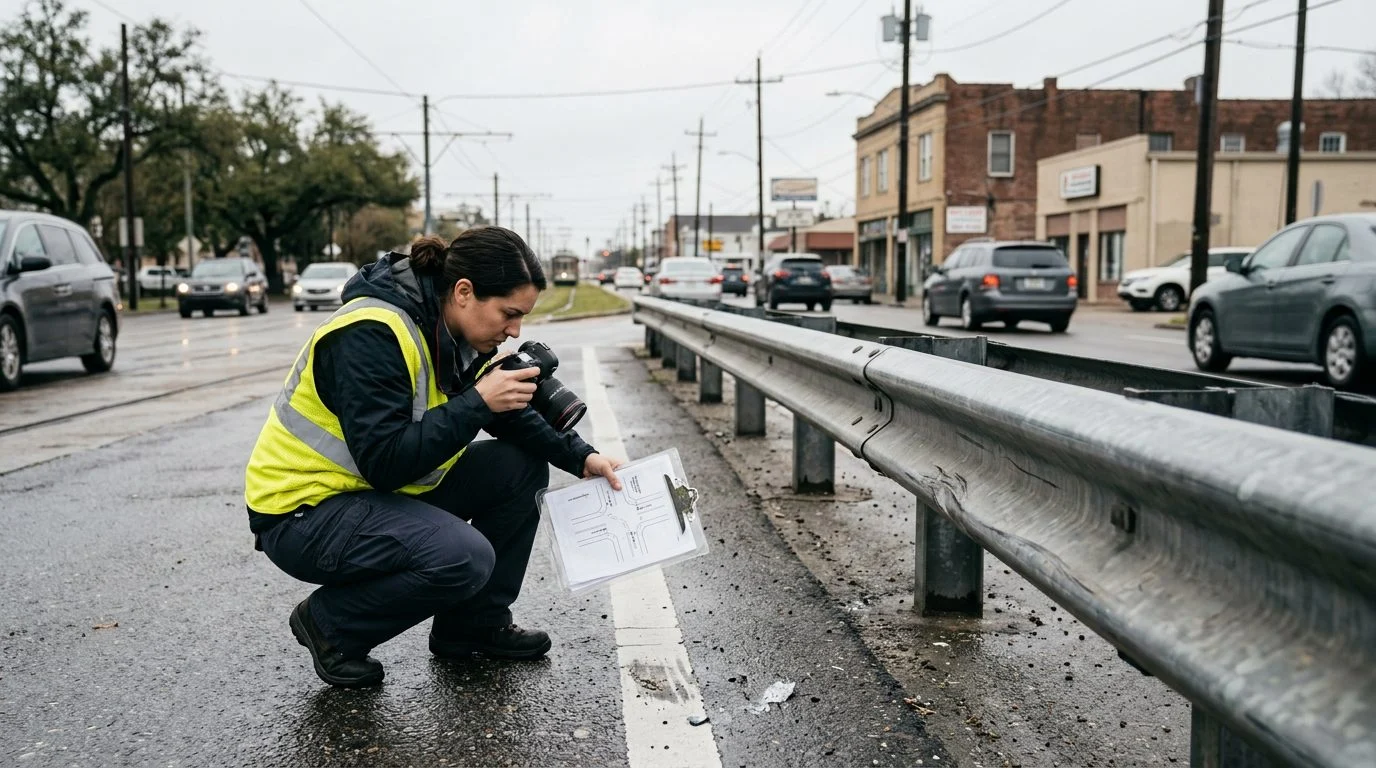
Photos taken at the scene show where the vehicles stopped, what was damaged and how the road looked. Those details are hard to recreate later.
Take wide shots first, then close-ups. Photograph every vehicle involved and the damage to each one. Include license plates, the intersection or roadway, traffic signals and signs, skid marks, debris, weather and lighting.
Photograph your injuries too. Bruises, cuts, swelling, bandages and braces can change over several days. Take new photos over time, with dates.
Show the scene as it was. Don’t crop, filter or edit the original photos. Keep the original files with their date data. Messages can compress photos and strip details, so send copies, but keep the originals.
Fault matters in Louisiana. Under Louisiana’s modified comparative fault rule, which took effect January 1, 2026, a person found 51% or more at fault recovers no damages, except that a claim is not reduced where the injury results partly from the person’s own negligence and partly from the fault of an intentional tortfeasor (La. Civ. Code art. 2323). A person found less than 51% at fault may recover damages, reduced in proportion to their share of fault (La. Civ. Code art. 2323). Photos of signals, lane position and road conditions can help show each driver’s share.
Write down the police report number and the responding agency
Write down the report number and the name of the agency that responded. You will need both to ask for the crash report later.
Under La. R.S. 32:398, the driver of a vehicle involved in a crash resulting in injury to or death of any person, or property damage in excess of five hundred dollars, shall give his name, address, and the registration number of the vehicle he was driving; if the crash occurs in a geographical area under an order of evacuation by a competent authority or under a declared state of emergency, the driver has seventy-two hours after the crash to do so (La. R.S. 32:398). On request, and if available, the driver must show their license to an injured person (La. R.S. 32:398).
At the scene, if the officer is still there, note their name and unit number. Also write down the other driver’s insurance details, plate numbers, and any witness names and phone numbers.
Crash reports are confidential. Upon request, they must be made available to the parties and others listed in the statute within seven working days after the investigation is complete (La. R.S. 32:398).
Write your own account of the crash too, dated and signed, while your memory is fresh.
Keep every medical note, bill and visit record
Keep every medical record, bill and visit summary from the crash. Get medical care for any injury, and hold on to the paperwork from each visit.
Save discharge papers, imaging reports, prescriptions, referrals, therapy notes and bills. Urgent care, emergency room, primary care and therapy visits each add to the record.
Start a simple written log. Note symptoms, the date, missed work and activities you can’t do. A log kept as things happen is more useful than one written months later.
Tell your provider about headaches, dizziness, confusion or memory changes, and write down when they happen.
Keep the statements from your health insurer too. When a health insurer or Medicare has paid a contracted provider, Louisiana law limits recovery of medical expenses to the amount actually paid, plus cost-sharing, not the amount billed (La. R.S. 9:2800.27). Explanation-of-benefits statements show those amounts.
If you have Medicare, know that its payments may need to be repaid from a settlement. CMS explains that liability insurance can pay first, and that Medicare’s conditional payments must be repaid when a settlement, judgment or other payment is made (CMS Medicare Secondary Payer overview).
Why timing matters for rideshare crash evidence
Rideshare evidence can change or disappear, so start saving now rather than later.
Trip data, phone photos, video from nearby businesses and witness memories are easier to gather early. Some of these sources can change or be lost over time.
Log-on times matter because a personal auto policy may not cover a driver during certain app periods. Insurers may exclude personal policy coverage during the pre-trip acceptance period or a prearranged ride (La. R.S. 45:201.7).
Medical records are also easier to gather when visits are documented close to the crash. Save what you have now.
Not sure what your next step is?
Talk it through with our team — the first consultation is free, confidential, and carries no obligation.
How the firm can help request records from the rideshare company
When the firm handles a case, its lawyers can send written requests for trip records, receipts and related documents to the rideshare company.
The firm can also help gather police reports, medical records and bills, so you don’t have to chase each one alone.
If you gave a written or recorded statement about the crash, you have a right to a copy. Under La. R.S. 13:3732, the person who took the statement, or anyone having possession of it or a copy of it, must, at the request of the person who made the statement or that person’s personal representative, provide a true and complete copy within twenty days after a written demand (La. R.S. 13:3732).
The firm may associate or refer a case to other law firms. Those firms are separate from American Trial Lawyer, LLC.
Talk with our team about your Uber or Lyft crash
After a rideshare crash, the paperwork can pile up fast: app screens, police numbers, bills and visit notes.
What should I save first after an Uber crash?
Save the trip screen, receipts, photos, the police report number and your medical records first. Keep copies in more than one place.
Can I get a copy of my police crash report?
Louisiana law makes crash reports available on request to the parties to the crash. Upon request, they must be available within seven working days after the investigation is complete.
Can I ask for a copy of a statement I gave?
Yes. Any person who took a written, recorded, or transcribed statement from an injured person, or who has possession of such a statement, must give the person who made it, or that person’s personal representative, a true and complete copy within twenty days after a written demand; if they refuse, the statement cannot be admitted in evidence or otherwise used in any civil action relating to its subject matter.
If you were a rider, a driver or another road user in an Uber or Lyft crash and now have screenshots, receipts and treatment papers, call 855-LUBECKI or request a free case evaluation through the contact page on this website. The office is in New Orleans. The first consultation is free, confidential and without obligation to continue.
Why Evidence Matters Early
Records change fast
App data, dashcam footage and surveillance video are often overwritten or deleted on a regular schedule.
Memories fade
Details of the route, the traffic and the other driver's statements are easier to recall while they are fresh.
Vehicles get repaired
Damaged cars and rideshare vehicles are often fixed or returned to service before anyone inspects them.
Evidence Checklist
Trip and app records
Screenshots of the trip screen, pickup and drop-off times, the driver's name and the receipt for the ride.
Photos and video
Scene photos, vehicle damage, road conditions, signs and any dashcam or phone video from the crash.
Police and crash report
The report number, the responding agency and the names of officers. Keep any citation you received.
Medical records and bills
Emergency room notes, follow-up visits, prescriptions, therapy records and every bill or statement.
Witness information
Names and phone numbers of anyone who saw the crash, plus any statements they made at the scene.
Work and expense records
Missed shifts, pay stubs, mileage, rides you could not take and out-of-pocket costs related to the injury.
Keep Your Own Notes Factual
Write down what you remember as soon as you can, stick to facts, and avoid posting about the crash on social media. Before giving a recorded statement to an insurance company, talk with a lawyer. The first consultation with Przemek Lubecki is free, confidential and without obligation. Przemek Lubecki and American Trial Lawyer, LLC may associate or refer a case to other law firms.
Talk with Przemek Lubecki in New Orleans About Your Crash
Related practice areas
- Rideshare Accidents in Orleans Parish
- Louisiana Rideshare Crash Claim Denied by Your Auto Insurer