
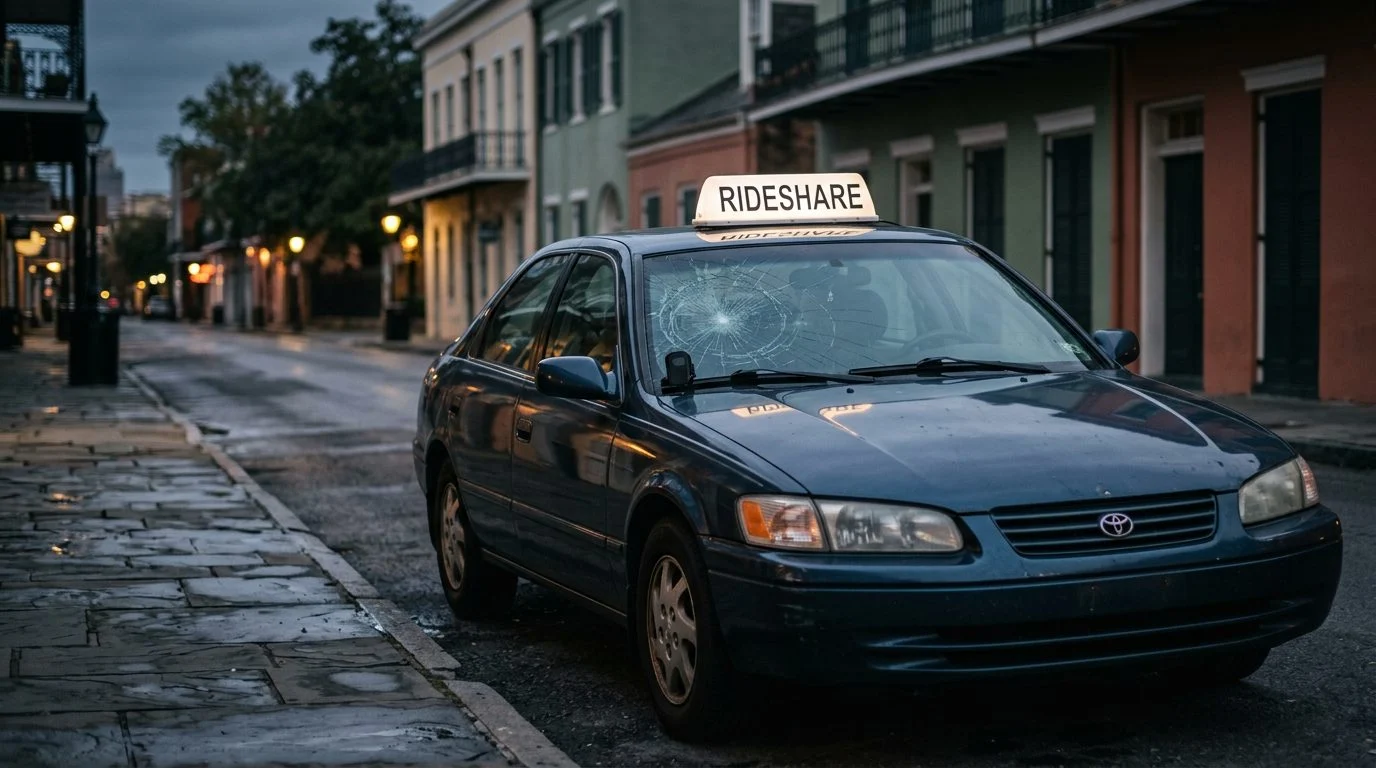
Rideshare Accident Claims | New Orleans, Louisiana
Hurt in an Uber or Lyft Crash? Talk With a New Orleans Trial Lawyer
Przemek Lubecki and the team at American Trial Lawyer, LLC represent people injured in rideshare crashes across Orleans Parish, the New Orleans metro and Louisiana. Your first consultation is free, confidential and comes with no obligation to continue. You may be responsible for case costs and expenses in addition to the fee.
By Przemek Lubecki · Published October 22, 2026
Uber Accident Lawyer New Orleans: Rideshare Crash Claims Explained
Hurt in a crash with an Uber or Lyft vehicle? You may have a claim under Louisiana law, but these cases often involve more than one insurance policy. If you need an Uber accident lawyer in New Orleans, start with how these claims work, who can file, and why timing matters.
If you're still recovering, caring for someone hurt in a crash, or sorting out insurance calls, you don't have to work through the next steps alone. Talk it through with our team — the first consultation is free, confidential, and carries no obligation.
What a rideshare accident claim involves
A rideshare accident claim seeks payment for harm caused by a crash involving a vehicle operated through an app-based service like Uber or Lyft. Louisiana regulates these services as transportation network companies (TNCs), as the Louisiana DOTD transportation network company page explains.
The basic question is familiar. Under Louisiana law, a person whose fault causes damage to another must repair it (La. Civ. Code art. 2315). What makes rideshare cases different is how many parties and insurers may be involved. A company policy, a personal auto policy and the at-fault driver’s coverage can all come into play. App records can also show what the driver was doing at the moment of impact.
Our team handles rideshare accidents as part of our car accident work in New Orleans and across Louisiana.
Who can bring a rideshare accident claim
Several people may have a claim after a rideshare crash. Who can recover depends on the facts of the crash.
- Passengers hurt while riding in an Uber or Lyft vehicle.
- Rideshare drivers hurt while driving, including their own injuries.
- Other drivers, motorcyclists, cyclists and pedestrians struck by a rideshare vehicle.
- Families after a fatal crash. Louisiana lets certain relatives bring a wrongful death claim, in order: a surviving spouse and children first, then parents if there is no spouse or child, then siblings, then grandparents; a father or mother who has abandoned the deceased during his minority is deemed not to have survived him (La. Civ. Code art. 2315.2).
Which insurance may apply and why app status matters
A transportation network company driver, or a transportation network company on the driver’s behalf, must maintain primary automobile insurance that meets the requirements of R.S. 45:201.6, including coverage during the pre-trip acceptance period and during a prearranged ride. The app status at the time of the crash often decides which coverage applies.
Louisiana’s transportation network company insurance law, La. R.S. 45:201.6, requires that automobile insurance during the pre-trip acceptance period be in the amount of not less than fifty thousand dollars for death and bodily injury per person, not less than one hundred thousand dollars for death and bodily injury per incident, and not less than twenty-five thousand dollars for property damage. Once a prearranged ride is underway, the statute requires automobile insurance in the amount of not less than one million dollars for death, bodily injury, and property damage (La. R.S. 45:201.6).
The company’s coverage does not wait for a personal insurer to deny a claim first. If the driver’s own insurance lapsed or falls short, the company must provide the required coverage starting with the first dollar and must defend the claim (R.S. 45:201.6).
Personal auto insurers may exclude any or all coverage for a loss or injury that occurs while a driver is logged on to the app during the pre-trip acceptance period or engaged in a prearranged ride (R.S. 45:201.7). That is why a driver’s own policy may deny a claim, and why several insurers can be part of one case.
Some evidence can be lost or overwritten, so early steps help. Preserve:
- trip and app records, which can show ride status and timing;
- dashcam footage and photos of the vehicles and scene;
- the police crash report, and witness names;
- medical records from the first day of care.
Crash reports are confidential. Crash reports are available only to the parties to the crash, parents or guardians of a minor party, insurers or insurance support organizations of a party, any healthcare provider or their agent that treated a party, succession representatives and attorneys of the parties, and news-gathering organizations requesting documents related to a specific crash, and on request within seven working days after the investigation is complete (R.S. 32:398). New Orleans explains its process for police report requests.
What a rideshare claim can cover
A claim may seek money for medical bills, lost income, vehicle damage and other harm from the crash.
- Medical care: emergency treatment, hospital stays, surgery, imaging and rehabilitation. Future medical costs are recoverable only when directly related to a manifest physical or mental injury (La. Civ. Code art. 2315).
- Bills paid by insurance: if a health insurer or Medicare paid a contracted provider, recovery is limited to the amount actually paid plus your cost-sharing, not the amount billed (R.S. 9:2800.27).
- Lost income: wages missed and reduced ability to earn.
- Property: vehicle and personal item damage.
- Other harm: such as pain and suffering, which may be part of a claim.
Brain and spinal injuries often need detailed medical records before anyone can measure the long-term effects. In a wrongful death case, family members may seek loss of consortium, service and society, which Louisiana allows for the same categories of people who could bring the wrongful death action (La. Civ. Code art. 2315).
How the process works, step by step
Most rideshare claims move through the same stages as other injury claims: care, documentation, review, negotiation and, if needed, a lawsuit.
- Get medical care and keep every record, bill and appointment note.
- Get the crash report number from the investigating agency.
- Be careful with recorded statements. Before you give an insurer a statement, consider contacting American Trial Lawyer to talk through your situation.
- Gather evidence: police report, app and trip data, witness information, vehicle records and medical documentation.
- Review fault and coverage: who was at fault, which insurance may apply, and whether the driver was working for the company in the exercise of the functions in which he was employed, which can affect who else may answer for the harm; an employer answers only when it might have prevented the act which caused the damage and did not (La. Civ. Code art. 2320).
- Negotiate, then file suit if needed in the proper Louisiana court.
Timing matters. Most injury claims in Louisiana have a two-year limit that generally starts on the day of injury, and that period does not run against minors or interdicts in actions involving permanent disability and brought under the Louisiana Products Liability Act or state product liability law (La. Civ. Code art. 3493.1). Wrongful death claims follow their own rule: one year from death or two years from the injury, whichever is longer (La. Civ. Code art. 2315.2).
Fault rules matter too. Under La. Civ. Code art. 2323, if the degree or percentage of negligence attributable to the person suffering injury, death, or loss is equal to or greater than fifty-one percent, that person is not entitled to recover damages, unless the other party was an intentional tortfeasor, in which case the claim is not reduced (La. Civ. Code art. 2323). If the degree or percentage of negligence attributable to the person suffering injury, death, or loss is less than fifty-one percent, the damages recoverable are reduced in proportion to that degree or percentage, but not when the harm was caused partly by an intentional tortfeasor (La. Civ. Code art. 2323). If liability is not solidary, a joint tortfeasor is not liable for more than his degree of fault and is not solidarily liable with any other person for damages attributable to that other person’s fault (La. Civ. Code art. 2324).
If you were riding in an Uber or Lyft vehicle when it was hit or when it hit someone, we can review the crash and the insurance involved. Talk it through with our team — the first consultation is free, confidential, and carries no obligation.
Why work with American Trial Lawyer
American Trial Lawyer is a New Orleans firm led by trial lawyer Przemek Lubecki, the responsible lawyer for this page. The firm represents people seriously hurt in truck, commercial vehicle and car crashes, and families in wrongful death cases.
- Office: New Orleans, Louisiana. We serve people across Orleans Parish, the New Orleans metro area, including Metairie, Jefferson Parish, Kenner and St. Bernard Parish, and elsewhere in Louisiana.
- Licensing: Przemek Lubecki is licensed to practice law in Louisiana.
- Support: Our team handles paperwork, evidence requests and insurer communication, so clients can focus on recovery and family.
- No promises: no outcome can be promised for any rideshare claim.
- Referrals: this firm may associate with or refer a case to other law firms.
Fees, costs and the free consultation
The first consultation is free, confidential and comes with no obligation to continue. You may be responsible for case costs and expenses in addition to the fee, such as records fees and filing charges.
Common questions about rideshare accident claims
Can I file a claim if I was a passenger?
Yes. A passenger hurt in a rideshare vehicle may have claims against at-fault parties and the insurance that applies.
Does it matter if the driver was offline?
Yes. Whether the driver was logged on or on a ride can change which insurance applies.
How long do I have to file?
Most injury claims in Louisiana have a two-year limit from the injury date. Wrongful death claims have their own deadline, so talk with us promptly.
Under La. Civ. Code art. 2323(A)(2)(a), if the degree or percentage of negligence attributable to the person suffering injury, death, or loss is equal to or greater than fifty-one percent, that person is not entitled to recover damages, unless the harm was caused partly by an intentional tortfeasor, in which case the claim is not reduced.
Will I have to go to court?
Some claims resolve without a trial. Others may need one. No outcome can be promised.
Talk with an Uber accident lawyer in New Orleans
If you’re still recovering, caring for someone hurt in a crash, or sorting out insurance calls, you don’t have to work through the next steps alone. Request a case evaluation or call 855-LUBECKI. Our office is in New Orleans, and Przemek Lubecki is the responsible lawyer.
How We Approach Rideshare Cases
Office in New Orleans
Our office is in New Orleans, and we represent people in Orleans Parish, Metairie, Jefferson Parish, Kenner, St. Bernard Parish, Slidell and across Louisiana.
Responsible Lawyer
Przemek Lubecki is the responsible lawyer for this page and for the claims we accept. Our team handles the paperwork and communication so you can focus on recovering.
Plain-Language Updates
We explain the insurance involved, what the records show and what the next steps are, in terms you can follow.
Confidential First Talk
Your first consultation is free, confidential and comes with no obligation to continue. You may be responsible for case costs and expenses in addition to the fee.
Before You Speak With an Insurer
Rideshare companies and their insurers may contact you soon after a crash. Before you give a recorded statement, sign a release or accept a settlement offer, consider speaking with a lawyer about your situation.
Not sure what your next step is?
Talk it through with our team — the first consultation is free, confidential, and carries no obligation.
Who We Help After a Rideshare Crash
Passengers
If you were riding in an Uber or Lyft vehicle when it was hit or when it hit someone, we can review the crash and the insurance involved.
Drivers
Drivers may face questions about whether the app was on, whether a ride was active and which policy applies. We look at those facts carefully.
Other Motorists and Pedestrians
People hurt by a rideshare driver on the road or on foot can also face serious medical bills, lost work and long recovery.
Families After a Fatal Crash
When a rideshare crash causes a death, our wrongful death work focuses on helping surviving family members understand their options during a painful time.
Talk With Przemek Lubecki About Your Rideshare Crash
Related practice areas
- Wrongful Death in a Rideshare Crash | New Orleans Families
- Rideshare Accidents Law Firm New Orleans
- Car Accident Lawyer Algiers New Orleans | Przemek Lubecki