
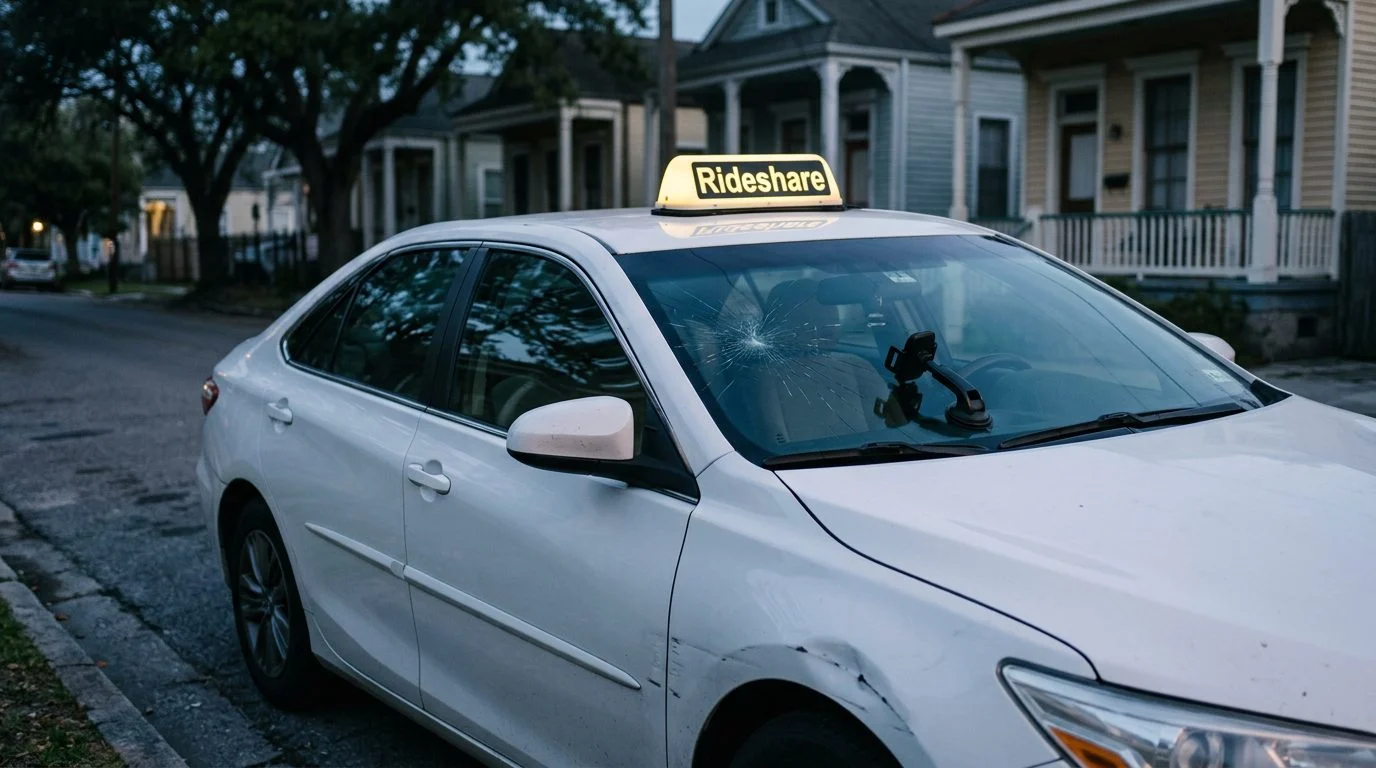
Rideshare Accidents | New Orleans, Louisiana
Driving for Uber or Lyft and Hurt in a Crash? Know Your Next Steps
A few early decisions can affect your health and your claim. Here is how to think them through, and how a trial lawyer can help you sort out the details.
By Przemek Lubecki · Published November 17, 2026
If you are an Uber driver injured in an accident in New Orleans, the days after can feel like too much at once. You may be dealing with pain, time off the road and questions about which insurance applies.
The short answer is this: a driver hurt in a crash may have a claim against the person whose fault caused it. Your status in the app at the time can also change which insurance applies. This page explains both points in plain language.
What this page covers and who it is for
This page is for rideshare drivers hurt while driving for Uber or Lyft in New Orleans, Orleans Parish and the nearby metro area. It is also for the family members, partners and friends who help them through it.
It covers crashes involving another car, a truck or a commercial vehicle, including crashes that happen while the driver is logged into the app. It answers four questions:
- Who may be responsible for the crash?
- Which insurance may apply?
- What may a claim include?
- What should you do next?
Each crash is different, and the answers turn on its details.
Request a free case evaluation
If a crash left you hurt and unable to drive, you may have options worth reviewing, and our team can talk them through with you. Talk it through with our team — the first consultation is free, confidential, and carries no obligation.
Can a rideshare driver bring a claim after being hurt?
Yes, a driver hurt in a crash may be able to pursue a claim against whoever’s negligence caused it. Louisiana law says a person whose fault causes damage must repair it (La. Civ. Code art. 2315). Negligence, imprudence and want of skill all count (La. Civ. Code art. 2316).
Injured drivers usually look at two paths. One is a claim against the at-fault driver, such as another motorist or a commercial truck driver. The other involves the rideshare company’s insurance. Whether that second path reaches the company turns on app status and the insurance terms, covered below.
Louisiana also shares fault between the people involved. Louisiana uses modified comparative fault under La. Civ. Code art. 2323, as amended effective January 1, 2026: a claimant whose share of fault is 51 percent or more is not entitled to recover damages, and Paragraph C separately provides that a claim is not reduced where the claimant’s fault combines with that of an intentional tortfeasor. Where a claimant’s share of fault is less than 51 percent, the damages recoverable are reduced in proportion to that share, unless the other person’s fault is that of an intentional tortfeasor, in which case the claim is not reduced.
How app status can change which insurance applies
Your status in the app at the moment of the crash can change which insurance applies. Louisiana sets minimum coverage for rideshare driving in La. R.S. 45:201.6 insurance rules.
- Before a ride is accepted: under La. R.S. 45:201.6, during the pre-trip acceptance period the rideshare driver, or the transportation network company on the driver’s behalf, must maintain primary automobile insurance of not less than fifty thousand dollars for death and bodily injury per person, not less than one hundred thousand dollars for death and bodily injury per incident, and not less than twenty-five thousand dollars for property damage. The company may rely on a policy the driver obtained only if it verifies that the driver maintains the policy and that it is specifically written to cover the driver’s use of a vehicle related to the company’s digital network.
- During a prearranged ride: under La. R.S. 45:201.6, the insurance must be not less than one million dollars for death, bodily injury and property damage, and must include uninsured and underinsured motorist coverage to the extent required by R.S. 22:1295. A transportation network company may satisfy its obligations through a driver’s policy only if the company verifies that the policy is maintained by the driver and is specifically written to cover the driver’s use of a vehicle related to a transportation network company’s digital network.
Personal policies can be a problem. La. R.S. 45:201.7 lets insurers exclude some or all coverage for losses while a driver is logged on or on a trip. Your own policy may not cover the crash for that reason.
The rideshare company’s policy does not wait for your personal insurer to deny a claim (La. R.S. 45:201.6).
Trip records matter. App timestamps often show when you were logged on and whether a ride was accepted. Save them early, while they are easy to get.
What a rideshare driver injury claim may include
A claim may include medical care, lost income and other losses that came from the crash. Common parts of a claim include:
- Medical care already received, such as emergency visits, imaging, surgery and medication
- Future treatment, but only when it is directly related to a manifest physical or mental injury or disease (La. Civ. Code art. 2315)
- Income lost from driving or from other work
- Vehicle repair or replacement, including sales tax paid on that repair
- Pain and suffering
Health insurance changes the math on medical bills. When a health insurer paid a contracted provider, recovery is generally limited to the amount actually paid plus your cost-sharing, not the full bill (La. R.S. 9:2800.27).
If you are on Medicare, liability insurance normally pays first, and Medicare pays second (CMS Medicare secondary payer rules). Medicare may make a conditional payment, which must be repaid from a settlement or judgment.
Brain injuries and back or spine injuries often need longer care, which can change what a claim includes. No amount can be promised before the injuries and coverage are reviewed.
Steps that help protect your claim after the crash
The most helpful steps are getting medical care, documenting the scene and saving your app records. Here is a checklist:
- Get checked by a doctor promptly, even if you feel fine at first. Keep every visit, test and prescription record.
- Get the crash report. In New Orleans, the police department investigates crashes inside city limits, and state police or the sheriff handles crashes outside them (La. R.S. 32:398). Upon request, crash reports are made available to the parties and their attorneys, as well as other listed persons such as parents or guardians of a minor party, insurers, and healthcare providers, within seven working days after the investigation is complete (La. R.S. 32:398).
- Record the other driver’s details. Note names, license and insurance information, witnesses and the exact location.
- Photograph the scene. Capture vehicle damage, road conditions and visible injuries.
- Save app records. Use the app’s reporting process and keep screenshots of trip status, timestamps and messages.
- Track your losses. Note missed shifts, lost income and out-of-pocket costs, and keep a simple daily log of pain, sleep and limits.
- Know your rights on statements. If you give a written or recorded statement, you can ask for a true copy. The person holding it must provide one within twenty days after your written demand (La. R.S. 13:3732).
How a consultation with American Trial Lawyer works
The first step is a free consultation, where you share the facts and ask your questions.
- Share the basics. Tell us the crash date and location, your app status, your injuries and the insurance information you have.
- Review your papers. We look at the crash report, medical records, app records and any letters from insurers.
- Decide next steps. If you choose to move forward, the firm may gather records and look into the crash. Timing turns on the injuries, the records and the insurance involved.
- You decide. You choose whether to move forward after the consultation.
The firm may associate or refer a case to other law firms where that is appropriate.
Not sure what your next step is?
Talk it through with our team — the first consultation is free, confidential, and carries no obligation.
Why American Trial Lawyer for rideshare driver injury cases
American Trial Lawyer is led by trial lawyer Przemek Lubecki, the responsible lawyer for this page. The firm’s office is in New Orleans.
The firm focuses on people seriously hurt in truck, commercial vehicle and car crashes, and on families in wrongful death cases. Its work includes rideshare accidents, car accidents, truck accidents, commercial vehicle accidents, motorcycle accidents, wrongful death, brain injury and negligent security.
Our team serves people in Orleans Parish, the New Orleans metro area, Metairie, Jefferson Parish, Kenner, St. Bernard Parish, Slidell and across Louisiana, from our New Orleans office.
Our approach is plain. We review the facts carefully and explain your options in everyday language.
Frequently asked questions
Can I sue Uber or Lyft if I’m a driver and get hurt?
It depends on the facts, including your app status and which insurance applies. A free consultation can review those details with you.
Do I need to report the crash to both the police and the app?
Both reports are commonly useful. The police report comes from the investigating department, and the app has its own reporting process.
What if the at-fault driver has little or no insurance?
Other coverage may be part of the review. Your own personal auto policy may exclude any or all coverage for any loss or injury that occurs during the pre-trip acceptance period while you are logged on to a rideshare company’s digital network, or while you are engaged in a prearranged ride (La. R.S. 45:201.7).
How long do I have to file a claim?
Under La. Civ. Code art. 3493.1, delictual actions are subject to a liberative prescription of two years, which commences to run from the day that injury or damage is sustained; it does not run against minors or interdicts in actions involving permanent disability brought under the Louisiana Products Liability Act or state law governing product liability actions in effect at the time of the injury or damage.
Is the consultation free?
Yes. The first consultation is free, confidential and without obligation to continue.
Talk with American Trial Lawyer about your crash
Being hurt behind the wheel can leave you unable to work, facing bills and unsure what comes next. You do not have to sort out the insurance questions by yourself. Call 855-LUBECKI to reach our New Orleans office and talk through what happened.
Why Talk With Our Firm
Focus on your recovery
Getting medical care comes first. We help you think through the paperwork so you can concentrate on healing.
Families included
When a rideshare crash leads to a death, our team works with surviving family members on wrongful death questions.
Our New Orleans office
Przemek Lubecki, a trial lawyer, leads our New Orleans office and serves Orleans Parish, the New Orleans metro area and Louisiana. The firm may associate or refer a case to other law firms.
Confidential, no-pressure conversation
The first consultation is free, confidential and without obligation to continue.
Information to Gather After the Crash
Trip and app details
Note your app status, the trip request and any screenshots showing the time and route.
Police and crash reports
Get the report number and the name of the responding department so the report can be located later.
Photos and witnesses
Photograph vehicles, road conditions, signage and injuries. Write down names and phone numbers of anyone who saw the crash.
Medical records
Keep every visit summary, prescription and bill, and track any time you missed from work or driving.
Be Careful With Insurance Calls
Insurance adjusters may ask for recorded statements soon after a crash. Before you give one or sign any document, consider speaking with a lawyer about what you are being asked to say.