

Rideshare Accidents | New Orleans, Louisiana
Save the Evidence Now: After an Uber or Lyft Crash in New Orleans
A rideshare crash can involve the driver, the app company and several insurers, and key records can disappear quickly. Here is what to gather while the details are still fresh.
By Przemek Lubecki · Published November 20, 2026
After an Uber or Lyft crash, you may be hurt, dealing with a damaged car, and fielding calls from several insurers. The proof you save in the first days can keep your account of the crash complete.
Save the trip record in the app, photos of the scene and vehicles, witness contact details, the crash report, and your medical records. Every crash is different, so the facts decide which items matter most.
Why Evidence Matters Early After a Rideshare Crash
Save evidence early, because a rideshare crash often involves more people and companies than a typical car crash. The other driver, the rideshare driver, the app company and one or more insurers may each hold part of the story.
Some of that proof is digital. App screens can be hard to retrieve later. Scene details also change quickly, as cars move and traffic clears.
Fault is central in Louisiana. Under La. Civ. Code art. 2323, if a person suffers injury partly from his own negligence and the degree or percentage of negligence attributable to him is equal to or greater than 51%, he cannot recover damages. If the injured person’s own negligence is less than 51%, the damages recoverable are reduced in proportion to the percentage of negligence attributable to that person; if the other party is an intentional tortfeasor, the claim is not reduced.
A complete record of each driver’s conduct makes that question easier to answer. A common mistake is assuming the record will still be there later. Save what you have now, even if it seems minor.
If you're unsure which coverage applies to your Uber or Lyft crash, you can talk it through with our team. Talk it through with our team — the first consultation is free, confidential, and carries no obligation.
Preserve the Trip Information in the Uber or Lyft App
Screenshot the trip details as soon as you can, because app screens can be hard to retrieve later.
Capture the pickup and drop-off addresses, the requested and actual times, the route map, the fare receipt and the trip ID. Save the driver’s name, photo, and vehicle make, model, color and plate.
Keep any in-app messages and support chats sent after the crash. Note whether the app showed the driver as online, on the way to you, or on a trip. That status matters.
Under La. R.S. 45:201.6, the required insurance changes by phase. Under La. R.S. 45:201.6, automobile insurance during a prearranged ride shall be in the amount of not less than one million dollars for death, bodily injury, and property damage, and a transportation network company may satisfy this obligation through a driver’s policy only if the company verifies that the policy is maintained by the driver and is specifically written to cover the driver’s use of a vehicle related to the company’s digital network. Automobile insurance during the pre-trip acceptance period shall be in the amount of not less than fifty thousand dollars for death and bodily injury per person, not less than one hundred thousand dollars for death and bodily injury per incident, and not less than twenty-five thousand dollars for property damage, as set out in La. R.S. 45:201.6, and a transportation network company may satisfy this obligation through a driver’s policy only if the company verifies that the policy is maintained by the driver and is specifically written to cover the driver’s use of a vehicle related to the company’s digital network.
Document the Scene, the Vehicles and Your Injuries
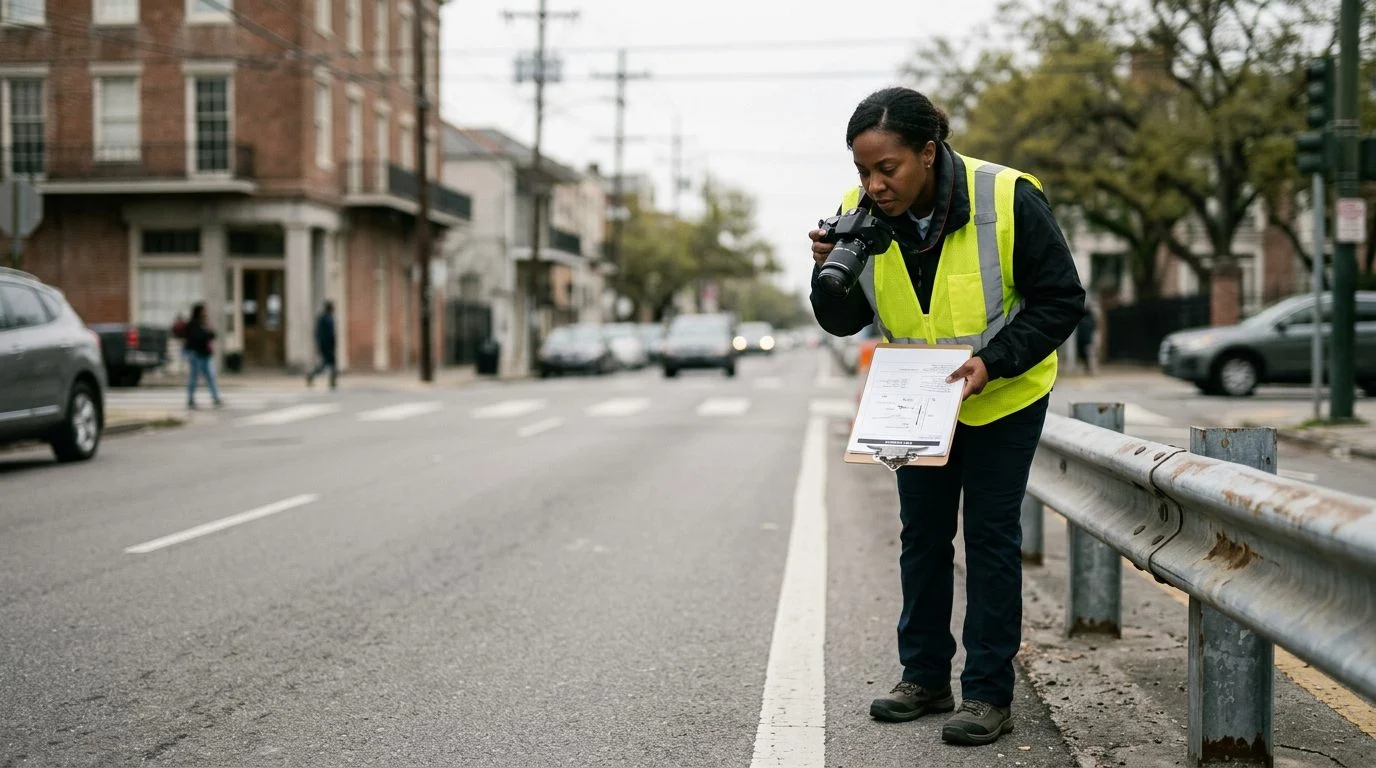
Photograph the vehicles and scene from several angles before anything is moved, if it is safe to do so. Start with a wide shot, then take close-ups. The wide view shows where each car sat on the road.
Capture the damage, the license plates, where each car came to rest, and any debris on the road. Include traffic signals, stop signs, lane markings and construction zones, plus the weather and lighting. These details matter on busy New Orleans streets, where several lanes and turns can meet at one intersection.
Your injuries are evidence too. Start a dated note about pain, stiffness, headaches, sleep, and how daily tasks have changed. Keep it short and factual. A note written close to the crash is more specific than one written months later.
Exchange Information and Gather Witness Details
At the scene, collect the other driver’s name, phone number, license, plate number, and insurance details.
Louisiana law requires a driver to share the core facts. La. R.S. 32:398 requires the driver of a vehicle involved in a crash resulting in injury to or death of any person, or property damage in excess of five hundred dollars, to give his name, address, and the registration number of the vehicle he was driving, subject to the exceptions and conditions set out in the section. On request, and if available, they must also show their license or permit to drive to anyone injured in the crash or to the driver or occupant of a damaged vehicle.
Ask passengers, bystanders and nearby business staff for names and phone numbers. Independent witnesses can confirm the order of events.
When you speak with police or the other driver, stick to facts. Describe what you saw, heard and felt. Avoid guessing about who was at fault. If the other driver was logged into a rideshare app, write that down when it’s visible or stated.
Get the Police Crash Report and Medical Records
Request the crash report from the investigating agency, and keep the report number.
Louisiana treats crash reports as confidential. Under La. R.S. 32:398, crash reports are made available only to the parties to the crash, parents or guardians of a minor party, insurers and insurance support organizations under contract to provide claims and underwriting for a party to the report, healthcare providers or their agents that rendered healthcare services to a party to the report, succession representatives and attorneys, and news-gathering organizations requesting a specific crash. Upon request, the report must be available within seven working days after the investigation is complete.
For copies of crash reports, the agency may charge a fee, but not more than five dollars per report of two pages or less, and no more than twenty dollars, inclusive of all service fees and other charges, per report exceeding two pages.
Medical records matter just as much. spinal cord injury information from MedlinePlus notes that motor vehicle accidents can cause spinal cord injuries, which need immediate medical attention.
Keep every visit summary, imaging result, prescription and bill. Together, the report and your records show when symptoms began and how your injuries were evaluated.
When the Other Driver Cannot Be Identified
If the other driver leaves the scene, write down everything you remember right away, including the time, place and vehicle details.
A hit-and-run leaves fewer facts at the start, so early notes matter more. Record any partial plate number, color, make or model, and which way the vehicle went. Report the crash to police as soon as possible.
Look beyond the scene. Ask nearby businesses whether they have security video, and note who might have seen the vehicle leave. Dashcam footage from your own car, if you have it, can also help.
Coverage can matter here too. Under La. R.S. 45:201.6, a rideshare company’s required insurance must include uninsured and underinsured motorist coverage, to the extent the statute requires it.
Identifying an unknown driver often depends on the evidence collected. That’s why early notes and photos help.
Not sure what your next step is?
Talk it through with our team — the first consultation is free, confidential, and carries no obligation.
Keep Insurance Claims and Communications Distinct
Keep a written log of every claim number, adjuster name, call date and letter. Treat each insurer separately.
Several policies can apply to one Uber or Lyft crash. These can include the rideshare company’s policy, the driver’s personal auto policy, and your own auto or health insurance. Which one responds can depend on the app status at the time of the crash.
Under La. R.S. 45:201.6, coverage under a rideshare company’s policy doesn’t depend on a personal insurer first denying a claim.
Under La. R.S. 45:201.8, within ten business days of a request for information, the rideshare company and potential insurers must cooperate to exchange relevant information. That includes the times the driver logged on and off the app in the twelve hours before and after the crash.
Recorded statements need care. Under La. R.S. 13:3732, anyone who takes a written or recorded statement from an injured person must give that person a true and complete copy. The copy is due within twenty days after a written demand. Review any written offer slowly before you reply.
Talk Through Your Circumstances With Our Team
If you’re unsure which coverage applies to your Uber or Lyft crash, you can talk it through with our team.
Maybe you were a passenger with a sore neck, a phone full of screenshots, and an insurer asking for a recorded statement. Or maybe you were driving, and the app showed you online when the crash happened.
You can call 855-LUBECKI (Office in New Orleans) to request a free case evaluation. Przemek Lubecki is the responsible lawyer for this page.
The initial consultation is free, confidential and without obligation to continue. The firm serves people across Orleans Parish, Jefferson Parish, Metairie, Kenner, St. Bernard Parish, Slidell and Louisiana. American Trial Lawyer, LLC may associate or refer a case to other law firms.
Frequently Asked Questions
How long do I have to file a claim after a rideshare crash in Louisiana?
Under La. Civ. Code art. 3493.1, delictual (tort) actions in Louisiana are generally subject to a two-year prescriptive period that begins to run on the day the injury or damage is sustained.
Do you get a copy of a recorded statement you give?
Yes. Under La. R.S. 13:3732, you can make a written demand, and the person who took the statement or who has possession of it must provide a true and complete copy within twenty days.
Why early documentation matters
Records change quickly
Trip data, app screens and dashcam footage can be overwritten or lost over time, so preserving them early helps keep the full picture intact.
Many parties are involved
A rideshare crash may involve your own insurer, the driver's insurer and the company's coverage, each with its own paperwork.
Your account stays consistent
Notes made at the scene, written while memory is fresh, give a clear and accurate record to work from later.
Who handles your case
Przemek Lubecki leads the firm from its New Orleans office. The firm may associate or refer a case to other law firms, and we will tell you if that happens.
Be careful with recorded statements
Insurance representatives may ask you for a recorded statement soon after a crash. Before you give one to any insurance company, consider speaking with a lawyer first. The firm may associate or refer a case to other law firms.
Evidence to gather
Photos and video
Take pictures of vehicle damage, the intersection, traffic signals, road conditions and any visible injuries, from several angles.
App and trip records
Screenshot the trip screen, driver name and vehicle details, pickup and drop-off points, and the time of the crash. Note whether the app showed the ride as in progress.
Police and medical records
Write down the report number and responding agency, then keep every visit summary, prescription and bill from the start of your treatment.
Witness and driver details
Collect names and phone numbers of anyone who saw the crash, plus the other driver's insurance and license information.