
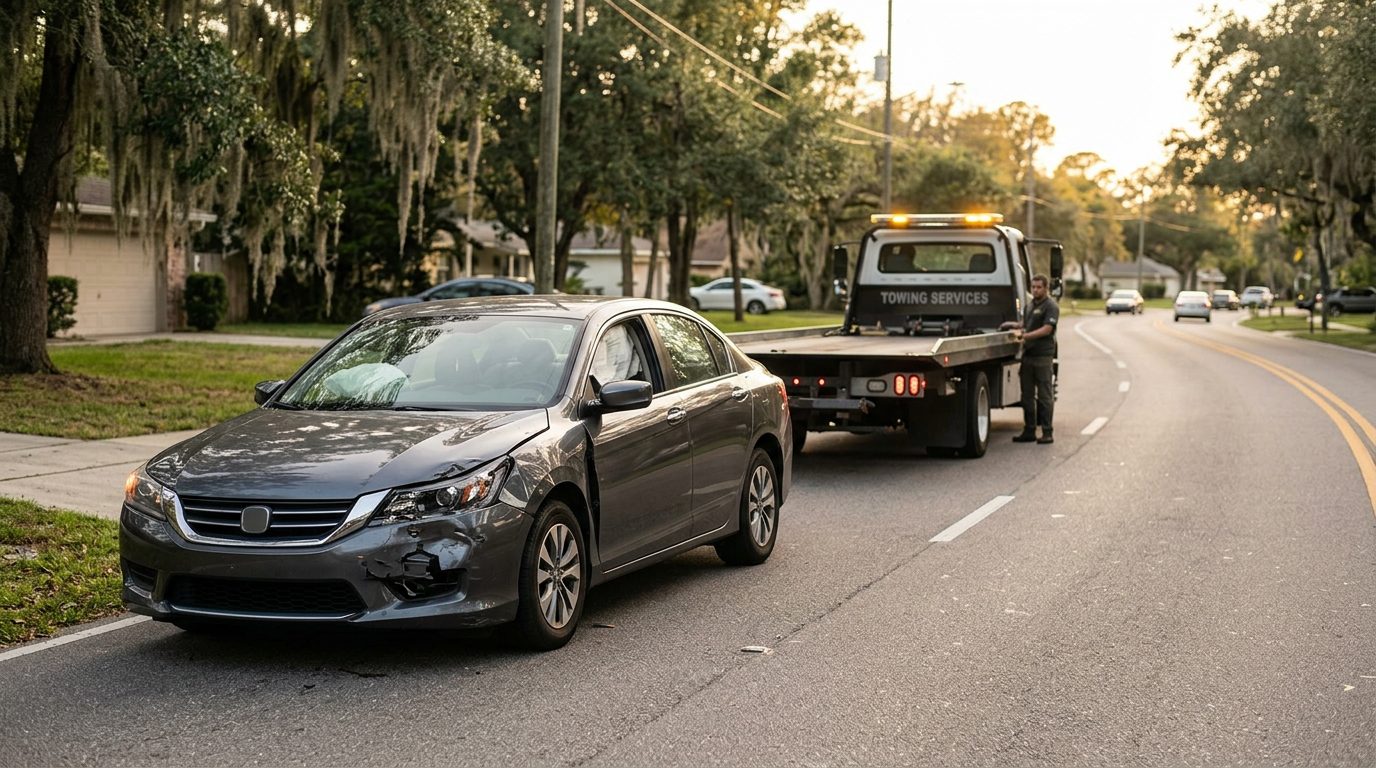
Truck Accidents | New Orleans, Louisiana
Hurt in a Truck Crash? Understand How the Claim Works Before You Decide Your Next Step
Przemek Lubecki, responsible lawyer, Office in New Orleans. Truck crashes can cause serious injuries and deaths. This guide explains who may be responsible, what evidence to protect and what families can expect. Your first consultation is free, confidential and without obligation. You may be responsible for case costs and expenses in addition to the fee.
By Przemek Lubecki · Published October 16, 2026
Truck accidents in New Orleans and Orleans Parish can cause serious injuries and deaths. An injured person may be able to seek compensation from the people and companies whose fault caused the crash. Louisiana’s fault rules can reduce or block a claim, though, so the details matter.
This guide explains how these claims work under Louisiana law. It covers who may be responsible, what evidence to protect, how deadlines run, and what families can expect when a crash causes a death. Nothing here predicts how your own claim will turn out.
What Counts as a Truck Accident in Orleans Parish
A truck accident is any crash involving a large commercial vehicle on a public road. That includes tractor-trailers, semi trucks, box trucks, dump trucks and commercial delivery vans.
Commercial vehicles follow rules that passenger cars don’t. Federal rules for property-carrying trucks cover how long drivers may work, how alert they must be, and how trucks must be maintained. Those rules also shape what records exist after a crash.
Crashes happen all over the parish. Interstate 10 and Interstate 610 carry heavy freight, and commercial vehicles also use surface streets in industrial and warehouse areas. If your crash happened on Interstate 10, read our Interstate 10 semi truck guide. For a broader view, see semi truck claims in Louisiana.
If a tractor-trailer or commercial van crash left you or someone you love hurt, you don't have to sort out insurance letters and medical bills alone, and we're glad to talk through your options.
How Often Large Trucks Are Involved in Serious Crashes
Large trucks are part of many serious crashes, but involvement is not the same as fault. A truck can be in a crash that another driver caused. The Insurance Institute for Highway Safety publishes research on large-truck crash deaths and occupant risk. That research gives general context on how severe these crashes can be.
Two points matter when you read crash statistics. First, a crash “involving” a truck is different from a crash “caused by” a truck. Second, agencies define terms differently, so numbers from one source may not match another.
This guide avoids figures it cannot tie to a clear source. For more context, see what percentage of accidents are caused by trucks.
What Commonly Causes Truck Crashes
Driver fatigue, distraction, speeding, and poor maintenance are among the most common contributing factors in truck crashes. Fault is decided case by case. Federal rules still show what the law expects of drivers and trucking companies.
Hours-of-service rules limit driving time. A driver may not drive without first taking 10 consecutive hours off duty. Driving is not allowed after a 14-consecutive-hour period that starts when the driver comes on duty, and within that period the driver may drive a total of 11 hours. A driver also needs a 30-minute break after more than 8 hours of driving time. See 49 CFR 395.3.
Weekly limits apply too. A driver may not drive after 60 hours on duty in 7 days, or 70 hours in 8 days, depending on how often the carrier runs trucks.
Federal rules also bar driving while impaired by fatigue. A federal motor carrier safety rule says a driver must not drive a commercial motor vehicle, and a motor carrier must not require or allow a driver to do so, when fatigue, illness, or any other cause has impaired the driver’s ability or alertness, or is likely to impair it, so much that it would be unsafe to begin or keep driving. The only exception is a grave emergency in which stopping would increase the danger to the vehicle’s occupants or other highway users, and then the driver may continue only to the nearest place where that hazard is removed.
Maintenance failures cause crashes too. Carriers must keep parts in safe condition at all times, including suspension systems, axles, wheels and rims, and steering systems. See 49 CFR 396.3. For the broader question of what causes most crashes, read what are 90 percent of accidents caused by.
Common Types of Truck Accidents
The most common truck accidents include rollovers, underride crashes, jackknifes, tire blowouts, and intersection, sideswipe and wide-turn collisions. Each type has its own cause and its own injury pattern.
A rollover happens when a high center of gravity or a shifting load tips the truck, often on curves or ramps. Rollovers can crush the cab and trap the driver.
An underride crash happens when a car slides beneath a trailer. Federal rules set a height limit for rear guards. For trailers made on or after January 26, 1998, the guard’s bottom edge may not sit more than 22 inches above the ground. See 49 CFR 393.86. A guard set too high can fail to stop a car from sliding under the trailer.
A jackknife can occur during sudden braking, when the trailer swings out and pushes the cab sideways. Tire blowouts often trace back to maintenance or to heavy loads.
Wide turns and lane changes also cause harm. A truck needs extra room to turn, and its trailer can swing into another lane. For more on two of these crash types, see rollover and underride truck accidents.
Who May Be Responsible After a Truck Crash
More than one party may be responsible after a truck crash. Under Louisiana Civil Code art. 2315, a person whose fault causes damage must repair it. That can include the driver and, in some cases, the company that employs the driver.
Under Louisiana Civil Code art. 2320, employers answer for damage their workers cause while doing their jobs. Responsibility attaches when the employer could have prevented the act and did not. Depending on the facts, maintenance contractors, cargo loaders, and equipment makers may also play a role.
In 2026, the U.S. Supreme Court addressed one type of claim in Montgomery v. Caribe Transport II, LLC. It held that a state-law claim that a broker negligently hired an unsafe carrier falls within the federal safety exception and is not preempted. That ruling addresses that claim type. It does not decide every claim against a broker.
Louisiana also uses comparative fault. Under Louisiana Civil Code art. 2323, if the degree or percentage of negligence attributable to the person suffering injury, death, or loss is equal to or greater than fifty-one percent, then the person suffering injury, death, or loss shall not be entitled to recover damages. If the degree or percentage of negligence attributable to the person suffering injury, death, or loss is less than fifty-one percent, then the amount of damages recoverable shall be reduced in proportion to the degree or percentage of negligence attributable to the person suffering the injury, death, or loss. Fault is assigned to all persons who contributed to the harm, including nonparties, even when a party cannot pay.
Evidence to Preserve Early in a Truck Claim
Evidence in a truck claim can disappear quickly, so early steps matter. Important records often include electronic logging device data, engine or event data recorder information (often called a black box), dashcam footage, driver qualification files, and maintenance records.
Carriers must keep maintenance records for a set time. Those records must be kept for 1 year where the vehicle is housed or maintained, and for 6 months after the vehicle leaves the carrier’s control. See 49 CFR 396.3.
Timing also matters for drug and alcohol testing. After certain crashes involving injury or tow-away damage, the employer must test surviving drivers as soon as practicable. If a controlled substances test is not given within 32 hours, the employer must stop trying and keep a record of why. See 49 CFR 382.303.
Records may be kept on any technology that accurately reflects the information and stays readable later. See 49 CFR 379.7. Keep your own records too. Save the police report number, names and phone numbers of witnesses, photos of the scene and vehicles, and every medical record. For a detailed list, see truck crash evidence, logs and black box data.
Not sure what your next step is?
How a Truck Injury Claim Moves Forward in Louisiana
Most truck injury claims start with an investigation and a claim to the insurer. Some then move into negotiation and, if needed, a lawsuit. Most claims do not go to trial. Still, a claim should be prepared as though it may be tried, because that preparation shapes how negotiations go.
Louisiana sets a time limit for filing. Under Louisiana Civil Code art. 3493.1, delictual actions are subject to a two-year liberative prescription. That period starts from the day injury or damage is sustained.
Other deadlines can apply depending on the type of claim and the dates involved. This summary is not a substitute for checking the dates in your own case. For the decision point many people face, read do I need a lawyer after a semi truck crash.
Damages, Medical Bills, and Who Pays Them
Injury damages usually fall into two groups. Economic damages include medical bills, lost wages, and property damage. Non-economic damages include pain, suffering, and loss of enjoyment of life.
Louisiana’s Civil Code limits one kind of future medical cost. Future treatment costs are recoverable only when they are directly related to a manifest physical or mental injury or disease. See Louisiana Civil Code art. 2315.
Several sources may help pay bills while a claim is pending. These can include your health insurance, medical payments coverage on your auto policy, and the at-fault party’s liability coverage. Louisiana requires motor vehicle liability insurance, as the state’s insurance requirements explain. If the other driver has no coverage, read what if the other driver has no insurance.
Case value depends on many facts, and no amount can be predicted here. For the factors involved, see how a truck case’s worth is evaluated. For the bill question, read who pays medical bills after a truck accident.
Wrongful Death Claims After a Truck Crash
When a truck crash causes a death, certain surviving family members may bring a claim. Under Louisiana Civil Code art. 2315.2, the surviving spouse and children come first. If none survive, the parents may sue, then siblings, then grandparents, depending on who is left. Adoptive relationships count.
Timing is strict. Under Louisiana Civil Code article 2315.2, a wrongful death claim generally has a one-year time limit that runs from the date of death. Because the dates in each case must be checked carefully, families should contact our office promptly. A survival claim for the injuries the person suffered before death follows a similar timeline under Louisiana Civil Code art. 2315.1.
Louisiana law also names certain losses. Damages may include loss of consortium, service, and society. In plain terms, these cover the loss of a loved one’s companionship, help, and everyday relationship. Those losses are recoverable by the same family members who could bring a wrongful death claim.
Families often face grief, funeral planning, and paperwork at the same time. Keep the decedent’s medical records, the crash report, and any letters from insurers. For the family’s first questions, read can I sue if my husband died in a truck crash and how to file a wrongful death lawsuit in Louisiana.
Fees, Costs, Referrals, and What to Avoid Saying
Any free case evaluation comes with a cost note. You may be responsible for case costs and expenses in addition to any fee.
American Trial Lawyer, LLC may associate or refer a case to other law firms. Co-counsel and referring lawyers are separate firms. They are not part of American Trial Lawyer, LLC.
Insurance adjusters often contact injured people early. What you say to an adjuster, or post on social media, can affect a claim. Think before you give a recorded statement or sign a release. For more, read what not to say to an injury lawyer.
Past outcomes in other cases do not predict how your case will turn out.
Talk With Przemek Lubecki About Your Truck Crash
Przemek Lubecki is the responsible lawyer for this page. Our office is in New Orleans, Louisiana. Przemek Lubecki is licensed to practice law in Louisiana.
If a tractor-trailer, box truck, or commercial van hurt you or someone in your family, the medical visits and insurance letters can pile up fast. You may be trying to work out who is responsible and whether to talk with the other side.
You can request a free case evaluation at our contact page or call 855-LUBECKI. You may be responsible for case costs and expenses in addition to any fee.
How We Approach Truck Accident Cases
Focus on the injured person
Serious injuries affect work, family and daily life. We take time to understand what you are dealing with, physically and financially.
Careful review of the evidence
Truck crashes often involve records that can be lost over time. We work to identify and protect the evidence that matters to your claim.
Clear communication
We explain each step in plain language so you can make informed decisions about your case.
Rooted in New Orleans
Our office is in New Orleans, and we represent people across Orleans Parish, the New Orleans metro area and Louisiana.
Case referrals
Depending on the facts and the location of the crash, we may associate or refer a case to other law firms. We will tell you if that happens.
Early Steps Matter
Get medical care right away, even if your injuries seem minor. Photograph the scene and your injuries when you can, and keep records of your treatment and expenses. Speak with a lawyer before you give a recorded statement to an insurance company.
Steps That Can Help Protect Your Claim
Get medical attention
A prompt medical evaluation protects your health and creates a record connecting your injuries to the crash.
Document the scene
Note the date, time, location, weather and the names of witnesses. Keep copies of police and crash reports.
Preserve evidence
Trucking companies keep logs, maintenance records, dispatch data and electronic data. Ask a lawyer to help request that this information be preserved.
Talk with a lawyer
A consultation can help you understand your options and the steps that come next, with no obligation to continue.
Speak With Przemek Lubecki in New Orleans. You may be responsible for case costs and expenses in addition to the fee.
Related practice areas
- Semi Truck Accident Lawyer in New Orleans, Louisiana