
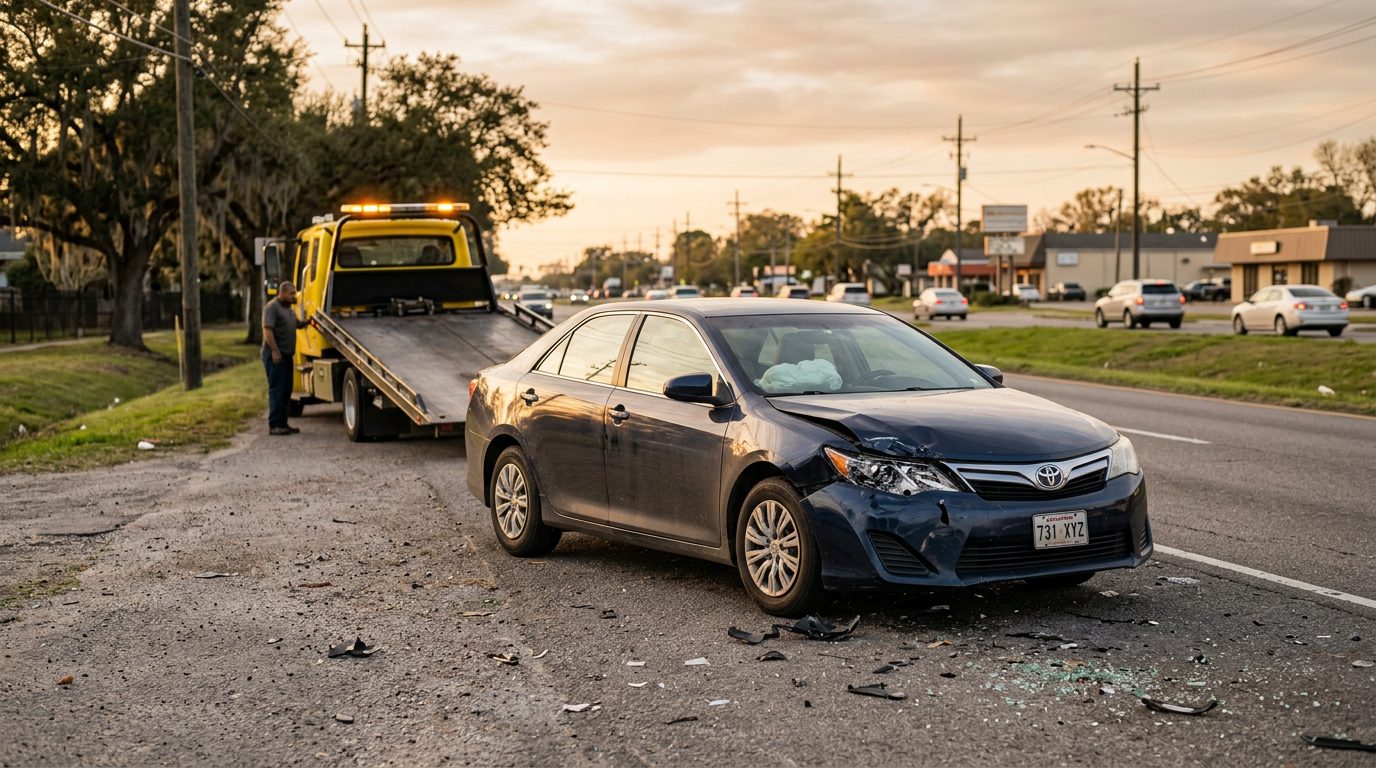
New Orleans Truck Accident Lawyer | Orleans Parish and Louisiana
Hurt by a Truck That Left the Scene? Talk to a New Orleans Trial Lawyer
Przemek Lubecki represents people seriously injured in truck, commercial vehicle and car crashes, and families in wrongful death cases. Call 855-LUBECKI or request a free case evaluation. Your first consultation is free, confidential and comes with no obligation to continue. You may be responsible for case costs and expenses in addition to any fee.
By Przemek Lubecki · Published October 20, 2026
A truck driver who drives away does not decide who was at fault. The evidence does. If the truck driver was at fault in a New Orleans crash, Louisiana law still looks at the fault of everyone who caused or contributed to the crash, even when that person’s identity is not known or reasonably ascertainable (Louisiana comparative fault law). This page explains the next steps for people hurt in these crashes in New Orleans and Orleans Parish, and for families of someone who was killed.
What It Means When a Truck Driver Leaves the Scene
A hit-and-run truck crash is one where the driver leaves before exchanging information with the people involved.
Louisiana law says a person whose fault causes damage must repair it (Louisiana general liability article). Many trucks belong to a company. Louisiana’s employer liability article says employers are answerable for damage caused by workers while doing their jobs. It also sets conditions on that responsibility (Louisiana employer liability article).
The steps below are in order. The first days after a crash often matter most.
Not sure what your next step is?
Talk it through with our team — the first consultation is free, confidential, and carries no obligation.
Immediate Steps at the Scene and in the First Days
The first steps are to call 911, get medical care, and record what you can while the scene is still there.
- Call 911 and ask for police, even if the truck has already left.
- Get a medical evaluation promptly. Some injuries show symptoms later, and early records help document them.
- Write down the truck’s color, markings, company name, DOT or unit numbers, direction of travel, and any part of the plate.
- Record witness names and contact details, plus the street, intersection, or nearest landmark.
- Photograph vehicle damage, skid marks, debris, and the road before anything changes.
- Keep a written log of symptoms, treatment, missed work, and calls with insurers, with dates and names.
Keep the police report number. Insurers and any later claim will rely on it.
How Fault Is Decided When the Truck Driver Left
Fault is decided by evidence. That includes the police report, witness accounts, damage patterns, and the layout of the scene.
In truck crashes, useful evidence often sits with the truck and the company behind it. Examples include traffic or business camera footage, dashcam video, and electronic records from the truck.
Louisiana uses comparative fault, which means shared fault. Under La. Civ. Code art. 2323, if the degree or percentage of negligence attributable to the injured person is equal to or greater than fifty-one percent, that person is not entitled to recover damages. Under La. Civ. Code art. 2323, if the degree or percentage of negligence attributable to the injured person is less than fifty-one percent, the amount of damages recoverable is reduced in proportion to that degree or percentage of negligence. This version took effect January 1, 2026.
Identifying the Truck, the Driver, and the Carrier
Identifying the truck and the company is often the first task in a hit-and-run truck case.
Where a truck has an electronic logging device (ELD), federal rules say it automatically records the date, time, truck location, engine hours, vehicle miles, driver or authenticated user identification data, and motor carrier identification data, among other data elements (49 C.F.R. § 395.26). Carriers must keep driver qualification files for as long as a driver works for them and three years after, except that certain records listed in paragraph (d) may be removed three years after execution (49 C.F.R. § 391.51).
Federal rules also let carriers preserve records with any technology that accurately reflects all of the information in the record and remains accessible in a form that can be accurately reproduced later for reference (49 C.F.R. § 379.7). Routine retention can overwrite data, so a written preservation request should go out early.
Federal rules set conditions on post-crash drug and alcohol testing for commercial drivers. Under 49 C.F.R. § 382.303, an employer must test a surviving commercial motor vehicle driver for alcohol as soon as practicable after certain accidents, including where the driver receives a moving traffic citation within 8 hours of the occurrence and the accident involved bodily injury with immediate medical treatment away from the scene. Testing without a citation is required only after a fatal crash (49 C.F.R. § 382.303).
Insurance Sources When the At-Fault Driver Cannot Be Found
Your own auto policy may include uninsured motorist coverage that can respond when the at-fault driver is unknown or uninsured. If the unknown vehicle had no physical contact with you, you must prove, by an independent and disinterested witness, that the injury was the result of the actions of that driver.
Louisiana law sets rules for this coverage. In a crash with no physical contact, for coverage to apply the injured person must prove, through an independent and disinterested witness, that the injury resulted from the actions of a driver whose identity is unknown or who is uninsured or underinsured (La. R.S. 22:1295). The same statute says the coverage required under this section is not applicable when any insured named in the policy rejects coverage, selects lower limits, or selects economic-only coverage, in the manner provided in Item (ii) of that subparagraph.
If the truck company’s insurer is known, that insurer may be a separate source of recovery. Louisiana law lets an operator file a written accident report that declares insurance information, and lets the vehicle’s owner file it only if the operator is physically incapable of making the report (La. R.S. 32:871). Adjusters may ask for recorded statements or early medical releases. You can ask for time before you answer.
Deadlines and Time-Sensitive Steps
Louisiana generally gives two years from the day of injury to file a fault-based injury claim. The delictual actions article sets that period, which starts on the day the injury or damage is sustained (La. Civ. Code art. 3493.1).
For a death, the wrongful death article says the right to sue lasts one year from the death or two years from the injury, whichever is longer (La. Civ. Code art. 2315.2). The same article lists who may sue, including a surviving spouse and children, and in some cases parents, siblings, or grandparents.
Time-sensitive steps include:
- Sending evidence preservation requests to the carrier and any camera owners.
- Keeping up with medical follow-up and saving every bill and record.
- Contacting witnesses while their memories are fresh.
Have questions about what happened?
Ask our team directly. The first conversation is free, confidential, and there is no obligation to continue.
What to Expect From a Free Consultation and the Case Process
The first step is a confidential intake conversation with Przemek Lubecki, the responsible lawyer, at the firm’s New Orleans office. The first consultation is free, confidential, and comes with no obligation to continue. You may be responsible for case costs and expenses in addition to the fee.
A typical case moves through these stages:
- Intake and review of the crash facts.
- Preservation letters for truck, carrier, and camera records.
- Investigation of the truck, driver, and company.
- Documentation of medical care and losses.
- Presentation of the claim to insurers.
- A lawsuit, if one is needed. Timing varies from case to case.
The firm may associate or refer a case to other law firms. No outcome can be promised. American Trial Lawyer, LLC is the firm’s name, and our team includes support staff who assist Przemek Lubecki in the office.
Frequently Asked Questions
Fault is decided on the evidence.
Do I need to find the driver myself?
No. Records requests and investigation can identify the truck and the company behind it.
Will my own insurance help if the at-fault driver is unknown?
It may, depending on your policy wording and the witness rule for no-contact crashes.
What if I was partly at fault?
Louisiana reduces recovery by your share of fault (La. Civ. Code art. 2323). Under La. Civ. Code art. 2323, if the injured person’s share of negligence is fifty-one percent or more, that person is not entitled to recover damages.
Who is responsible for this page?
Przemek Lubecki is the responsible lawyer for this content, which American Trial Lawyer, LLC publishes from its New Orleans office.
If a truck driver drove away after hurting you or someone you love, you may have a claim, and you don’t have to sort it out alone. Call 855-LUBECKI or request a case evaluation.
How We Approach a Hit-and-Run Truck Case
Focused on Trial-Ready Preparation
Our work is built around the possibility of trial from the first day, so evidence is gathered and preserved early.
Identifying the Truck and Its Owner
Records requests and investigation can help identify the commercial vehicle and the company responsible for it, even when the driver fled.
Attention for Families
When a crash has caused a death, we speak with families with patience and clarity about the legal options that may be available.
Based in New Orleans
Our office is in New Orleans, and we serve people across Orleans Parish, the New Orleans metro area and Louisiana.
Plain-Language Communication
We explain each step in terms you can follow, so you always know where your case stands.
Important: Your Case May Be Referred
Our firm may associate or refer a case involving a truck, commercial vehicle or other type of crash to other law firms. Any co-counsel or referring firm is not part of American Trial Lawyer, LLC. You may be responsible for case costs and expenses in addition to any fee.
If You Were Hurt and the Driver Drove Away
Get Medical Care First
See a doctor or go to the emergency room even if you feel you have only minor injuries. Some injuries, including brain injuries, may not show symptoms right away.
Report the Crash
Call 911 and ask for a police report. Note the truck's markings, company name, DOT number, license plate and direction of travel if you can.
Write Down What You Remember
Record the time, location, weather and what happened while the details are fresh. Save photos, witness names and any dashcam or surveillance footage you can locate.
Call Us Before Speaking to Insurers
Insurance adjusters may contact you quickly. Talk with Przemek Lubecki before giving a recorded statement or signing any document.
Speak with Przemek Lubecki in a Free, Confidential Consultation. You May Be Responsible for Case Costs and Expenses in Addition to Any Fee.
Want to know where you stand?
Tell us what happened and our team will walk you through the options available to you, at no cost.
Related practice areas
- Truck Accidents in New Orleans and Orleans Parish: How Injury Claims Work
- Can I Sue If a Semi Truck Hit Me on I-10 in New Orleans
- How Much Is My 18 Wheeler Accident Case Worth in Louisiana