
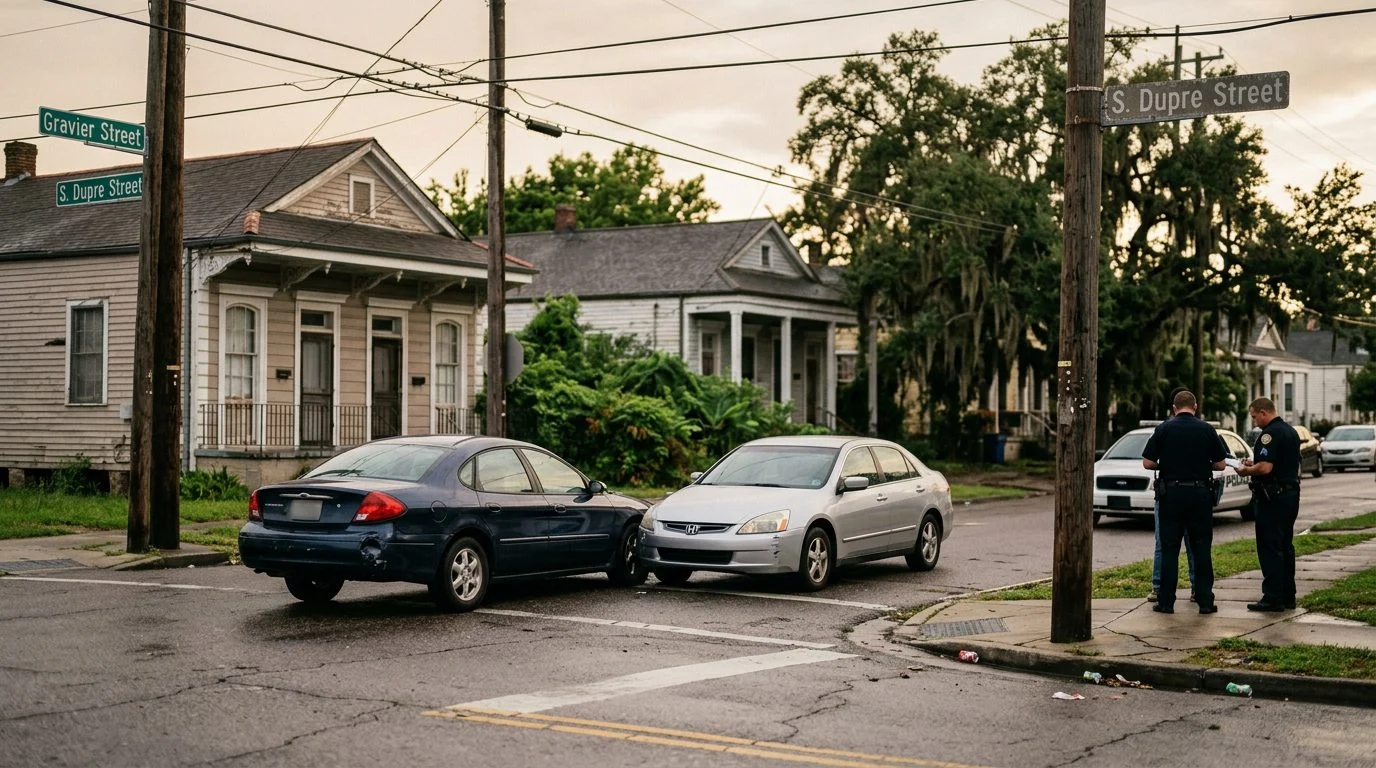
Injury claims | New Orleans, Louisiana
Louisiana's Comparative Fault Rule and What It Means for Your Injury Claim
A plain-language guide to how responsibility can be shared after a crash, and how to talk through your own facts with our New Orleans trial team.
By Przemek Lubecki · Published November 14, 2026
After a crash, a hard question often comes up: if you were partly at fault, can you still recover? Under the Louisiana comparative fault rule, a person whose share of fault is 51% or more cannot recover damages, and a person whose share is less than 51% has damages reduced in proportion to that share (La. Civ. Code art. 2323).
This page explains the rule in plain words. It is written for people hurt in truck, commercial vehicle, and car crashes in Orleans Parish and the New Orleans metro, and for family members looking into it for someone else.
What Is Louisiana’s Modified Comparative Fault Rule?
Louisiana divides fault by percentage among everyone who contributed to an injury. The rule is written into Louisiana Civil Code article 2323.
The article requires that the degree of fault of all persons who caused or contributed to the injury be determined. That includes people who are not parties to the lawsuit. It also covers any claim for damages, whatever legal theory it rests on.
Because the percentages drive the result, the exact allocation is central to any claim.
If you were partly at fault in a crash and aren't sure what that means for you, we can talk through the facts with you. Talk it through with our team — the first consultation is free, confidential, and carries no obligation.
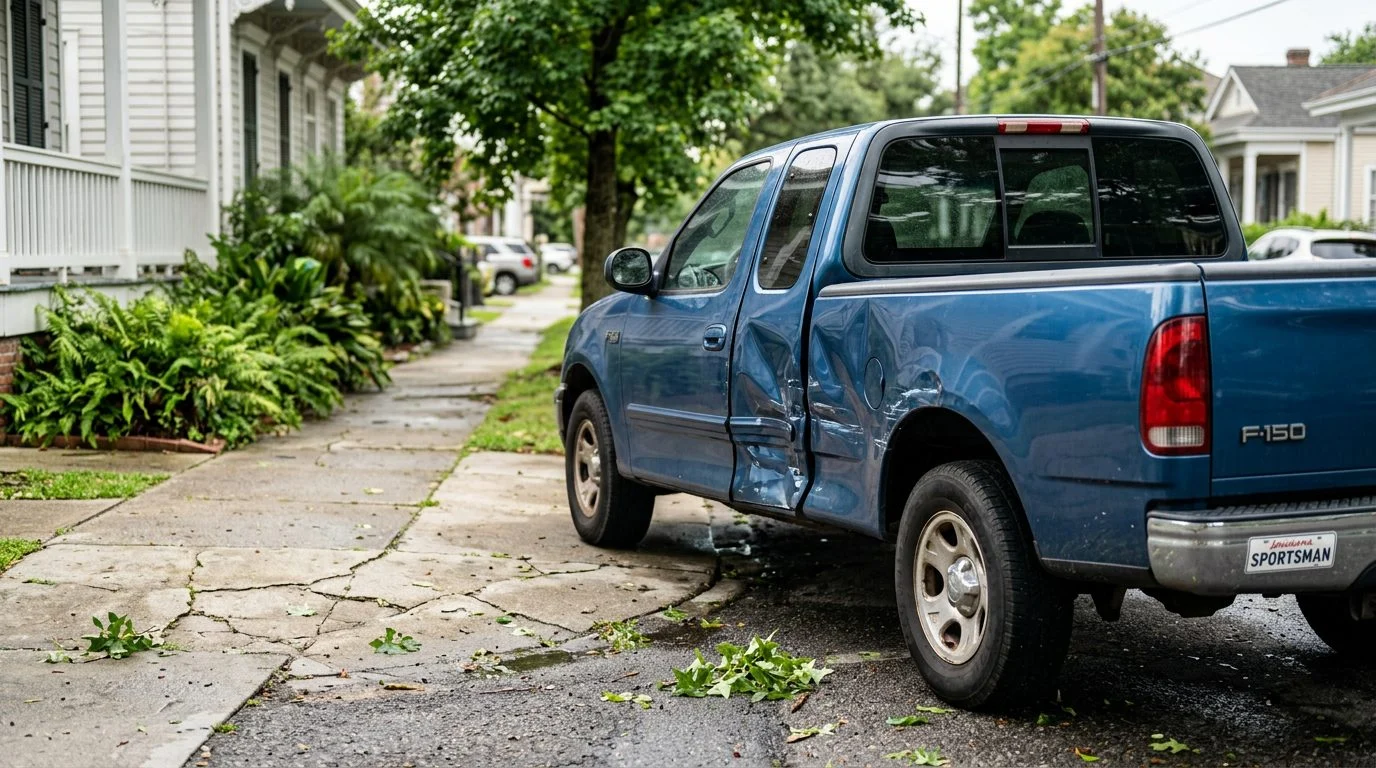
How does Louisiana’s comparative fault rule affect recovery when the injured person shares fault for the crash?
For a crash on or after January 1, 2026, partial fault reduces recovery in proportion to the injured person’s share.
It reduces recovery by that share.
Here is an illustration only, not a prediction. Suppose a fact-finder assigned 20 percent of the fault to the injured driver. Recovery would drop by 20 percent.
Those percentages are set on the facts of each crash. Under Article 2323 as amended effective January 1, 2026, a claimant whose share of fault is less than 51% can recover damages reduced in proportion to that share, while a claimant whose share is 51% or more cannot recover damages (La. Civ. Code art. 2323).
Louisiana’s Modified Comparative Fault Rule
Contributory negligence is a different approach that some states use. Under it, any fault by the injured person can bar recovery completely, even a small share. Louisiana’s article 2323 instead ties the result to a percentage.
That difference matters when you are deciding whether to pursue a claim after a crash. Under a percentage system, the exact share of fault is central. Under an all-or-nothing system, a single share of blame can decide the outcome. Understanding this difference helps you read the rule correctly, whatever your situation.
How Comparative Fault Applies in Truck and Commercial Vehicle Crashes
In a truck or commercial vehicle crash, fault can be split among several people. Those people can include the driver, the company that operates the truck, and another motorist. Each share is weighed on its own.
Louisiana makes a person responsible for damage caused by negligence, imprudence, or want of skill. A person whose fault caused damage must repair it. Under article 2324, if liability is not solidary, a joint tortfeasor is not liable for more than its own degree of fault; a person who conspires with another to commit an intentional or willful act is answerable, in solido, with that person. If liability is not solidary under paragraph A, a joint tortfeasor is also not solidarily liable for another party’s fault, including the fault of the person suffering injury, regardless of that party’s insolvency, ability to pay, or immunity. Each party’s percentage matters on its own.
Federal rules require motor carriers to keep records that can bear on fault. Drivers must record their duty status for each 24-hour period on an electronic logging device (ELD); a manual grid is allowed only in limited cases, such as for a commercial motor vehicle manufactured before model year 2000 (49 C.F.R. § 395.8).
This firm may associate or refer a case to other law firms. Any other firm involved is separate from American Trial Lawyer, LLC.
How Crash Reports and Time Limits Fit In
Louisiana generally gives two years to file an injury claim. The clock generally starts on the day the injury happens. The two-year period is set by Louisiana Civil Code article 3493.1, which says the period does not run against minors or interdicts in product liability actions involving permanent disability. How the timing applies depends on the facts.
After a crash, the driver must give injured people their name, address, and vehicle registration number. If the crash results in injury or death to any person, or property damage over five hundred dollars, the driver must also show a license on request, if one is available, to any person injured, to the driver or occupant of a damaged vehicle or property, or to a police officer at the scene or investigating (La. R.S. 32:398). Crash reports are confidential. Upon request, they are provided within seven working days after the crash investigation is complete.
Quick answers
How long do I have to file?
Louisiana generally allows two years from the day of injury for these claims (La. Civ. Code art. 3493.1). Some exceptions apply.
Can I get a copy of a crash report?
Parties and their attorneys can request one. It is made available within seven working days after the investigation is complete.

Talking Through Your Situation After a Crash
If you were hurt, or you are watching someone you love recover, a question about fault can feel heavy. You may have been told you share the blame, and you may not know what that means for a claim.
Przemek Lubecki, a trial lawyer, is the responsible lawyer for this page. Our office is in New Orleans. The initial consultation is free, confidential, and without obligation to continue. Call 855-LUBECKI or request a free case evaluation, and we can talk through the facts of your crash with you.
Before you rely on this page
Every case turns on its own facts. Reading this page does not create an attorney-client relationship. The firm may associate or refer a case to other law firms.
Key ideas to understand
Shared responsibility
Comparative fault looks at how responsibility for an accident may be divided among the people involved, and that division can affect an injury claim.
Evidence that shapes the picture
Crash reports, photographs, vehicle data, witness statements and medical records often help show how an accident happened.
What to bring to a consultation
Gather the crash report number, insurance letters, and dates of treatment so the conversation can focus on your facts.
Plain answers, no pressure
Our team takes the time to explain how these ideas may apply to your situation before you decide on any next step.
Why talk with American Trial Lawyer
Office in New Orleans
Our office is in New Orleans, and we serve people in Orleans Parish, the New Orleans metro and across Louisiana.
Led by Przemek Lubecki
Trial lawyer Przemek Lubecki leads the firm's work for people seriously hurt in truck, commercial vehicle and car crashes, and for families in wrongful death cases.
Plain-language answers
We explain how fault rules may apply to your facts in terms you can follow.
Confidential first conversation
The initial consultation is free, confidential and without obligation to continue.