
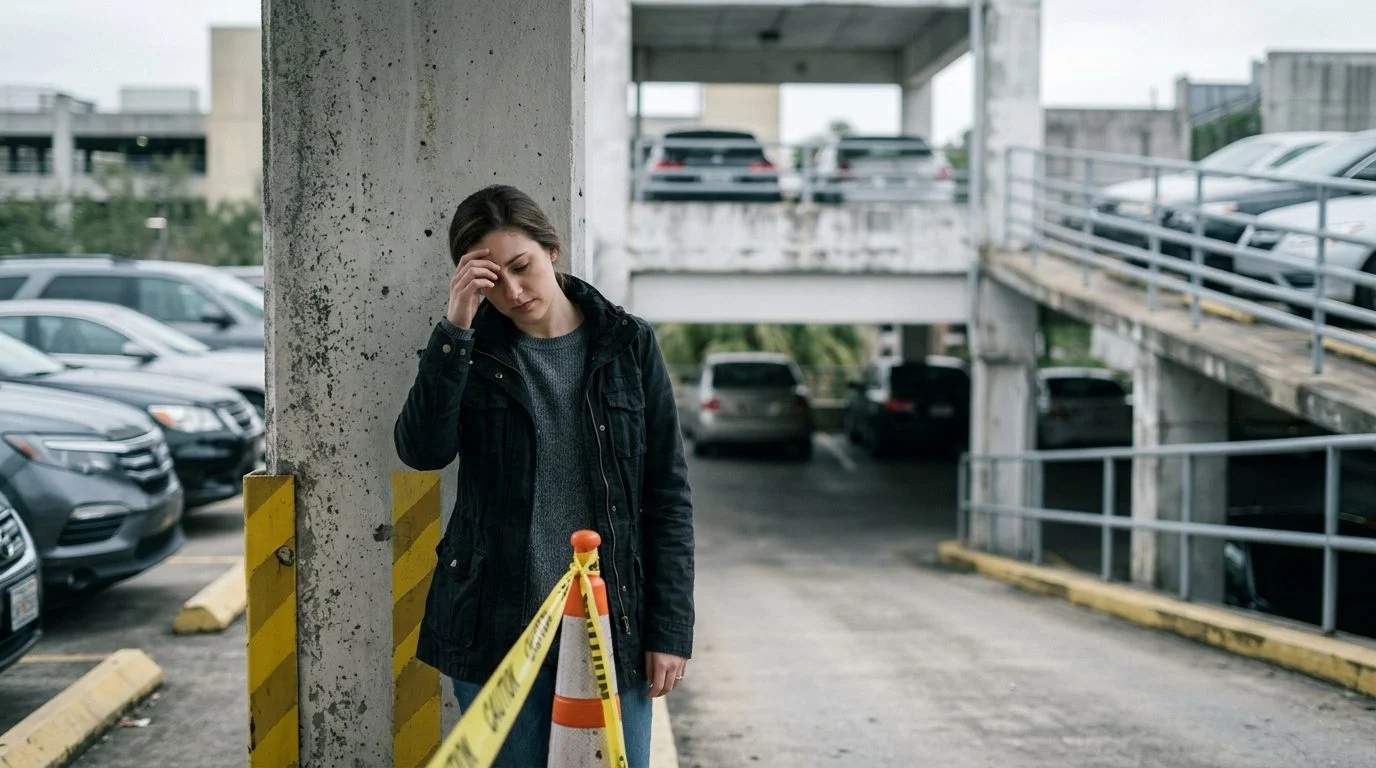
Parking Garage Attack Lawsuit Orleans Parish
If you or someone you love was hurt in a parking garage attack, you may wonder whether the garage could be held responsible. In Louisiana, a parking garage attack lawsuit asks a specific question: did the garage side fail to take reasonable steps against a risk it knew about or should have known about? This guide explains how that question is looked at in Orleans Parish, what a claim can cover, and what to do first.
What a parking garage attack claim is
A parking garage attack claim is a civil case against the party responsible for a garage when a visitor is hurt by someone else’s crime there.
The attacker commits the crime. The civil question is different. It asks whether the garage owner, the operator, or a security contractor failed to take reasonable steps against a risk they knew or should have known about.
This kind of case is often called a negligent security claim. It can follow an assault, a robbery, a shooting, or a fatal attack. It can involve visitors, tenants, employees, and rideshare passengers.
A civil claim is separate from any criminal case. An attacker who was never identified does not end the question, though it does shape how the case is built.
This page is written for injured people and for families of people killed in Orleans Parish and the New Orleans metro area who are deciding what to do next.
Not sure what your next step is?
Talk it through with our team — the first consultation is free, confidential, and carries no obligation.
When a garage owner or operator may be responsible
A garage owner or operator may be responsible when it knew, or reasonably should have known, about an unreasonable risk and did not act with reasonable care.
Under La. Civ. Code art. 2317.1, the owner or custodian of a thing is answerable for damage occasioned by its ruin, vice, or defect only upon a showing that he knew or, in the exercise of reasonable care, should have known of the ruin, vice, or defect which caused the damage, that the damage could have been prevented by the exercise of reasonable care, and that he failed to exercise such reasonable care. Did the owner know, or should it have known, of the condition that caused the damage? Could reasonable care have prevented the damage? And did the owner fail to use that care? Louisiana law also makes a person responsible for harm caused by negligence or want of skill under art. 2316.
Facts that often get examined include:
- Earlier robberies, assaults, or car break-ins in or near the garage
- Complaints from tenants or patrons
- Police calls to the address
- Lighting in stairwells, elevators, and walkways
- Cameras that were broken, blocked, or not recording
- Gates, access controls, or stairwell doors left open or unlocked
A security company or management firm hired to run the garage may share responsibility. Leases, service contracts, and who controlled the space can matter a great deal.
Defendants may also argue that the injured person shared the blame. Under La. Civ. Code art. 2323, if the degree or percentage of negligence attributable to the person suffering injury, death, or loss is equal to or greater than fifty-one percent, then that person shall not be entitled to recover damages, but notwithstanding this, if a person suffers injury, death, or loss as a result partly of his own negligence and partly as a result of the fault of an intentional tortfeasor, his claim for recovery of damages shall not be reduced. A smaller share reduces the amount recoverable. Whether that applies, and how, depends on the facts.
What a claim can cover
A claim can seek money for losses an injury caused. In a fatal case, it can seek money for losses the family suffered. No particular amount can be promised, because each case turns on its own evidence.
For an injured person, losses can include:
- Past and future medical bills and rehabilitation
- Medications and medical equipment
- Lost wages and lost ability to earn
- Pain, suffering, and emotional distress
- Reduced quality of life
Louisiana law also allows certain family members to recover damages for loss of consortium, service, and society under La. Civ. Code art. 2315. These are harms to a family’s relationship with the injured person.
La. Civ. Code art. 2315.2 lists who may sue. It starts with a surviving spouse and children. When no closer relative survives, it allows parents, then siblings, then grandparents, but a father or mother who has abandoned the deceased during his minority is deemed not to have survived him.
Possible defendants include the owner, the operator or management company, and a security contractor. Each is judged on its own role. Under La. Civ. Code art. 2324, if liability is not solidary under Paragraph A, a joint tortfeasor is not liable for more than its own degree of fault.
Evidence to preserve early
The evidence that matters most is often the evidence that disappears first. Acting early helps protect it.
- Surveillance video. Ask that footage be saved right away. Camera systems can record over older footage.
- Police report and incident number. Keep any supplemental reports too.
- Photos and notes of the location. Capture lighting, camera positions, gates, entry points, and the route to the car or exit.
- Witness names and contact details. Include other patrons, attendants, and rideshare drivers.
- Medical records. Keep records from the first visit onward, including imaging and notes on symptoms that appeared later.
- Prior incident history. Earlier crimes at the garage may show what the owner knew.
Write down what you remember while it’s fresh. Note the time, the level, the path you took, and who was nearby.
How the process works and what to expect
A claim usually moves through review, investigation, a settlement demand, and either a settlement or a lawsuit. Timelines vary, and many cases take months or longer.
- Initial review. A lawyer reviews what happened, the injuries or losses, and what is known about the garage’s security.
- Investigation. Records are requested, evidence is preserved, and the responsible parties and their insurers are identified.
- Demand and negotiation. A settlement demand may go to insurers. Any offer is weighed against the evidence and your goals.
- Lawsuit, if needed. If a fair resolution isn’t reached, a suit may be filed in the proper Louisiana court. Discovery, depositions, and motions follow.
- Trial or resolution. A case may settle at any stage or proceed to trial.
Deadlines matter. La. Civ. Code art. 3493.1 sets a two-year period for delictual actions, running from the day injury or damage is sustained. La. Civ. Code art. 3493.3 applies a two-year period to damages from an act defined as a crime of violence, except as provided in Article 3496.2. Wrongful death claims follow art. 2315.2, which allows one year from death or two years from injury, whichever is longer; for medical malpractice actions, the right of action prescribes one year from the death of the deceased. These periods can be strict, so it’s wise to act promptly.
Why American Trial Lawyer for this type of case
American Trial Lawyer is a personal injury trial law firm. Przemek Lubecki, a trial lawyer, is the responsible lawyer for this page and leads the firm’s personal injury practice, which includes negligent security matters.
- Office. The firm’s office is in New Orleans, Louisiana. It serves Orleans Parish, the New Orleans metro, and Louisiana matters. The firm also has an office in Park Ridge, Illinois.
- Team. Our team includes support staff who help with records, evidence requests, and client communication.
- Trial readiness. The firm is a trial law firm, so it prepares cases with a possible trial in mind from the start.
- Other lawyers. The firm may associate or refer part or all of a case to other law firms. Those lawyers are not part of American Trial Lawyer, LLC.
Have questions about what happened?
Ask our team directly. The first conversation is free, confidential, and there is no obligation to continue.
Common questions about parking garage attack claims
Can I bring a claim if the attacker was never identified?
A civil claim can still be looked at based on the garage’s conduct. Identifying the attacker affects who may be named and how the case is built.
Does the garage need prior attacks to be responsible?
Prior incidents are an important factor. Lighting, cameras, and access controls can also be relevant.
What if I was partly at fault?
Louisiana’s comparative fault rule can reduce a recovery (La. Civ. Code art. 2323). Under La. Civ. Code art. 2323, if a person’s own share of negligence is less than fifty-one percent, the damages recoverable are reduced in proportion to that share, while a share equal to or greater than that figure means no damages are recovered; but if the person suffers injury, death, or loss as a result partly of his own negligence and partly as a result of the fault of an intentional tortfeasor, his claim for recovery of damages shall not be reduced.
Is there a deadline I need to know about?
For most injury claims, Louisiana generally allows two years from the day of injury (La. Civ. Code art. 3493.1). Protecting evidence early also matters.
Can a family file a claim after a fatal attack?
Yes. Under Louisiana wrongful death law, eligible survivors may sue, depending on their relationship to the person who died.
Talk with our team about what happened
If someone you love was hurt or killed in a parking garage, you may be dealing with hospital visits, insurance calls, and hard questions all at once. If you want to talk through what happened, call 855-LUBECKI (our New Orleans office) or request a free case evaluation. The first consultation is free, confidential, and without obligation to continue. You may be responsible for case costs and expenses in addition to any fee.
Related practice areas
- When Someone Is Hurt on Another Person’s Property in New Orleans: Who Can Be Held Responsible
- New Orleans Company Car Accident Claims Against an Employer