
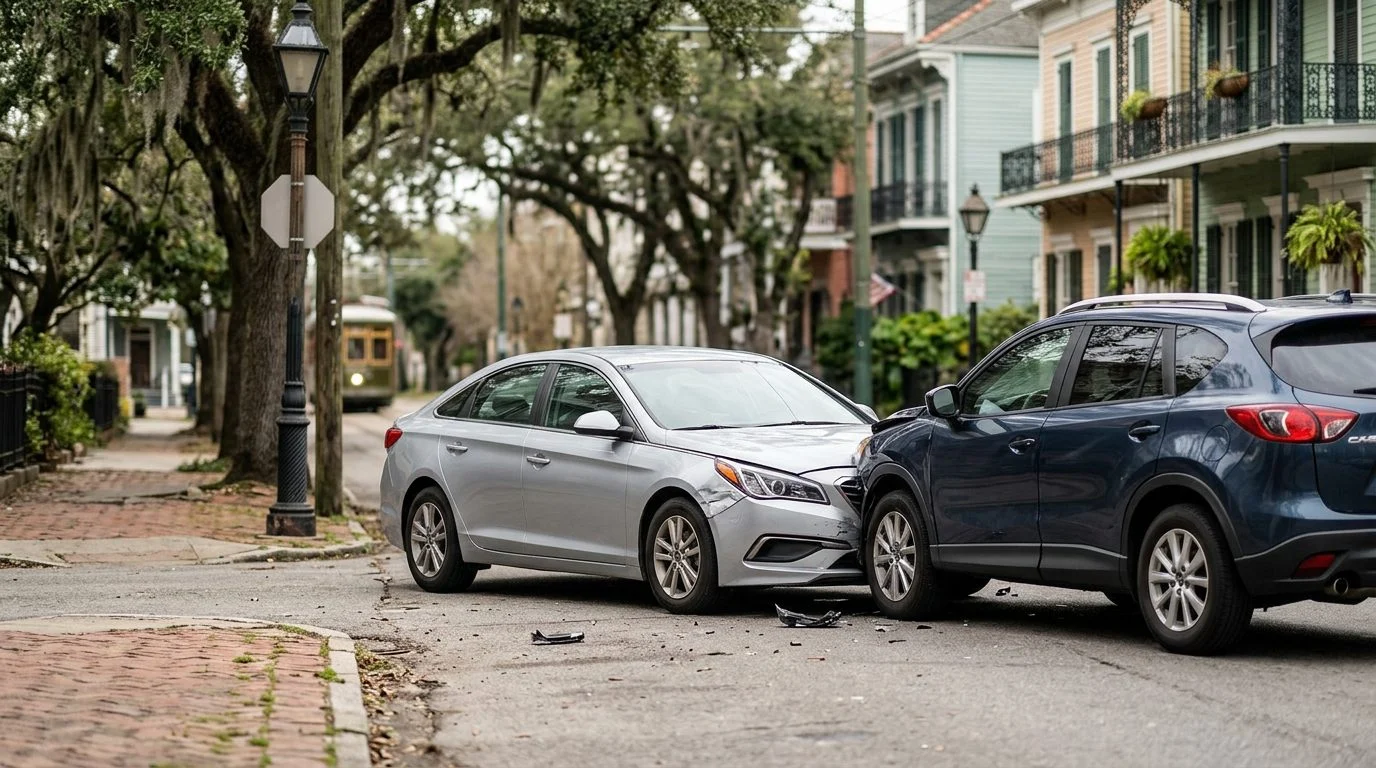
Car Crash New Orleans: What Happens Next
Why the First Days After a New Orleans Car Crash Matter
If you are searching for car crash New Orleans what happens next, the answer starts in the first few days. Early choices about medical care, evidence and insurance contact shape what can be proven later. Those choices often happen while you’re sore, shaken and dealing with a car that won’t drive.
Many injuries don’t feel serious at the scene. Neck, back and head injuries can show up hours or days later. Insurance calls can also come quickly, sometimes before anyone has checked your health. Knowing the order of events helps you avoid the most common mistakes.
This guide follows the questions injured people usually face. It covers the scene, medical care, the crash report, fault, adjusters, insurance coverage, special crash types, damages, time limits and local questions across Orleans Parish and nearby areas. It gives general information about Louisiana law. It is not advice about your specific crash, and no early step promises a particular result.
Not sure what your next step is?
Talk it through with our team — the first consultation is free, confidential, and carries no obligation.
What to Do at the Scene: Safety, 911 and Information to Collect
The first priority at a crash scene is safety. Call 911 when anyone is hurt. If you can, move your car out of traffic and turn on your hazard lights. Ask for police and medical help even if you feel fine.
Under La. R.S. 32:398, the driver of a vehicle involved in a crash resulting in injury to or death of any person, or property damage in excess of five hundred dollars, must immediately give notice of the crash to the local police department if the crash occurs within an incorporated city or town, or to the nearest sheriff’s office or state police station. La. R.S. 32:398 covers those reporting rules, so make sure the crash is documented properly.
Collect the other driver’s name, phone number, insurance company, policy number and license plate. Note the vehicle make, model and color. Write down witness names and the exact location, including the lane, intersection or parking row. Take photos of vehicle damage, the roadway, traffic signals, skid marks and any visible injuries.
Avoid admitting fault or guessing about speed at the scene. Stick to facts you know. A common mistake is telling the other driver “I’m fine,” then waking up the next morning with a stiff neck. Keep your photos and notes, and don’t delete them.
Seek Medical Attention First: Why Symptoms and Records Matter
Getting a medical checkup soon after a crash protects your health first. It also creates a record that connects your injuries to the crash. Some injuries, including neck, back and head injuries, don’t show symptoms right away. Pain can build over several days.
Seek care right away if you notice worsening headaches, confusion, memory trouble, dizziness, vomiting, slurred speech or unusual drowsiness. Those signs can point to a brain injury, and brain injuries need prompt evaluation.
Keep every appointment, prescription and test result. Write down when pain started, what it feels like and which activities it limits. Keep work notes that show missed shifts or lifting limits. These details help your doctors and matter later.
Louisiana’s evidence code also addresses causation. La. Code Evid. art. 306.1 says that a lack of prior medical history does not, by itself, create a presumption that the crash caused a condition. Clear records of symptoms after the crash help show what changed.
Getting the Crash Report and Other Official Records
A crash report is the official record the investigating agency creates. It usually lists the date, location, drivers, vehicles, passengers, witnesses and the officer’s notes. Inside New Orleans city limits, the New Orleans Police Department usually investigates. Outside city limits, state police or the sheriff’s office usually does.
Louisiana treats crash reports as confidential. They are available to the parties to the crash, their insurers and their attorneys, and certain healthcare providers. On request, the report must be made available within seven working days after the investigation is complete. La. R.S. 32:398 sets out who may receive it and when.
To request your copy, contact the investigating agency. Have the date, time and location of the crash ready, along with any report number you were given at the scene.
Reports can contain errors. Check names, plates, directions and the description of events against your photos and notes. If something is wrong, tell the investigating agency in writing and keep a copy of what you sent.
How Fault Is Decided in Louisiana
Louisiana decides fault by looking at who caused the harm and how much each person contributed. Under Louisiana law, a person whose fault causes damage must repair it. La. Civ. Code art. 2315 states that general rule.
Many crashes involve more than one person’s conduct. Louisiana uses comparative fault, which means each person’s share of fault is weighed. Under La. Civ. Code art. 2323, the rule that bars recovery for a person at fault depends on when the claim arose, so the date of the crash matters. Under La. Civ. Code art. 2323, if the degree or percentage of negligence attributable to the person suffering injury, death, or loss is less than fifty-one percent, the amount of damages recoverable is reduced in proportion to that degree or percentage.
The art. 2323 changes apply only to claims arising on or after January 1, 2026. Claims arising earlier remain under the prior pure comparative fault rule, under which a person found more than 50% at fault may still recover a reduced amount.
Many people assume the rear driver is always at fault in a rear-end crash. That isn’t always true.
An insurer’s first label on fault is not the final word. Fault is decided on the evidence, including the crash report, photos, vehicle damage, witness accounts and statements.
Talking With Insurance Adjusters and Recorded Statements
An insurance adjuster works for the insurance company, not for you. Adjusters often call early and ask for a recorded statement, a quick account of what happened, or a signed form. These calls are normal, but they deserve care.
Louisiana law gives injured people rights about statements. If someone takes a written, recorded or transcribed statement from you about the crash or your injury, that person must give you a true and complete copy. La. R.S. 13:3732 requires the copy within twenty days after a written demand.
Before you answer questions, slow down. Stick to what you know. Say “I don’t know” or “I need to check” when that’s true. Avoid guessing about speed, distance or your injuries.
Be careful about signing releases or accepting an early payment. Injuries can develop over weeks, so an early payment may not cover later care. Read every document before you sign, and take time to review it.
Have questions about what happened?
Ask our team directly. The first conversation is free, confidential, and there is no obligation to continue.
Who Pays: Liability Coverage, Your Own Policy and Uninsured Drivers
In most injury claims, the at-fault driver’s liability insurance is the first source of payment. Louisiana requires registered self-propelled motor vehicles to carry liability coverage or another listed form of security, with exceptions the statute lists. La. R.S. 32:861 sets out that requirement.
Policy limits can cap what a policy pays, so the limits matter. Your own policy may also include uninsured or underinsured motorist coverage.
In Louisiana, uninsured motorist coverage choices are made on a form prescribed by the commissioner. Rejecting coverage, choosing lower limits or choosing economic-only coverage each requires a properly completed, signed form. If the form is signed but not properly completed, coverage may not apply. La. R.S. 22:1295 explains these rules.
Keep a copy of your policy and any coverage forms you signed. Coverage depends on policy language and the facts of the crash, so general information can’t confirm what applies to your claim.
Special Crash Types: Hit-and-Run, Private Property, Commercial and Rideshare Vehicles
Hit-and-run crashes need quick action. Move to safety, call 911 and write down everything you remember about the other vehicle. Even a partial plate, the color or the direction of travel can help. Ask witnesses for their contact details before they leave.
Crashes on private property, such as parking lots, can raise different questions. Who controlled the area and how the crash happened both matter. The facts decide how a claim applies.
Truck and commercial vehicle crashes often involve more records and more parties. Federal rules limit how long property-carrying commercial drivers can drive, including an 11-hour driving limit. Montgomery v. Caribe Transport II shows that claims against parties other than the driver can exist in some truck cases.
American Trial Lawyer handles truck, commercial vehicle, rideshare and motorcycle accidents. The firm may associate or refer a case to other law firms.
Lost Wages, Pain and Suffering and What Affects a Claim
Injury claims in Louisiana usually cover several categories. Medical expenses are one. Lost wages from missed work are another. General damages, such as pain and suffering, cover how the injury changes daily life.
Medical bills follow a special rule. When a health insurer or Medicare paid a contracted provider, recovery of medical expenses is limited to the amount actually paid and any cost sharing you owe. It is not the full amount billed. La. R.S. 9:2800.27 explains this limit.
Other factors often shape how a claim is evaluated. These include the severity and length of the injury, the treatment you received, how well records document the injury and how consistent the account of the crash is. No single factor decides a claim.
No page can predict the value of a specific claim. Each claim is evaluated on its own facts, and two crashes that look alike can involve very different injuries and records.
Time Limits for Filing: Why Deadlines Matter
Louisiana sets time limits, called prescription, for filing injury claims. Missing that deadline can end a claim, even when fault is clear. For delictual actions arising after July 1, 2024, the period is generally two years under La. Civ. Code art. 3493.1. Injuries that occurred earlier may fall under the one-year period of former art. 3492, and other deadlines or exceptions may apply depending on the defendant and the facts. La. Civ. Code art. 3493.1 says that period starts on the day the injury or damage is sustained.
Wrongful death claims follow their own rule. Under La. Civ. Code art. 2315.2, the deadline to file a wrongful death claim is tied to the date of death, and the applicable period depends on when the death occurred because the statute was changed in 2024. Listed family members may bring the claim, including a surviving spouse and children, and in some cases parents, siblings and grandparents.
Counting dates can be tricky. Don’t rely on memory. Write the crash date on your calendar now and keep it with your records.
Local Guidance for New Orleans, Metairie, Kenner, Slidell and Other Louisiana Areas
State law applies the same way across Louisiana. Local police agencies, traffic patterns and records can differ by parish and city, though. Crashes in Orleans Parish, Jefferson Parish, St. Bernard Parish, Slidell and elsewhere each have local details to check.
Crashes inside New Orleans often involve the New Orleans Police Department. Crashes in Metairie, Kenner and other Jefferson Parish areas, and in St. Bernard Parish and Slidell, may involve other local or state agencies. The investigating agency matters when you request records.
Przemek Lubecki is the responsible lawyer for this content. The firm’s office is in New Orleans. Pages for the New Orleans metro, Orleans Parish, Metairie, Jefferson Parish, Kenner, St. Bernard Parish, Slidell and Louisiana serve people in those communities. They do not mean the firm has an office in those cities.
Want to know where you stand?
Tell us what happened and our team will walk you through the options available to you, at no cost.
Frequently Asked Questions After a Car Crash in New Orleans
What is the first thing you should do in a car accident?
Move to safety if you can, call 911 and ask for medical help if anyone is hurt.
How do insurance companies decide who is at fault?
They review the crash report, photos, witness accounts, vehicle damage and statements. Their first view is not the final answer.
What should you not tell your insurance company?
Avoid guessing about speed, injuries or fault. Don’t sign a release before you know the extent of your injuries.
What is the penalty for hit-and-run?
Criminal penalties are set by Louisiana law and depend on the facts of each case.
Talk With Our New Orleans Office About Your Crash
If you were hurt in a crash, an adjuster is asking for a recorded statement, or you lost a family member and don’t know what comes next, the questions in this guide can feel overwhelming. You don’t have to sort them out alone. You can request a free case evaluation or call 855-LUBECKI (Office in New Orleans) for a free consultation. You may be responsible for case costs and expenses in addition to any fee.
Przemek Lubecki is the responsible lawyer for this page. American Trial Lawyer’s office is in New Orleans. The firm may associate or refer a case to other law firms.
This page is general information, not legal advice. It is not a promise of any outcome or amount.