
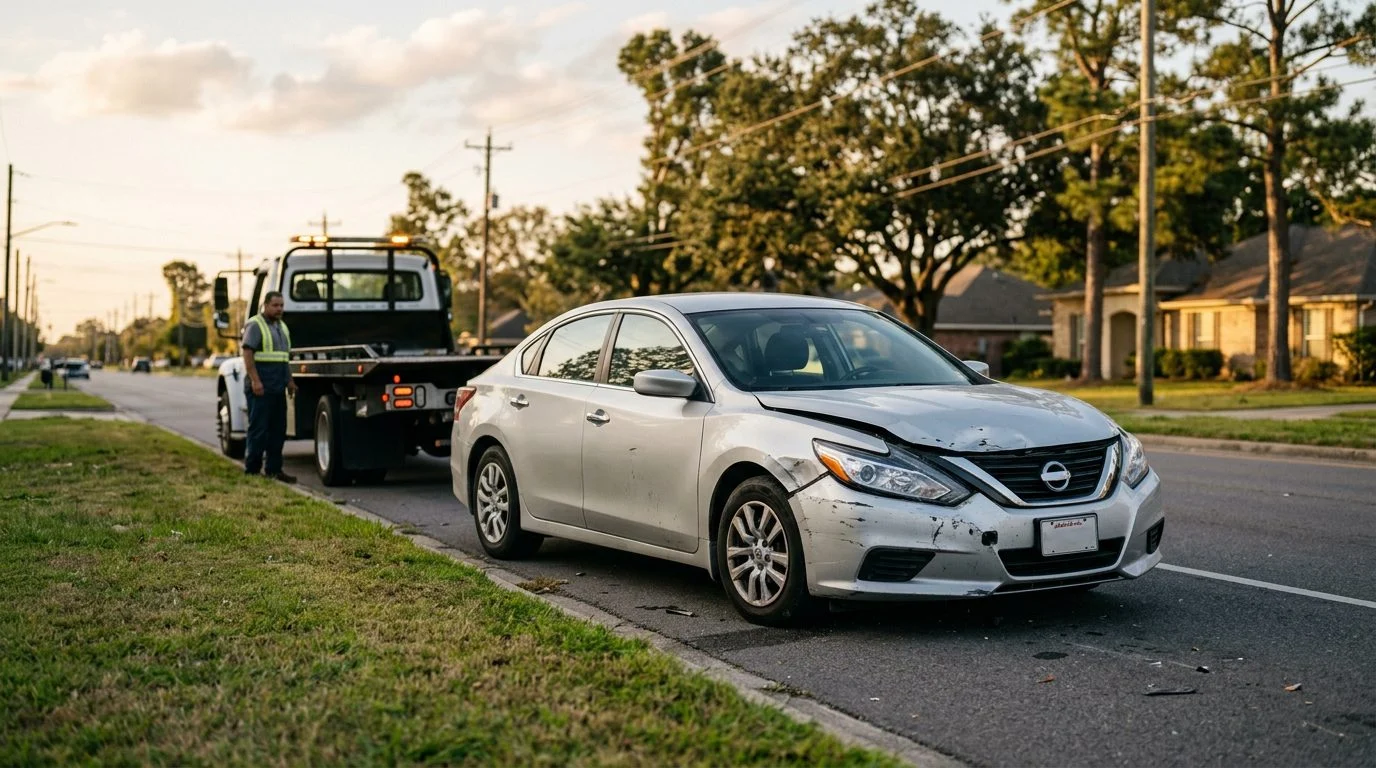
Car Accidents | New Orleans, Louisiana
Who Pays for Personal Injury in a Car Accident in Louisiana?
Medical bills, lost income and insurance calls can arrive all at once after a crash. Here is a plain-language look at the common sources of payment, written by New Orleans trial lawyer Przemek Lubecki.
By Przemek Lubecki · Published November 6, 2026
Written under the responsibility of Przemek Lubecki, trial lawyer, New Orleans.
Who pays for personal injury in a car accident? Usually, the at-fault driver’s liability insurance pays for the injured person’s damages, once fault is decided and coverage applies. Other sources can also be part of the picture, including your own auto policy and health insurance.
If you were hurt in a crash, or you are helping a family member sort out the bills, this page walks through each layer in the order most people meet them. Whether the crash happened in Orleans Parish, Jefferson Parish, St. Bernard Parish, or elsewhere in Louisiana, the same state rules generally apply. This is general information, not advice about any one crash.
Short Answer: Who Pays for Personal Injury in a Car Accident?
The at-fault driver’s liability insurance is usually the main source of payment for injury damages. Which sources apply depends on who was at fault, what coverage exists, and the injuries involved.
Think of payment as layers. The first layer is usually the other driver’s liability policy. Which insurance policies may apply after a crash depends on the facts of each case, and a lawyer can review your coverage with you. Health insurance, Medicare, or Medicaid may also pay medical bills along the way. Those payers may later ask to be repaid from a settlement.
The most common mistake is assuming the first number offered covers everything. Early offers often come before the full extent of an injury is known. Each layer follows its own rules, and the order can change from one case to the next. Louisiana’s fault rules also decide how much a person can recover.
If you're sorting out a family member's medical bills, insurance letters, and repair decisions after a crash, you don't have to work through it alone; you can start with a free, confidential consultation. Talk it through with our team — the first consultation is free, confidential, and carries no obligation.
Liability Insurance Is the Main Source of Injury Payment
Liability insurance pays for harm the insured driver causes to other people, including bodily injury and property damage. La. R.S. 32:900 describes what a motor vehicle liability policy must cover and, with limited exceptions, requires every motor carrier as defined in R.S. 32:1 to be covered by a liability policy. Bodily-injury liability coverage is the part that pays for injuries to others, as the NAIC auto insurance guidance explains in general terms.
A claim usually goes to the at-fault driver’s insurer. The adjuster works for that insurer, not for you. The adjuster’s job is to evaluate the claim for the insurer.
Limits matter. The required minimum coverage may fall well short of the total cost of a serious injury. When an officer investigates a crash, the officer must instruct drivers to report the liability carrier’s name and the insurance agent’s contact details to all parties suffering injury or property damage as an apparent result of the crash. If a driver was working when the crash happened, the employer may also be answerable under La. Civ. Code art. 2320, but only if the employer might have prevented the act that caused the damage and did not do it. Our commercial vehicle accidents page covers that situation.
How Louisiana Fault Rules Affect What You Can Recover
Under La. Civ. Code art. 2323, a person whose share of negligence is equal to or greater than fifty-one percent is not entitled to recover damages. Under La. Civ. Code art. 2323, if the person suffering injury, death, or loss is less than fifty-one percent at fault, the amount of damages recoverable is reduced in proportion to that person’s share of negligence, unless the other party is an intentional tortfeasor, in which case the claim is not reduced. This is set out in La. Civ. Code art. 2323, in the version effective January 1, 2026.
Here is a simple way to picture it. Imagine total damages as 100 parts. If a court assigned 20 parts of fault to the injured person, the recovery would be reduced by those 20 parts, leaving 80.
The same rule applies to any claim for damages, whatever the legal theory behind it. Insurers often argue that the injured person shared the blame. That is why accident evidence matters early. Photos, witness names, and the crash report can help show what happened. For how fault is often discussed in one common crash type, see our rear-end collisions page.
Your Own Auto Coverage and Other Policies That May Respond
Your own policy may pay when the at-fault driver has no insurance or not enough insurance. The rules are set out in La. R.S. 22:1295.
Under La. R.S. 22:1295, any insured named in the policy may reject coverage, select lower limits, or select economic-only coverage, but only on a form prescribed by the insurance commissioner and signed by the named insured or his legal representative. Economic-only coverage excludes noneconomic loss, such as pain and suffering. Which option is on your policy changes what it pays, so the choice matters.
Some policies also include medical payments coverage. It can help pay certain medical bills, usually no matter who caused the crash. The limits and terms are in your policy, so look for them on your declarations page and endorsements. For more on this crash type, see our uninsured and underinsured drivers page.
Health Insurance, Medical Bills, and Liens
Health insurers, Medicare, Medicaid, and some medical providers may seek repayment from a settlement. A lien is a claim against money recovered for care that has already been paid. A lien does not decide who was at fault.
Louisiana limits what can be recovered for medical bills in many cases. When a health insurer or Medicare paid a contracted provider, recovery is generally limited to the amount actually paid plus the patient’s cost-sharing, not the amount billed, under La. R.S. 9:2800.27.
Keep every bill, explanation of benefits, and provider letter. These records help you and your family understand what has been paid and what may still be owed. Get medical care based on your doctor’s advice. Prompt care supports your health and also creates a clear record of your injuries.
Property Damage and Injury Claims Are Separate Issues
Vehicle repair, total-loss payments, rental coverage, and towing are property claims. They are handled apart from bodily injury damages. A total-loss check for your car does not automatically resolve an injury claim.
Louisiana law says a settlement under a vehicle liability policy for property damage is not an admission of liability on other claims from the same accident. That rule is in La. R.S. 22:1290. It helps explain why a property payment is not the same as an injury settlement.
Before you sign any release, ask what it covers. Some releases can end later claims, so read every page first. Property and injury claims may also be handled by different adjusters, on different timelines. Keep each file organized so nothing gets lost between them.
Not sure what your next step is?
Talk it through with our team — the first consultation is free, confidential, and carries no obligation.
What Compensation Can Include: Economic Losses and Pain and Suffering
Compensation can include economic losses, such as medical bills and lost wages. It can also include non-economic harm, such as pain and suffering. Louisiana Civil Code article 2315 says that every act that causes damage to another obliges the one at fault to repair it, as set out in the Civil Code.
Common economic losses include past medical bills, future medical care, lost wages, lost earning capacity, and out-of-pocket costs such as rides to appointments. Article 2315 limits future medical costs unless they are directly related to a manifest physical or mental injury or disease.
Pain and suffering means the non-economic harm from an injury. It can include physical pain, emotional distress, loss of enjoyment of life, and daily inconvenience. In a wrongful death case, family members may pursue certain losses, and those rules are explained on our wrongful death page.
How Insurers Evaluate Pain and Suffering and Medical Records
Insurers usually look at medical records, treatment timing, imaging, prior medical history, and whether symptoms stay consistent over time. Gaps in treatment often raise questions. A clear, honest record of symptoms can help show how an injury affects daily life.
Start a simple journal. Write down pain levels, sleep problems, missed work, and activities you can no longer do. Keep it factual and dated. Bring it to your doctor visits.
Be careful with early requests. An insurer may ask for a recorded statement or broad medical authorizations. Louisiana requires that anyone who takes a recorded statement from an injured person give that person a true copy, and must do so within twenty days after a written demand, under La. R.S. 13:3732. Ask for the copy. Say only what you know, and do not guess.
Why a Settlement Number Is Not the Same as Money Received
A headline settlement figure is the gross amount. The amount a person actually receives can be smaller after deductions.
Louisiana law limits some recoveries, and it can reduce subrogation claims in proportion to fault. Medical recovery rules also affect how bills count, as explained above. Each category can change the final number, so one figure rarely tells the whole story.
Deductions are usually reviewed before funds are paid out. A settlement statement should show the breakdown. Before you agree to any settlement, ask for that written breakdown and review it carefully. No estimate of any specific amount is made here.
How Personal Injury Lawyers Are Paid
Personal injury lawyers usually set out fee terms in a written agreement. The terms are discussed at the first meeting, so you know how the arrangement works before you decide anything. Your fee is set out in that written agreement, and you may be responsible for case costs and expenses in addition to the fee.
The firm may associate or refer a case to other law firms. Any such association is disclosed in the written agreement.
The initial consultation is free, confidential, and without obligation to continue. You can ask questions about your crash, your insurance letters, and your bills before you decide whether to move forward.
Next Steps After a Crash, and the Time Limits That Apply
The most useful early steps are getting medical care, keeping records, and checking the time limit. Write down the crash details while they are fresh. Photograph the scene and the vehicles, and keep every letter from an insurer.
Crash reports help. Under La. R.S. 32:398, the parties, their insurers, and their attorneys can obtain a crash report, generally within seven working days after the investigation is complete. Check whether the report lists the right vehicles and drivers.
Time limits matter too. Louisiana generally gives two years from the day of injury for delictual (tort) actions, under La. Civ. Code art. 3493.1. The statute has exceptions, so check your timing early.
Who pays for personal injury in a car accident if the other driver is at fault?
Usually the at-fault driver’s liability insurance pays for injury damages, once fault and coverage are established.
Does Louisiana reduce recovery if I was partly at fault?
Yes. Under La. Civ. Code art. 2323, if a person suffers injury partly from his own negligence and partly from the fault of others, a person whose negligence is equal to or greater than fifty-one percent is not entitled to recover damages, and a smaller share of negligence reduces the damages recoverable in proportion to that share; but if the other party is an intentional tortfeasor, the claim is not reduced.
What if the other driver has no insurance?
Your own uninsured motorist coverage may respond, depending on your policy and its limits.
If you're sorting out a family member's medical bills, insurance letters, and repair decisions after a crash, you don't have to work through it alone; you can start with a free, confidential consultation. Talk it through with our team — the first consultation is free, confidential, and carries no obligation.

Talk Through Your Situation With Przemek Lubecki
Przemek Lubecki is the responsible lawyer for this page. The office is in New Orleans. Office in New Orleans: 855-LUBECKI.
If you are handling a family member’s medical bills, insurance letters, and repair decisions after a crash, you don’t have to sort it out alone. A free, confidential consultation, with no obligation to continue, is a good place to start. You can request a free case evaluation or call 855-LUBECKI (Office in New Orleans).
Licensed jurisdiction: Louisiana.
Common Sources of Payment After a Car Accident
The other driver's liability insurance
When another driver caused the crash, that driver's liability insurance is often the first place people look for compensation for injuries and property damage. How coverage applies depends on the facts and the policy.
Your own auto policy
Some Louisiana drivers carry optional coverages, such as medical payments or uninsured and underinsured motorist coverage. Whether these apply to a particular crash depends on the policy language and the circumstances.
Health insurance and medical bills
Health insurance, Medicare or Medicaid may cover treatment while a claim is pending. Bills, liens and reimbursement rights can affect how much a person ultimately keeps, so they deserve careful review.
Commercial vehicles and employers
Crashes involving trucks, delivery vans, rideshare vehicles or work-related driving can involve more than one insurer or company. Identifying every potential source of coverage often takes a closer look.
Why Talk With Our Office Early
Free first consultation
Your first consultation is free, confidential and without obligation to continue.
Organized review of coverage
We can help you gather police reports, insurance information and medical records so the question of who may pay is answered with clear facts.
Responsible lawyer
Przemek Lubecki is the responsible lawyer for this page and the New Orleans office, focused on people seriously hurt in car, truck and commercial vehicle crashes.
Office in New Orleans
Our office is in New Orleans, and we serve people across Orleans Parish, the New Orleans metro area and Louisiana.
Plain-language guidance
We explain options in straightforward terms so you can make informed decisions about your family's next steps.
Careful with insurers
Insurance adjusters work for their companies. Talking with a lawyer before you give statements or sign releases can help protect your interests.
Important: Act Early and Keep Records
Keep photos, the police report number, receipts and every medical record. Avoid signing releases or giving recorded statements to an insurer until you have talked with a lawyer. Depending on the facts, a case may be associated with or referred to other law firms; we will tell you if that is the case.