
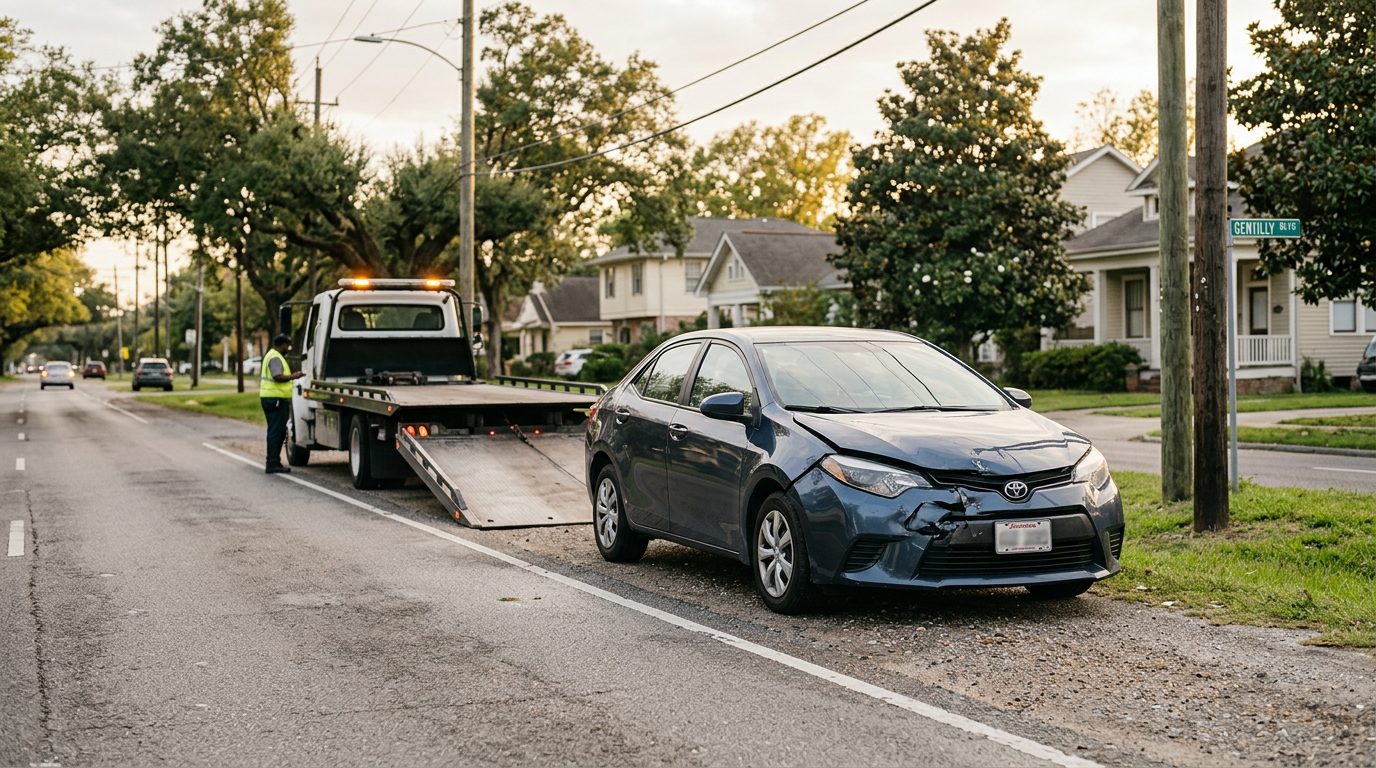
New Orleans Car Accident Injuries: Fault and Next Steps
By Przemek Lubecki · Published October 17, 2026
What to Know First After a Car Accident in New Orleans
Car accident injuries in New Orleans can start small and grow worse over hours or days, and Louisiana law sets rules for who may be responsible and when a claim must be filed. This page walks through those questions in the order most people face them, from the scene to the claim.
It covers injuries, fault, insurance, medical records and deadlines for crashes in Orleans Parish, the New Orleans metro area and across Louisiana. Przemek Lubecki is the responsible lawyer for this content, and the firm’s office is in New Orleans, where he practices.
This is general information, not legal advice about your claim. Every crash turns on its own facts, so no page can tell you what your case will be worth. Use this guide to understand the terms, then focus on your own situation.
Start here if you’re still sorting out what happened.
If you were hurt in a crash and an insurer is asking for a recorded statement, you don't have to work through that on your own. Talk it through with our team — the first consultation is free, confidential, and carries no obligation.
Common Car Accident Injuries and Why Symptoms Can Be Delayed
Common car accident injuries include neck and back strain, soft tissue damage, broken bones, cuts, and head injuries. Crashes involving trucks, commercial vehicles or rideshare vehicles often produce more serious harm because of vehicle size and speed.
Pain often hides right after impact. Adrenaline and shock can mask symptoms for hours. Stiffness, headaches, dizziness, sleep trouble and irritability can show up over the next few days.
This matters because insurers and other drivers sometimes argue that a late symptom was not caused by the crash. Louisiana law speaks to that argument. In a personal injury claim, the lack of a prior history of an injury does not by itself create a presumption that the crash caused it, as stated in La. Code Evid. art. 306.1.
Delayed concussion symptoms deserve their own careful read, and a separate page covers them. For now, know this: new headaches, dizziness, confusion, vision changes or unusual behavior need prompt medical evaluation. Don’t wait to see whether they fade.
What to Do at the Scene and What to Document
The first steps at a crash scene are to check for injuries, call 911 if anyone is hurt, and move to safety when it’s safe to do so. Your health comes before the paperwork.
Keep your account of the scene short and factual. Don’t admit fault, guess at speeds or sign anything you don’t understand. Statements made at the scene are often repeated later, so say only what you know.
Document the scene while it’s fresh. Take photos of both vehicles, the damage, the roadway, traffic signals, skid marks, weather and any visible injuries. Write down names, phone numbers, insurance details, license plate numbers and witness contact information.
Then write a timeline: the time, the location, each vehicle’s direction of travel and what you saw and heard. People who wait days to write this down often forget small details that later matter. A police report can help organize the facts, so request a copy when you can. Save receipts, discharge papers and a running list of costs.
How Fault Is Decided Under Louisiana Law
Louisiana uses comparative fault, which means blame can be split among everyone who contributed to a crash. Louisiana’s rule is set out in La. Civil Code art. 2323, which requires the fault of all persons who caused or contributed to the injury to be determined.
The same article sets a hard line. Under La. Civ. Code art. 2323, a person who suffers injury, death, or loss is not entitled to recover damages if the degree or percentage of negligence attributable to that person is equal to or greater than fifty-one percent. Under La. Civ. Code art. 2323, if the degree or percentage of negligence attributable to the person suffering injury, death, or loss is less than fifty-one percent, the amount of damages recoverable is reduced in proportion to that degree or percentage.
Negligence is the core idea behind most car claims. Under La. Civil Code art. 2316, a person is responsible for damage caused by negligence, imprudence or want of skill, not only by a deliberate act.
Fault questions in rear-end crashes and in crashes where both drivers share blame raise their own issues. Those are covered on separate pages in this cluster. The practical point is the same: the facts, the photos and the timeline shape how fault is argued, and insurers often start by assigning as much blame to the injured driver as they can.
Insurance Coverage: Minimum Limits, Your Own Policy and Uninsured Drivers
Louisiana requires most registered vehicles to carry liability security. Under La. R.S. 32:861, each self-propelled vehicle registered in the state must be covered by an automobile liability policy or one of the other listed forms of security, subject to exceptions the statute lists.
The Louisiana Department of Public Safety explains the state’s compulsory insurance rules and enforcement on its insurance information page. That page is useful for checking the basic requirements.
Required coverage is not the same as enough coverage. Minimum limits are often lower than the cost of a serious injury, so an at-fault driver’s policy may not pay everything. Your own policy may include uninsured or underinsured motorist coverage, and Louisiana law governs how that coverage is issued, as set out in La. R.S. 22:1295.
Coverage depends on the specific policy and the facts. Read your declarations page, note the policy dates and keep copies of everything you receive from your insurer. Don’t assume a policy covers a situation until you’ve read its language.
Talking to Insurers: Recorded Statements and Reporting Deadlines
An insurance adjuster may ask you for a recorded statement soon after a crash. Before you agree, it helps to know what the statement is for, who will hear it and how it may be used.
Louisiana law gives injured people a specific right on this point. Under La. R.S. 13:3732, a person who takes a written, recorded or transcribed statement from an injured person must give that person a true and complete copy, and must do so within twenty days after a written demand.
The same statute says a statement cannot be used in a civil action if the person holding it refuses, after a request, to provide a copy. Ask for a copy in writing if you give a statement.
Keep a log of every call with the insurer, including the date, the name of the person and what was said. Keep copies of all letters and emails. Read any release before you sign it, because a signed release can end a claim you didn’t mean to close.
Louisiana also lets a vehicle operator file a written report of a claim with the state commissioner. Under La. R.S. 32:871, that report declares the vehicle’s insurance, including the insurer’s name and policy number.
Not sure what your next step is?
Talk it through with our team — the first consultation is free, confidential, and carries no obligation.
Medical Care, Records and Keeping Treatment Consistent
Consistent medical care creates a clear record of your injuries. Attend appointments, describe all of your symptoms to each provider and keep the discharge papers, imaging results, referral notes and work restriction notes.
Medical decisions belong to you and your doctors. This page does not give medical advice, and it does not replace a visit with a medical provider.
Medical bills are a common point of dispute. Under La. R.S. 9:2800.27, when a health insurance issuer or Medicare pays a contracted medical provider, recovery of those medical expenses is limited to the amount actually paid plus any applicable cost sharing, not the amount billed.
Start a simple daily journal. Note your pain level, sleep, headaches, missed work, and tasks you can’t do, such as lifting, driving or caring for children. A written record made day by day is more reliable than memory reconstructed months later.
Special Situations: Passengers, Government Defendants and Other Parties
Passengers injured in a crash may have claims that look different from the driver’s. The fault rules still apply, but the question of who caused the crash can change what a passenger can pursue. Passenger questions are covered on a separate page.
Crashes caused by a road defect may involve a public entity. Under La. R.S. 9:2800, a claim based on the condition of things in a public entity’s care generally requires that the entity had actual or constructive notice of the specific defect before the crash, and a reasonable chance to fix it. Those rules can be strict, so act early.
Truck, commercial vehicle and rideshare crashes can involve more parties, including employers, carriers and additional insurers. These cases often include more records, such as driver logs and maintenance files. Those issues are covered on related pages.
Acting early helps with every special situation. Records fade, witnesses move and notice steps can be time-sensitive.
Damages, Pain and Suffering, and Filing Deadlines
Damages in a car accident claim can include medical expenses, lost wages and pain and suffering. Louisiana law also allows certain family members to recover loss of consortium, service and society in some cases, as described in La. Civil Code art. 2315.
The same article limits future medical costs. Those costs are not recoverable unless the treatment is directly related to a manifest physical or mental injury or disease.
Pain and suffering is the harm to your body and daily life that isn’t a bill or a paycheck. No formula gives a single number for it, and no general page can predict an amount for your case.
Time limits matter. Under La. Civil Code art. 3493.1, delictual actions are subject to a liberative prescription of two years, which starts to run from the day the injury or damage is sustained. Some exceptions exist in limited situations, so don’t assume your deadline is different without reviewing the facts early.
Car Accident Injury Claims Across New Orleans and Louisiana
The firm serves people injured in car crashes in Orleans Parish, the New Orleans metro area and across Louisiana. Crashes on Interstate 10 and along busy corridors through the city often involve drivers from neighboring parishes, so the facts can cross parish lines.
Metro and parish pages serve people in Metairie, Jefferson Parish, Kenner, St. Bernard Parish and Slidell. Those pages describe local crash issues for each community. They do not mean the firm has an office in those areas.
The firm’s office is in New Orleans. Przemek Lubecki practices from that office and is responsible for this content.
Louisiana law applies the same core rules across the state. Local detail, such as which parish records are kept where, can still shape how a claim is handled.
Costs, Referrals and Your Next Step
Fee terms are explained in writing before any agreement. Clients may owe case costs and expenses in addition to any fee, and those amounts are explained as part of the fee discussion. Fee questions are covered on a separate page in this cluster.
The firm may associate or refer a case to other law firms when the case calls for it. Any referral or association is disclosed as part of that process.
Frequently Asked Questions
Does Louisiana use comparative fault for car accidents?
Yes, Louisiana uses comparative fault, which divides blame among everyone who contributed to a crash (La. Civ. Code art. 2323).
How long do I have to file a car accident claim in Louisiana?
Delictual actions generally have a two-year prescription period that starts on the day of injury or damage.
Do I have to give a recorded statement to an insurer?
Think before you agree, and ask for a copy in writing if you give one, since Louisiana law requires a copy after a written request.
If you were hurt in a crash and an insurer is asking for a recorded statement, you don’t have to work through that on your own. Request a free case evaluation at this contact page or call 855-LUBECKI. You may owe case costs and expenses in addition to any fee.
Have questions about what happened?
Ask our team directly. The first conversation is free, confidential, and there is no obligation to continue.
Ready to take the next step?
Related practice areas
- Big Rig Crash Claims in Orleans Parish: How They Work
- Car Crash Injury Claim Jefferson Parish: Key Facts
- Truck Accident Guide Orleans Parish: Fault and Deadlines
- Louisiana Truck Accident Injury Claims: Rights & Next Steps