
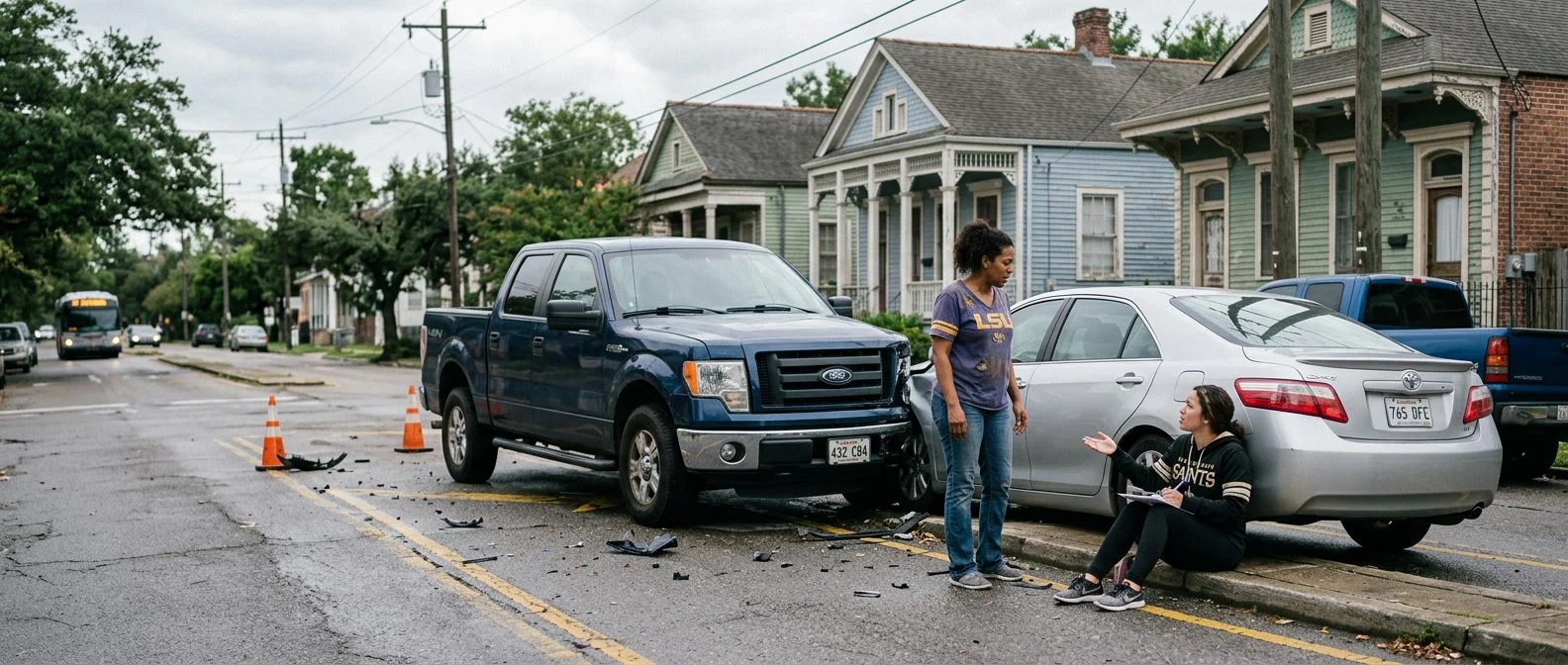
Louisiana Comparative Fault Rules for Car Accident Claims
After a car crash, the question of who was at fault can shape everything that follows. For crashes on or after January 1, 2026, a person who is 51% or more at fault cannot recover damages.
This page explains how the rule works, how fault is decided, and what to watch for after a crash on a Louisiana road, including in Orleans Parish and the New Orleans metro area.
Which Fault Rule Applies to Your Crash?
The current text of La. Civ. Code art. 2323 was amended by 2025 Acts No. 15, effective January 1, 2026. For accidents and injuries on or after that date, recovery is barred when the injured person’s share of negligence is 51% or greater, unless the injury also resulted from the fault of an intentional tortfeasor, in which case the claim is not reduced. When that share is less than 51%, damages are reduced in proportion to it, unless the injury also resulted from the fault of an intentional tortfeasor, in which case the claim is not reduced.
Many older articles describe one fault rule for every Louisiana crash. That description fits earlier accidents, but not crashes occurring on or after January 1, 2026. The crash date is the first fact to check.
How Does a Percentage of Fault Change the Amount?
A fault percentage reduces recovery by the injured person’s own share, as long as that share is below the bar for the crash date.
Suppose the total harm from a crash is set at 100 points. A judge or jury finds the injured driver 20% at fault. Under the reduction rule, the recovery is cut by 20%, leaving 80 points. For a 2026 crash, that driver would still recover, because 20% is below 51%.
Now change one number. If the injured driver were found 51% at fault, the 2026 rule would bar recovery.
Article 2323 also counts the fault of everyone who contributed to the harm. That includes people who are not parties to the lawsuit, people immune by statute, and people whose identity is unknown. No one can promise a specific percentage before the evidence is in.
Modified Versus Pure Comparative Fault: What Changes?
A modified rule bars recovery once fault reaches a set threshold. A pure rule reduces recovery but does not bar it.
Some states use a threshold bar. For crashes on or after January 1, 2026, the modified 51% bar applies.
The change matters most when fault is split close to the line, such as 49% and 51%. For the wider steps in a claim, see our car accident claim overview for Orleans Parish.
How Is Fault Determined in a Louisiana Car Accident?
Fault is shown when a driver breached a duty to act carefully and that breach caused the harm. Louisiana law makes a person responsible for damage caused by negligence, imprudence, or want of skill (La. Civ. Code art. 2316).
Driving rules set the standard. Under La. R.S. 32:58, a driver must drive in a careful and prudent manner, and failing to do so is careless operation. Under La. R.S. 32:81, a driver may not follow another vehicle more closely than is reasonable and prudent. Under La. R.S. 32:81, the driver of a motor truck traveling upon a highway outside a business or residential area shall not follow another motor truck within four hundred feet, but this does not prevent one motor truck from overtaking and passing another.
Common breaches include speeding, failing to yield, following too closely, and distracted driving.
More than one driver can share fault. Under La. Civ. Code art. 2324, a joint tortfeasor is not liable for more than their own degree of fault, unless they conspired with another person to commit an intentional or willful act, in which case they are answerable in solido with that person for the resulting damage. Each at-fault driver is generally answerable for their own share, which makes the percentages central.
What Evidence Shapes the Fault Percentage?
Evidence of what each driver did before impact is central to fault. The most useful records often come from the scene and the first days after the crash.
Key evidence includes the crash report, photos of the vehicles and roadway, witness contact information, traffic signal timing, and vehicle damage patterns. Under La. R.S. 32:398, a driver in a crash causing injury, death, or property damage over five hundred dollars must give their name, address, and registration number. Police agencies may charge up to five dollars for a report of two pages or less, and up to twenty dollars for longer reports, including all fees.
To learn how to request a report in New Orleans, see how to get a police report. Photos and names fade from memory. Save them early, along with medical records as they become available.
Insurance Offers, Recorded Statements, and Releases
An insurer may ask for a statement or make an offer before fault is settled. Its view of fault is not the final word on your claim.
If you give a written, recorded, or transcribed statement as an injured person about an accident or injury, La. R.S. 13:3732 says the person who took it must give you a true and complete copy. Upon written demand, they must furnish it within twenty days.
Early offers can arrive quickly and may not reflect the full picture. Read more about why an early insurance offer can be low.
A release can close a claim, so read its terms before you sign. See what a release says before signing.
How Far Back Can You File a Louisiana Car Accident Claim?
For injuries sustained on or after July 1, 2024, Louisiana’s general deadline is two years from the date of injury. Under La. Civ. Code art. 3493.1, delictual (tort) actions are subject to a two-year liberative prescription. That is a legal time limit for filing suit. It starts on the day injury or damage is sustained.
Other facts can change timing. Claims against a government entity can carry separate notice requirements, so the date and the defendant both matter.
Frequently Asked Questions About Louisiana Comparative Fault
Does Louisiana use pure comparative fault for every car accident?
Crashes on or after January 1, 2026 use a 51% bar.
What is the modified comparative fault rule in Louisiana?
For crashes on or after January 1, 2026, a person found 51% or more at fault cannot recover damages. Below 51%, recovery is reduced by that person’s share.
Can I recover if I was partly at fault?
Under the reduction rule, yes, if your share is below the bar for your crash date. Your recovery is reduced by your percentage.
How far back can I file a claim?
For injuries on or after July 1, 2024, the general deadline is two years from the injury (La. Civ. Code art. 3493.1).
Talk With Przemek Lubecki About Your Accident
If you’re researching after a crash you didn’t choose, fault questions can feel like one more weight on top of your injuries. Przemek Lubecki is the responsible lawyer for this content, and the office is in New Orleans, Louisiana. You can call 855-LUBECKI or request a free case evaluation. The first consultation is free, confidential, and without obligation.
American Trial Lawyer may associate or refer a case to other law firms. This page is general information, not legal advice about a specific accident.