
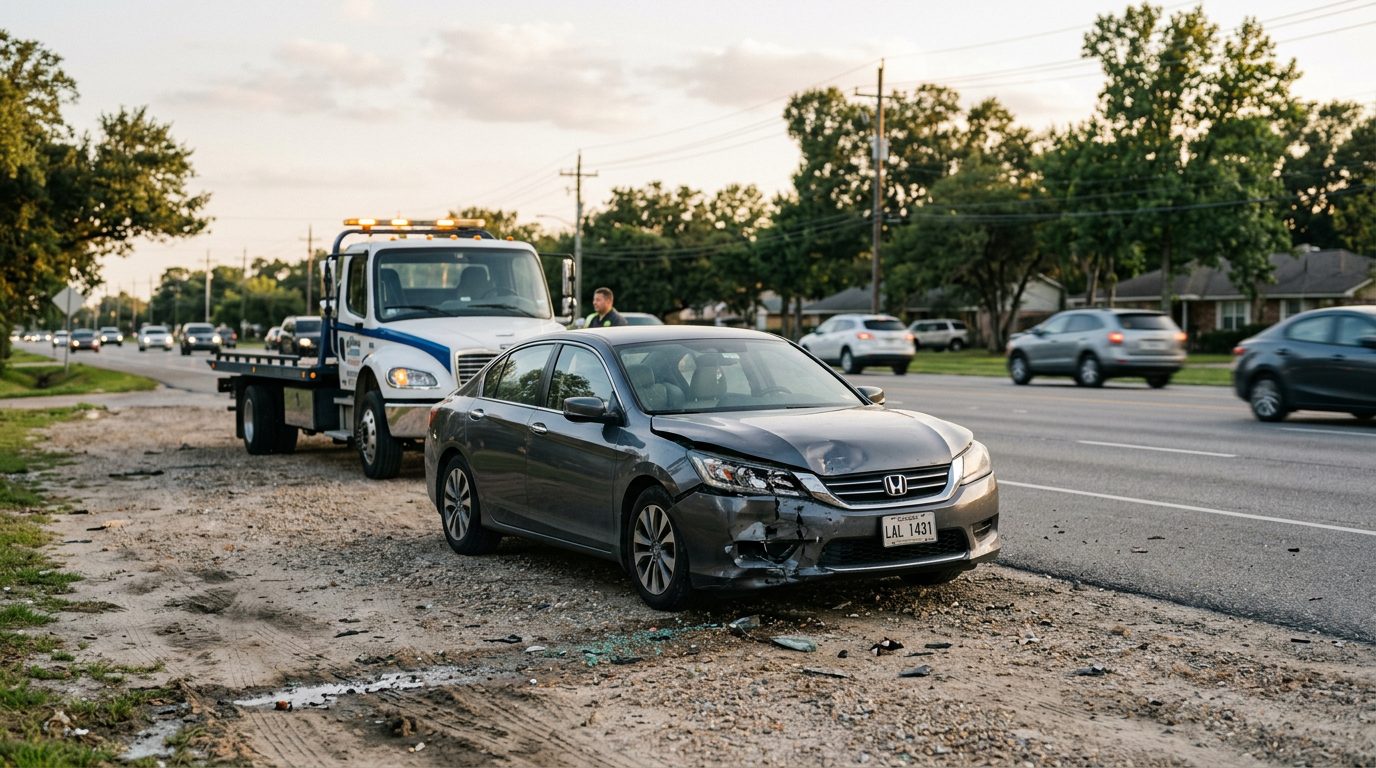
Truck Accidents | New Orleans, Louisiana
Do Truck Accident Cases Go to Trial in Louisiana?
Some do. Many settle before trial. Przemek Lubecki, responsible lawyer at our New Orleans office, explains what can shape the path of a truck accident case and what to expect along the way.
By Przemek Lubecki · Published November 7, 2026
Short Answer: Some Truck Accident Cases Go to Trial in Louisiana
Do truck accident cases go to trial in Louisiana? Some do. Many others end through settlement, where the parties agree on payment without a judge or jury deciding the case. Whether a particular case reaches a courtroom depends on the facts, and no one can predict that outcome in advance.
Three terms help. A claim is a demand made to an insurer for payment. A lawsuit is a case filed in court by a petition. A trial is the hearing where a judge or jury decides the disputed issues. A case can move through all three, or it can resolve at the claim stage.
Truck crashes often involve more parties than a typical car crash. The driver, the trucking company, a cargo or maintenance party and their insurers may each play a role. That layering can make the process take longer to sort out.
If a truck crash has left you or a family member facing injuries, medical bills or insurance calls, you don't have to sort it out alone. We're glad to talk through your situation. Talk it through with our team — the first consultation is free, confidential, and carries no obligation.
What Decides Whether a Truck Accident Claim Reaches Court
A truck accident claim usually reaches court when the two sides cannot agree on fault, injuries or money. Disputes in those areas often lead to formal litigation.
When the trucking company or its insurer disputes who caused the crash, the facts must be proven. Disagreement over medical care, future treatment, lost pay and daily life can also be hard to value without a full look at the records.
Evidence often shapes how early the parties agree. Electronic logs, driver qualification files, maintenance records and dash camera footage can show what happened. When that proof is clear, the parties may reach agreement sooner.
Settlement positions matter too. If a defense offer falls far from what the injured person and their lawyer consider fair, the case may move forward. Filing a lawsuit does not automatically mean a trial will follow.
Louisiana Deadlines That Shape a Truck Accident Case
Louisiana sets strict time limits for filing suit, and missing one can end a claim. La. Civ. Code art. 3493.1 sets a two-year prescriptive period (a deadline for filing suit) for delictual (tort) actions. The two-year period is counted from the date of the injury or damage, but it does not run against minors or interdicts in actions involving permanent disability and brought pursuant to the Louisiana Products Liability Act or state law governing product liability actions in effect at the time of the injury or damage.
Injuries that happened earlier follow the rules that applied at that time, so the date of the crash matters. Wrongful death and survival claims have their own timing rules. Under La. Civ. Code art. 2315.2, a wrongful death action runs out one year from the death or two years from the day injury or damage is sustained, whichever is longer, except that a medical malpractice action runs out one year from the death. La. Civ. Code art. 2315.1 uses the same whichever-is-longer period for survival claims, except that medical malpractice survival actions are governed by R.S. 9:5628.
The surviving spouse and children come first. If there is no spouse or child, the parents may sue, but a father or mother who abandoned the deceased during his minority is deemed not to have survived him. Then siblings, and then grandparents, follow in that order.
Missing a deadline can end a claim regardless of its merits, so early timing matters. Przemek Lubecki can go over the dates in a specific situation during a free consultation.
First Steps After a Truck Crash Shape Later Litigation
The first steps after a crash often shape what evidence exists later. Early medical care protects health first, and it also creates records. Injuries documented from the first visit form the foundation for any later claim or lawsuit.
Trucking companies keep detailed records. 49 C.F.R. § 395.8 provides that, except for a private motor carrier of passengers (nonbusiness), a motor carrier subject to that part must have each driver record the driver’s duty status for each 24-hour period using the methods the section prescribes, including an electronic logging device (ELD) where the section requires one. A lawyer can send a preservation demand asking the company to keep these records, along with maintenance files and driver records.
Crash reports and witness names matter too. The police report and contact information for witnesses help show how the crash happened. Keep copies of photos, bills and notes about missed work.
Insurance calls need care. Before giving a recorded statement or signing a release, it helps to understand what you are agreeing to. La. R.S. 22:1269 lists specific situations where a direct action is allowed, such as the insured’s bankruptcy or insolvency.
Filing a Lawsuit in the Proper Louisiana Court
A lawsuit starts when a petition is filed in a Louisiana court. The petition names the people or companies responsible and describes what happened. Choosing the right court looks at where the crash happened and related facts.
Defendants often include the driver, the motor carrier or employer, and other parties the investigation identifies. Louisiana law holds employers answerable for harm their workers cause while doing their jobs. La. Civ. Code art. 2320 says masters and employers are answerable for damage occasioned by their servants in the exercise of the functions in which they are employed, but responsibility only attaches when they might have prevented the act which caused the damage and did not do it.
This is called service of process, and the defendant then has a set time to respond.
American Trial Lawyer, LLC is based in New Orleans. Its New Orleans office serves clients in Orleans Parish, the New Orleans metro area and across Louisiana, including Metairie, Jefferson Parish, Kenner, St. Bernard Parish and Slidell. The firm may associate or refer a case to other law firms, and the client would be informed of any such arrangement.
Discovery, Motions and Preparing for Trial
Discovery is the stage where each side gathers facts from the other. Common tools include written questions called interrogatories, requests for documents and depositions, which are sworn interviews taken outside the courtroom.
Truck cases often turn on detailed trucking rules. Hours-of-service records and driver logs are common topics, because they show whether a driver was on duty and for how long. Technical witnesses, such as accident reconstruction professionals or treating medical providers, may explain physical evidence or injuries to a judge or jury.
Pretrial motions ask the court to decide certain issues before trial. They can narrow the disputes, address evidence questions or resolve parts of a claim. Preparation takes time, because lawyers review records, prepare witnesses and organize exhibits.
Settlement talks often continue during discovery and before trial. Mediation, where a neutral person helps the parties talk, may also be used at this stage.
Not sure what your next step is?
Talk it through with our team — the first consultation is free, confidential, and carries no obligation.
What a Truck Accident Trial Involves
A civil case can be tried to a jury or decided by a judge, depending on the case and the procedure that applies. In a jury trial, lawyers question prospective jurors during jury selection. Each side then gives an opening statement that previews its evidence.
Witnesses testify under oath. The other side can cross-examine them, asking questions to test their account. Documents and records are introduced as exhibits. At the end, each side gives a closing argument.
The injured person has to prove the claim. La. Civ. Code art. 2316 makes every person responsible for the damage they occasion not merely by their act, but by their negligence, imprudence or want of skill. The defense may dispute fault, causation or the extent of injuries.
Damages are decided by the judge or jury. La. Civ. Code art. 2324.1 says much discretion must be left to the judge or jury in assessing damages in cases of offenses and quasi-offenses.
Trial is one possible outcome, not the only one. It can take considerable time, so many people weigh settlement during the case.
Fault, Comparative Fault and Settlement Versus Trial
Louisiana’s comparative fault rule can reduce what an injured person recovers when they share some blame. La. Civ. Code art. 2323 provides that if the degree or percentage of negligence attributable to the person suffering injury, death, or loss is equal to or greater than fifty-one percent, that person shall not be entitled to recover damages. Under La. Civ. Code art. 2323, if the degree or percentage of negligence attributable to the person suffering injury, death, or loss is less than fifty-one percent, the amount of damages recoverable shall be reduced in proportion to that degree or percentage.
The same article looks at everyone who contributed to the harm. The law determines the fault of all persons causing or contributing to an injury, whether or not they are parties to the lawsuit.
Insurers evaluate fault using the crash report, witness statements, physical evidence and company records. Their view may differ from the injured person’s own account of events. That gap is often where negotiation begins.
Settlement ends a case through a negotiated agreement, without a trial. Settlement terms may be confidential, depending on the agreement. The decision to settle or keep going belongs to the client, made with advice from the lawyer. No one can predict a specific amount.
The first consultation with American Trial Lawyer, LLC is free, confidential and without obligation.
Talk Through Your Truck Accident Situation With Przemek Lubecki
If you are reading this after a truck crash, you may be dealing with injuries, a family death, medical bills or calls from an insurer. Those questions are hard to sort out while you are hurting or grieving.
For a broader walkthrough, read the Orleans Parish truck accident guide.
Frequently Asked Questions
Do truck accident cases go to trial in Louisiana?
Some do. Many others settle, and no one can predict how a specific case will end.
How long do I have to file a truck accident lawsuit in Louisiana?
For injuries on or after July 1, 2024, the general delictual period is two years from the day of injury (La. Civ. Code art. 3493.1). Earlier injuries follow the rules that applied then.
Can I sue the trucking company’s insurer directly?
Not in every case. Louisiana allows a direct action against an insurer only in the situations listed in La. R.S. 22:1269.
Przemek Lubecki, the responsible lawyer for this page, and the New Orleans office of American Trial Lawyer, LLC offer a free, confidential consultation with no obligation. If you’re weighing your options now, you don’t have to face them alone. Call 855-LUBECKI or request a free case evaluation.
This page is general information, not legal advice. Reading it does not create an attorney-client relationship.
What Shapes Whether a Truck Case Goes to Trial
The Evidence Gathered
Crash reports, driver logs, maintenance records and photographs often determine how much is known early and how the case is framed.
The Parties Involved
Trucking companies, insurers and their lawyers each bring different positions, and those positions can change as the case develops.
The Pace of the Case
Some cases move toward trial after months of discovery. Others resolve through negotiation before a courtroom is ever needed.
The Injured Person's Needs
Medical recovery, care needs and family circumstances all factor into whether a resolution outside the courtroom makes sense.
Important: Referrals and Case Handling
The firm may associate or refer a case to other law firms. If a truck accident case is referred or associated with another lawyer or firm, we will say so. Trucking cases are complex, and no one can predict how a specific case will end.
Typical Stages of a Truck Accident Case
Investigation
Gathering crash data, records and witness information to understand what happened.
Negotiation
Discussing the claim with the other side and their insurer to see whether a fair resolution can be reached.
Filing Suit
If a resolution cannot be reached, a lawsuit may be filed to move the case forward in court.
Trial or Resolution
Some cases are resolved during litigation, and some proceed to trial. Each case follows its own path.