
Parking Lot Crashes | New Orleans, Louisiana
Hurt in a New Orleans Parking Lot Crash? Start With the Questions That Matter
Parking lot collisions can leave people with injuries, insurance calls and hard questions about who is responsible. Here is a plain-language guide to help you think them through.
By Przemek Lubecki · Published November 15, 2026
You may be standing beside two damaged cars, or on the phone with an insurer, wondering who is to blame. In a parking lot crash, fault is decided on the evidence, and more than one driver can share it. For crashes on or after January 1, 2026, a driver whose share is 51% or more recovers no damages. Below, you’ll find how fault is usually assigned, when traffic rules apply, and what to say to an insurer.
Who decides who is at fault in a parking lot crash?
Fault is decided from the evidence. That usually means the drivers’ accounts, witness statements, photos and any video. An insurance adjuster often reviews these first. If the dispute isn’t settled, a court can decide it.
Louisiana uses comparative fault, or shared fault. Under La. Civ. Code art. 2323, the fault of everyone who contributed to a crash is determined, even if that person isn’t a party to the case. A person below 51% recovers damages reduced by their own share. Crashes before January 1, 2026 fell under an earlier version of that article.
La. Civ. Code art. 2315 says whoever’s fault causes damage must repair it. La. Civ. Code art. 2316 makes a person responsible for damage caused by negligence or want of skill.
Start gathering facts early. Note where each car sat, the lot’s layout, witness names, and the time and place. Under La. R.S. 32:398, crash reports are confidential and are made available only to the parties to the crash, parents or guardians of a minor party, their insurers or an insurance support organization under contract to provide claims and underwriting, any healthcare provider or their agent that rendered healthcare services to a party, succession representatives, attorneys, and news-gathering organizations requesting a specific crash; upon request, they are made available within seven working days following completion of the crash investigation.
If a parking lot crash has left you unsure who is responsible, our team can talk it through in a free, confidential consultation with no obligation. Talk it through with our team — the first consultation is free, confidential, and carries no obligation.
Common parking lot scenarios and how fault is often assigned
Fault in a lot usually turns on who had to yield and who was moving unsafely. Each scenario raises its own questions.
Backing out of a space. The driver backing out must look and yield to traffic in the aisle. Fault can shift if the other driver was speeding down the aisle or ignored a clear sign.
Pulling forward into a through lane. Insurers and courts usually ask who was already moving in the lane and who had room to stop or turn.
Pedestrians. Under La. Civ. Code art. 2316, a person is responsible for the damage he occasions not merely by his act, but by his negligence, his imprudence, or his want of skill. Insurers and courts often look closely at speed and distraction.
Intersecting aisles. Right-of-way is often disputed. Lot markings, signs and the direction each car was traveling get examined.
A parked car or fixed object. Fault usually turns on how the moving vehicle was driven and whether the driver could reasonably have avoided contact.
Do traffic laws apply in parking lots?
Sometimes. Whether a specific traffic statute applies depends on the facts, but the duty to drive with reasonable care still applies.
Louisiana’s careful driving statute, La. R.S. 32:58, covers operating a motor vehicle on the public roads of this state.
Another rule, La. R.S. 32:79, applies where a roadway is divided into clearly marked lanes. A vehicle must stay within a single lane as nearly as practicable. Painted lane lines in a lot may bring this rule into play.
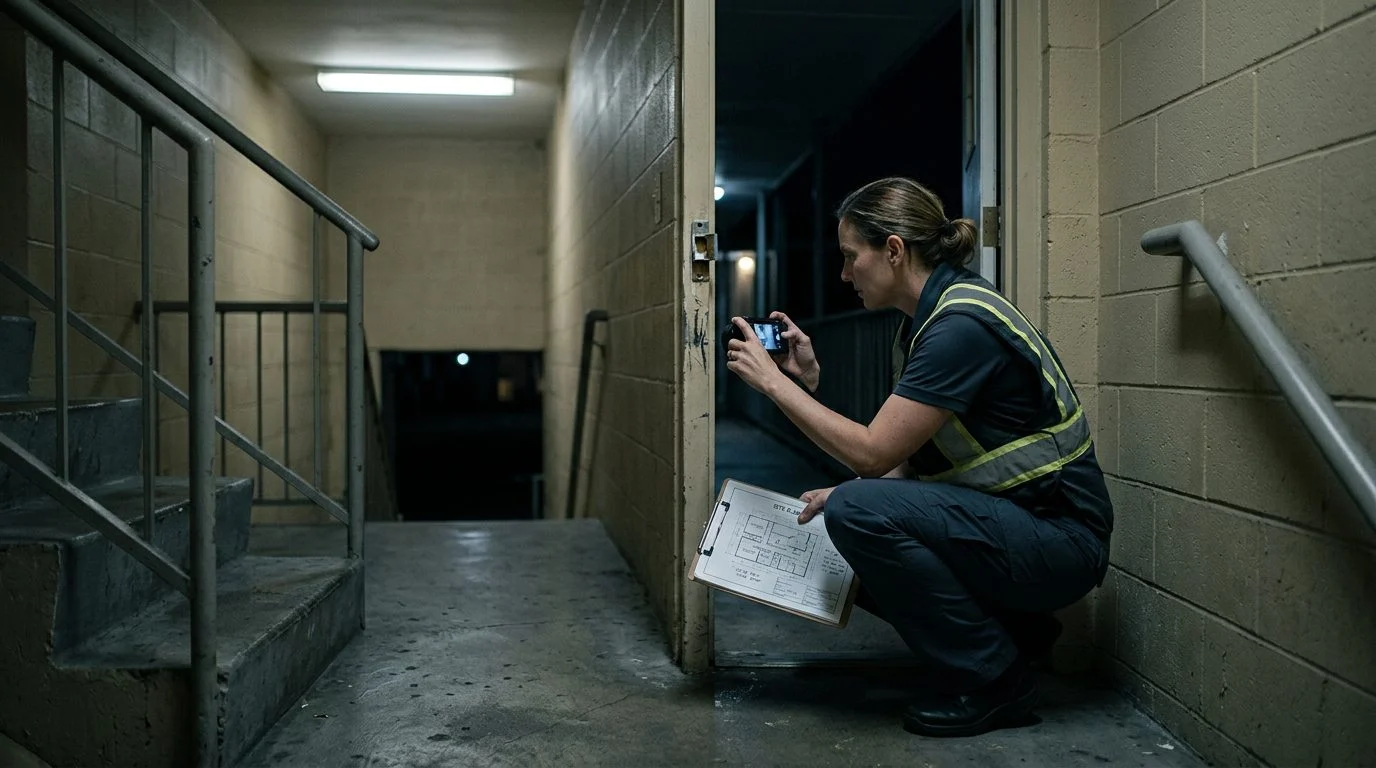
A common mistake is assuming that a private lot has no rules at all. Posted signs, painted arrows, stop bars and fire lanes show how traffic was meant to flow. Photos of them, taken soon after the crash, can help.
Are rear-end accidents in a parking lot always the fault of the rear driver?
No. Rear-end contact often points to the trailing driver, but that is a starting point, not a rule that applies every time.
Some facts can change the picture. A sudden or unexpected stop may matter. So can a vehicle that backed into the path of the car behind it, a driver who stopped to let someone pass, or a car pushed into the vehicle ahead.
Following too closely is one thing a court or insurer may examine. Louisiana law says a driver shall not follow another vehicle more closely than is reasonable and prudent, under La. R.S. 32:81. Phone use and distraction can also count, and they can cut either way. Photos of where each car stopped and of the damage can help show what happened.
What to say, and what to avoid saying, to your insurance company
Stick to what you saw, heard and did, and skip guesses about fault, speed or injury.
Give the date, time, location and vehicle details you know. Describe the sequence in plain words. Don’t estimate a speed you did not measure, and don’t call an injury minor before a medical evaluation. Ask the adjuster for their name, the claim number and contact details. Keep copies of everything you send and receive.
If you gave a written, recorded or transcribed statement about an injury, La. R.S. 13:3732 says the person who took it must give you a true and complete copy. That copy must be furnished within twenty days after written demand, so put your request in writing. A statement can’t be used in a civil case about its subject matter if the holder refuses a copy after you ask.
How insurance works when the crash was not your fault
When another driver is found at fault, that driver’s liability insurance is often where your claim starts.
Your own policy can still matter, depending on what you carry, such as medical payments, collision or rental coverage. If you’re driving a rental and at least one vehicle on your policy has comprehensive and collision or liability insurance coverage, La. R.S. 22:1296 says the coverage in your original policy extends to the rental vehicle, and that insurance is primary, unless you buy other automobile insurance or financial responsibility protection for the rental, which then becomes primary. For more, see our rental car guide.
Uninsured motorist claims have their own rules. In a crash with no physical contact, La. R.S. 22:1295 puts the burden on the injured person to prove, through an independent and disinterested witness, that the injury was the result of the actions of a driver whose identity is unknown or who is uninsured or underinsured. Under La. R.S. 9:5629, these actions are subject to a two-year time limit from the accident.
When more than one driver shares fault and liability is not solidary, such as when a driver did not conspire with another person to commit an intentional or willful act, La. Civ. Code art. 2324 says a driver is not liable for more than his own degree of fault.
Not sure what your next step is?
Talk it through with our team — the first consultation is free, confidential, and carries no obligation.
If you were hurt in a parking lot crash, talk with Przemek Lubecki
A parking lot crash can leave you unsure who is responsible, and you don’t have to sort that out alone.
Przemek Lubecki is the responsible lawyer for this page. The firm’s office is in New Orleans, Louisiana. The firm offers a free, confidential first consultation with no obligation to continue, where you can ask how fault may be argued in your situation. The firm may associate or refer a case to other law firms. For the broader picture, read our guide to car accident claims in Orleans Parish.
Can I be partly at fault in a parking lot crash in Louisiana?
Yes. Under La. Civ. Code art. 2323, your recovery is reduced by your own share, and a share of 51% or more bars recovery for crashes on or after January 1, 2026.
Can I get a copy of my recorded statement?
Yes. Under La. R.S. 13:3732, the person who took the statement, or who has possession of it or a copy, must provide a true and complete copy within twenty days after written demand.
How do I get a copy of a crash report?
Crash reports are available on request to the parties and their insurers and attorneys, within seven working days after the investigation is completed, under La. R.S. 32:398.
If a parking lot crash has left you unsure who is responsible, our team can talk it through in a free, confidential consultation with no obligation. Call 855-LUBECKI or request a free case evaluation.
Before you give a statement
An insurance adjuster may ask for a recorded statement soon after a crash. Speaking with a lawyer first can help you understand what you are being asked and how your words may be used.
Information that can help after a parking lot crash
Photos and video
Pictures of vehicle positions, damage, lighting, lane markings, signs and any nearby cameras can preserve details that fade over time.
Witness contact information
Names and phone numbers of people who saw the crash, including other shoppers or workers, can be useful later.
Medical records
Seeing a doctor promptly and keeping copies of every visit, test and bill helps document injuries from the start.
Notes about the crash
Write down what you remember, including the time, weather, where each vehicle was and what was said, while the details are fresh.
How our firm can help
Trial lawyer leadership
Przemek Lubecki leads the firm's work on this page and on the cases we handle, from the first conversation through the work that follows.
Office in New Orleans
Our office is in New Orleans, and we serve people across Orleans Parish, the New Orleans metro area and Louisiana.
Confidential, no-obligation start
The first consultation is free, confidential and without obligation to continue.
Referrals may occur
Depending on the facts, a case may be associated with or referred to other law firms. If that happens, we will tell you.