
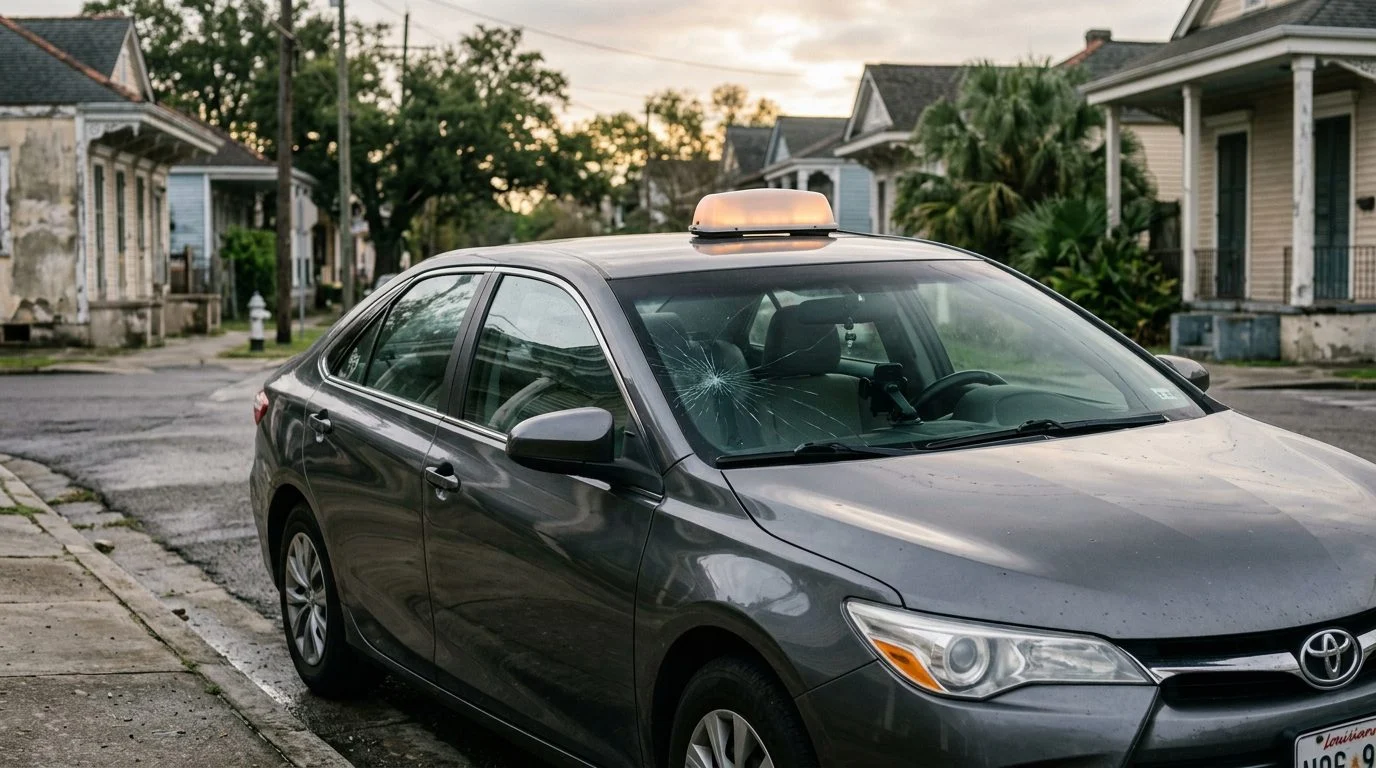
Uninsured Driver Crashes | New Orleans, Louisiana
Hit by an Uninsured Driver? Understand Your Options Before You Decide
From our New Orleans office, trial lawyer Przemek Lubecki helps people hurt in crashes sort out where they stand, which coverage may apply, and whether pursuing a claim makes sense for their situation.
By Przemek Lubecki · Published November 11, 2026
If a driver with no insurance hurt you or someone you love, you may be wondering whether a lawsuit is worth the effort. Short answer: it can be, but the decision turns on three things: your own insurance coverage, whether the driver has money to pay, and how serious the harm is.
A lawsuit can name the driver personally. Whether that leads to money you can actually collect is a separate question, and it is the one most people get stuck on.
Why this question comes up after a crash with an uninsured driver
Most people ask this after a crash they did not choose. The driver had no liability insurance, and now there are medical bills, missed work, and repairs to face. Some people assume the other driver’s insurer will pay anyway. When the driver is uninsured, that assumption changes the whole plan.
Some readers are asking for someone else, such as a spouse, parent, or adult child who was hurt, or a family member who died.
Is it worth suing someone with no insurance? That question has two parts. The first is the legal right to bring a claim. The second is whether a claim can produce money you can collect.
This page walks through the main factors: your own coverage, the driver’s finances, the seriousness of the harm, the evidence, the deadlines, and the time a lawsuit takes. None of them predicts how a particular case will turn out. Each one helps you see what a claim may look like on your facts.
If an uninsured driver hurt you or someone you love, you do not have to weigh your options alone, and we are glad to talk through your facts. Talk it through with our team — the first consultation is free, confidential, and carries no obligation.
Legal right versus practical reality
A person hurt by another driver can generally bring a claim against that driver, even if the driver has no insurance. Louisiana Civil Code art. 2315 says a person whose fault causes damage to another must repair it.
A court can rule that the driver is responsible, but a ruling does not put money in your account. Getting a judgment and collecting on it are two separate steps. A judgment is a formal court decision that a person owes a set amount. It is only as useful as the money behind it. If the driver has no income, savings, or property that can be reached, collecting may be very hard, even after a court rules.
That is why the question is not only “Can I sue?” It is also “Who can pay?” Both answers matter before you decide anything.
Check your own uninsured motorist coverage first
Your own auto policy may be the first place to look for money after a crash with an uninsured driver. Uninsured motorist coverage is protection you buy for yourself. It can apply when the at-fault driver has no liability insurance.
Under La. R.S. 22:1295, the uninsured motorist coverage requirement applies to any liability insurance covering an accident that occurs in this state and involves a resident of this state. The named insured can reject it, choose lower limits, or choose economic-only coverage.
Economic-only coverage deserves a close look. It leaves out noneconomic loss, such as pain, suffering, inconvenience, and mental anguish. If you chose lower limits years ago, check whether that choice still fits your situation. Whether coverage applies, and how much is available, turns on your policy language and the choices on your declarations page. The National Association of Insurance Commissioners says consumers can review their auto insurance protection, including bodily injury liability coverage. Pull out your declarations page now, while the details are fresh. During a consultation, we can go over it with you.
The judgment-proof problem: can the driver pay?
A driver with few assets or little income may be what lawyers call judgment-proof. That means a court award could be hard to collect. A judgment-proof defendant is a person whose assets and income are too limited to pay that award.
The facts that matter include the driver’s job, bank accounts, real estate, vehicles, and other assets. Those facts are often unknown when a crash happens, and a driver’s situation can change over time. Finding them takes investigation, and the answers may still be limited.
Louisiana law also attaches legal interest, from the date of judicial demand, to all judgments sounding in damages ex delicto. La. R.S. 13:4203 states that rule.
The practical value of any judgment turns on the driver’s finances, and no particular amount can be promised. Before you decide, ask two plain questions. What could realistically come from the driver? What could come from your own policy?
Severity of injuries and damages
The seriousness of the harm is a major factor in whether a claim is worth pursuing. Injury claims may seek losses such as medical bills, lost income, and pain and suffering. A serious brain injury, a long recovery, or a death in the family changes how much is at stake and how the claim is built.
A claim for vehicle damage alone is different. Under La. R.S. 22:1295, unless the named insured has rejected uninsured motorist coverage, an automobile liability policy that does not afford collision coverage for a vehicle insured under it must, at the written request of a named insured, provide coverage for the protection of insured persons who are legally entitled to recover property damage from the owner or operator of an uninsured motor vehicle, in the amount of the lesser of the vehicle’s actual cash value or the minimum property damage liability amount required by the Motor Vehicle Safety Responsibility Law, subject to a deductible of two hundred fifty dollars for any one accident and to the exclusions listed in the statute. See La. R.S. 22:1295.
Fault matters too. Under Louisiana Civil Code art. 2323, where a person suffers injury partly from their own negligence and partly from another’s fault, a person whose negligence is 51% or more cannot recover damages, but a claim involving an intentional tortfeasor is not reduced. A person whose negligence is less than 51% has damages reduced in proportion to their percentage of negligence, unless the fault involved is that of an intentional tortfeasor, in which case the claim is not reduced. That is comparative fault, or shared fault.
Bring a list of the treatment you received, the work time you missed, and your medical records to any consultation. These details show how the harm happened and what it has cost you so far.
Evidence, deadlines, and the time and cost of a lawsuit
Louisiana sets filing deadlines by law, and for a general delictual (tort) claim the period is two years. Under Louisiana Civil Code art. 3493.1, delictual actions are subject to a liberative prescription of two years that commences to run from the day that injury or damage is sustained, and it does not run against minors or interdicts in actions involving permanent disability brought under the Louisiana Products Liability Act or state law governing product liability actions in effect at the time of the injury or damage. The law has exceptions, so raise timing with us early rather than assuming.
Other clocks run differently. A claim under uninsured motorist provisions prescribes two years from the accident. See La. R.S. 9:5629. See Louisiana Civil Code art. 2315.2.
Evidence starts at the scene. La. R.S. 32:398 sets out duties for the driver of a vehicle in a crash that causes injury, death, or property damage over five hundred dollars. Crash reports are confidential and are made available only to the parties to the crash, their attorneys, parents or guardians of a minor party, insurers, healthcare providers, and news-gathering organizations that request documents related to a specific crash, and other persons the statute lists. Upon request, they are made available within seven working days after the crash investigation is complete.
Keep photos, witness names, medical records, and records of lost work time. A lawsuit can also involve depositions, paperwork, and long waits, so think about the time and stress it would take. The firm may associate or refer a case to other law firms, and we will explain any such arrangement during a consultation.
Not sure what your next step is?
Talk it through with our team — the first consultation is free, confidential, and carries no obligation.
Talk with the New Orleans office about your situation
A lawsuit may be worth exploring once you know your coverage, the driver’s finances, the harm, and the deadlines. You may be reading this after a crash you did not choose, maybe for an injured relative or a family member who died, and still deciding what to do. That is a reasonable place to be.
Przemek Lubecki is the responsible lawyer for this page. American Trial Lawyer, LLC works from its New Orleans office and represents people in Orleans Parish, the New Orleans metro area, and across Louisiana.
Can I sue a driver who hit me with no insurance?
Generally, yes, you may bring a claim against that driver. Your own uninsured motorist coverage may also apply.
Is it worth suing someone who has no money?
It may still be worth looking at, but collecting from a driver with no assets can be hard. Check your own coverage first.
The first consultation is free, confidential, and without obligation to continue. To talk through your own facts, call 855-LUBECKI or request a free case evaluation.
How a Conversation With Our Team Can Help
Review the Crash Facts
We look at the police report, photos, medical records and the details of how the crash happened so you can see the full picture.
Check Your Own Coverage
Your own policy may include uninsured motorist protection. We can help you understand what your policy says and how it may apply.
Consider Every Possible Source
Depending on the facts, other parties or coverages may be relevant. We explain what may be available in your case.
Plain-Language Answers
We explain the process, the possible costs and the realistic questions in terms you can understand, with no pressure to decide quickly.
Keep Track of What Happened
Save the police report number, photos of the vehicles and scene, names and contact details of any witnesses, and every medical bill and record. If you are unsure whether a claim makes sense, these details help. The firm may associate or refer a case to other law firms when that is in the client's interest.
Questions People Often Ask Us
Can I sue a driver who has no insurance?
In many cases, a claim can be brought against the driver directly. Whether it makes sense depends on the facts and on the driver's ability to pay.
What if my own policy covers uninsured drivers?
Your own coverage may apply. Bring your policy to a consultation so we can review how it fits your situation.
Is it worth it if the driver has few assets?
Collecting from a driver with limited money can be difficult. We talk through that honestly before you decide how to proceed.
Do I have to decide right away?
No. Your free, confidential consultation comes with no obligation to continue, and you can take the time you need.
Talk With Przemek Lubecki About Your Crash
Related practice areas
- Car Accident Claims in Orleans Parish
- Car Accident Claim on Earhart Boulevard, New Orleans