

Louisiana Injury Claims | New Orleans Office
Will Your Medical Bills Be Paid From a Louisiana Settlement?
Hospital visits, treatment and prescriptions add up quickly after a serious crash. Here is a plain-language guide to how medical costs can factor into a claim, and what to raise early.
By Przemek Lubecki · Published November 21, 2026
If you were hurt in a crash, medical bills can pile up fast. You want to know whether those bills will come out of any money you recover.
Often, they do. Medical providers and others with a payment claim can be repaid from a settlement before the injured person receives the balance. Who gets paid, and how much, depends on who covered the bills and what claims attach to the money.
Who gets paid from a settlement
Medical providers and others with a payment claim can be repaid from a settlement before the injured person keeps the rest.
Crash-related care can include ambulance and emergency treatment, hospital stays, imaging, surgery, physical therapy, prescriptions and follow-up visits. Each bill can be handled in a different way, so it helps to look at them one at a time.
Several kinds of claims can attach to a settlement:
- Unpaid providers. A provider may hold a medical lien explanation, which is a claim to part of the recovery. The bill may then be paid from the proceeds.
- Health insurers. A health plan that paid for care affects how much of the bill can be recovered. When a health plan or Medicare paid a contracted provider, Louisiana law limits recovery to what was actually paid, plus any cost-sharing amounts you paid or owe, not the amount billed.
- Medical payments coverage. Some auto policies include this coverage, which pays medical bills after a crash.
- Government programs. Medicare and Medicaid each have their own repayment rules, covered below.
Keep every bill, explanation of benefits and payment notice. An explanation of benefits (EOB) is the statement an insurer sends showing what it paid and what it did not.
If medical bills and payment claims are weighing on you while you consider a settlement, we are glad to talk through your own situation. Talk it through with our team — the first consultation is free, confidential, and carries no obligation.
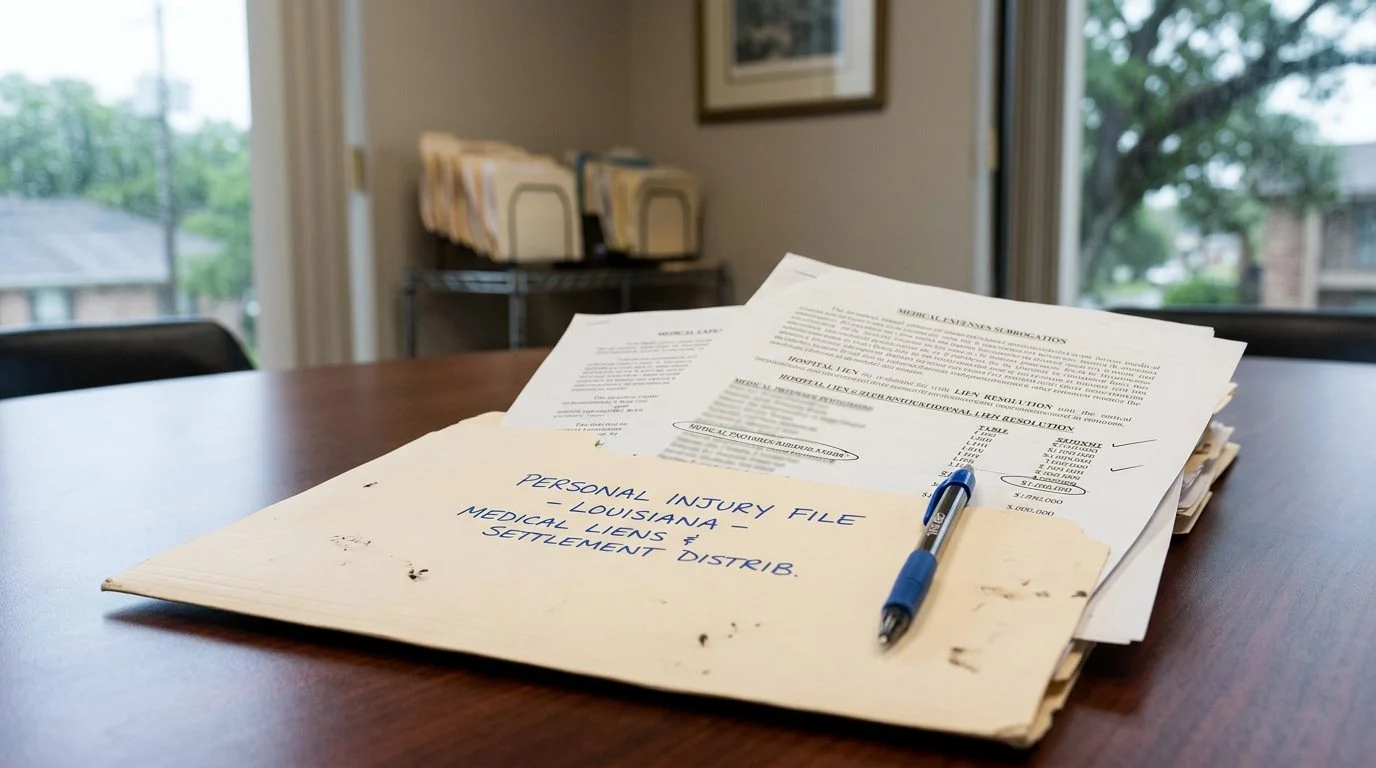
Liens and other expenses can sometimes be reduced
Often, a lien amount is not the final number, and it can sometimes be negotiated.
Louisiana law limits some medical claims. Under La. R.S. 9:2800.27, when a health insurer or Medicare paid a contracted provider, recovery is limited to the amount actually paid plus cost-sharing amounts, not the amount billed. The statute also covers cases where the claimant’s attorney has entered into a pre-negotiated agreement with a medical provider, under which the provider accepts less than the billed amount as full payment. In that case, recovery is limited to the amount paid under that agreement, plus any applicable cost sharing amounts paid or owed by the claimant.
Negotiation usually starts with the paperwork. Check every bill, ask providers for itemized statements, verify the amounts actually paid, and discuss the outstanding balance with each provider or lienholder. Other case costs, such as records fees, may also come out of a recovery. These vary from case to case.
Don’t sign a final release until you know which bills and liens remain open. Negotiation can help, but outcomes aren’t predictable and turn on the specific claims involved.
Who paid the bills and when matters
The payer decides which rules apply to each bill.
Louisiana’s billed-versus-paid rule covers bills paid by a health insurer, Medicare or Medicaid. It does not apply to benefits received through an auto policy’s medical payments coverage, or in cases brought pursuant to R.S. 40:1231.1 et seq. or 1237.1 et seq., as subsection H of La. R.S. 9:2800.27 states.
Medicare works differently. CMS explains that when a person with Medicare is in an accident involving liability insurance, that insurance pays first and Medicare pays second. If the insurer will not pay promptly, Medicare may make a conditional payment, which must be repaid from a settlement. See the CMS Medicare secondary payer overview.
The conditional payment letter is not a final amount, and Medicare may make more payments while a claim is pending. A formal recovery demand comes only after a settlement, judgment, award or other payment. See the CMS attorney services guidance.
Medicaid has its own rule. Under 42 U.S.C. § 1396k, a state keeps part of any amount it collects under an assignment, to repay its medical assistance payments. The remainder goes to the individual.
Timing matters too. Bills may keep arriving while treatment continues. Under La. Civ. Code art. 2315, damages do not include future medical costs unless they are directly related to a manifest physical or mental injury or disease.
Do you have to pay taxes on medical lawsuit settlements?
Generally, no. 26 U.S.C. § 104 excludes damages other than punitive damages received on account of personal physical injuries or physical sickness.
Emotional distress is not a physical injury by itself. Damages for emotional distress tied to a physical injury are excluded, according to 26 C.F.R. § 1.104-1. How these rules apply to a specific recovery depends on the facts.
The tax question is separate from who gets repaid for medical bills. Keep the two questions apart when you review a settlement.
Do I get money back for medical expenses?
Usually, medical bills are not repaid to you separately from the claim. Medical expenses are part of what the claim seeks to recover. What you keep is the settlement less amounts owed to providers, lienholders and others.
Under La. R.S. 9:2800.27, recovery of past medical expenses other than those provided by Subsection B or C of this Section includes amounts paid for the claimant and amounts still owed to a provider, including amounts secured by a lien. Attorney fees are part of the math too. You may be responsible for case costs and expenses in addition to the fee.
No average or example amount can predict what you will keep. Read the settlement statement line by line. Each line should show the amount, who is paid and why, and it should match a bill or claim you recognize.

Talking with the firm about your bills
You may be reading this while a family member is still recovering. Bills, an insurer’s or Medicare’s letter, or a settlement offer may already be on the table.
If you want to talk through the bills and payment claims in your own case, call 855-LUBECKI to request a free case evaluation. The first consultation is free, confidential and without obligation to continue.
Przemek Lubecki is the responsible lawyer for this page. The office is in New Orleans, Louisiana. The firm may associate or refer a case to other law firms. This page is general information and does not promise or predict any outcome.
Quick answers
Does the billed-versus-paid rule apply to medical payments coverage?
No. The statute says it does not apply to benefits under an auto policy’s medical payments coverage.
Is a Medicare conditional payment the final amount?
No. CMS says the conditional payment letter does not give a final amount.
Are settlements taxed?
Generally not for physical injury damages. Punitive damages are not excluded.
How Our Team Can Help With Medical Costs
Reviewing your bills
We look at the medical charges, records and payment history connected to your injuries so you understand what has been billed and what has been paid.
Identifying claims against a recovery
Health plans, insurers and government programs sometimes ask to be repaid from a settlement. We help identify those claims early so they are not a surprise later.
Explaining your options
We answer your questions in plain language about how medical expenses, settlement offers and repayment issues may fit together in your situation.
Focusing on your recovery
Our team works to keep the paperwork manageable so you can concentrate on your health and your family.
Before you sign anything
Do not sign a release or accept a settlement check until you understand how your medical bills and any repayment claims will be handled. Once a release is signed, it is often difficult to reopen the claim.
Common Questions About Medical Costs and Settlements
Medical bills and settlement funds
Many people wonder whether their hospital and doctor bills are paid directly from the settlement. The answer depends on the type of coverage, the bills involved and the terms of the claim.
Medical payments coverage
Some auto policies include medical payments coverage. Asking how it applies to your bills can help you see the full picture of what is available.
Liens and repayment claims
Health plans and government programs may assert claims against a recovery. Raising these questions early helps avoid surprises at the settlement table.
Taxes on settlements
Tax questions about a settlement are different from medical billing questions. Discuss them with a tax professional, and bring your questions to us so you know what to ask.
Have questions about medical bills after a crash?
Talk with Przemek Lubecki. Office in New Orleans.