
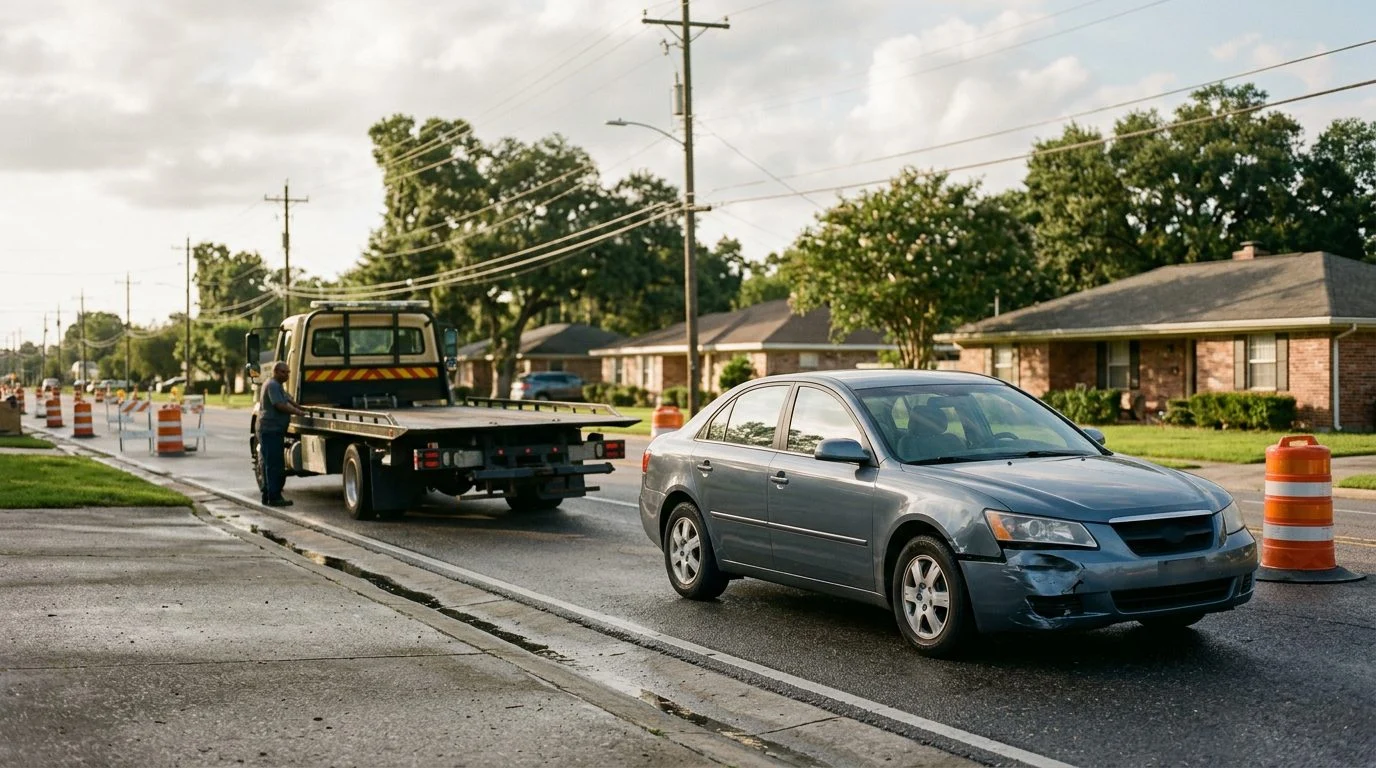
Car Accidents | New Orleans, Louisiana
Hurt in a New Orleans Construction Zone? Let's Look at Who Is Responsible
Lane shifts, missing barriers and unclear signs can turn a routine drive into a serious crash. Przemek Lubecki helps people hurt in these crashes understand the possible sources of fault.
By Przemek Lubecki · Published November 15, 2026
A crash in a construction zone can leave you hurt and unsure who caused it. Maybe the lanes shifted without warning, or a barrier was missing.
Responsibility may rest with the driver, and in some cases with a contractor, subcontractor, employer or government body that controlled the work zone. Which party fits depends on the facts of your crash.
Who may be responsible for a car accident in a New Orleans construction zone?
More than one party can share fault in the same crash. The driver is always a possible party, but the companies and public bodies running the work zone can be too.
By Przemek Lubecki, responsible lawyer, American Trial Lawyer, LLC, New Orleans office.
Louisiana law makes a person answer for damage caused by negligence, imprudence or want of skill. La. Civ. Code art. 2316 makes every person responsible for the damage he occasions not merely by his act, but by his negligence, his imprudence, or his want of skill. Which party answers for a crash turns on the facts at the scene, such as the signs, lane closures, barriers, lighting and traffic control. Those details are what a review looks at first. Sorting out each party’s role early helps you see which questions to ask. A crash can have more than one responsible party, and each one’s share is a separate question. For the broader picture, see car accident claims.
Not sure what your next step is?
Talk it through with our team — the first consultation is free, confidential, and carries no obligation.
Common causes of construction zone crashes
Several conditions can set up a crash in a work zone. Each one can change who had control of the scene.
- Lanes that shift or merge with unclear or missing warning signs.
- Barriers, cones or drums that are missing, knocked out of place or poorly positioned.
- Narrowed lanes, uneven pavement, unmarked edges or debris in the travel lane.
- Poor visibility from nighttime work, glare or weak lighting.
- Flaggers or detours that changed without clear notice to drivers.
A missing barrier and a shifted lane can both matter in the same crash. A common mistake is to look at only one cause. Each cause raises a different question. Was the warning missing, or was it there and hidden? Did the crew place the barrier, or did it move later? Those answers help sort out who may be responsible.
The driver and the truck or vehicle operator
A driver in a work zone still has a duty to drive carefully. Louisiana’s careless operation law says a driver must drive “in a careful and prudent manner, so as not to endanger the life, limb, or property of any person.” La. R.S. 32:58 Your own speed and attention still count, even when the work zone was confusing.
A driver who ignored lowered speed limits, lane signs or a flagger may share fault. This can be true even when the zone itself was poorly marked.
Keep two questions apart. One asks whether the driver acted carefully. The other asks whether the work zone was safe. A crash can involve both.
The contractor, subcontractors and employers
A contractor, subcontractor or employer may share responsibility when its crew or vehicle created a dangerous condition or failed to fix one. Which company controlled the lanes is often a central fact.
Louisiana makes an owner or custodian answerable for damage from a ruin, vice, or defect only upon a showing that it knew or should have known with reasonable care of the defect, that the damage could have been prevented by reasonable care, and that it failed to exercise such reasonable care, although the court may apply res ipsa loquitur in an appropriate case. A thing’s owner or custodian is answerable for damage caused by its ruin, vice, or defect only if they knew or should have known of the defect, the damage could have been prevented with reasonable care, and they failed to exercise that care. La. Civ. Code art. 2317.1
Louisiana law sets out how responsibility is shared when more than one party is at fault, including when liability is solidary and when it is joint and divisible. La. Civ. Code art. 2324
Government bodies, utilities and site owners
A city, parish, state agency or utility may be responsible if it controlled the work zone or the road where the crash happened. Utilities and site owners raise a separate question: who had control of the spot where the crash happened.
Louisiana law says no suit against a state agency or political subdivision may be filed in any court other than a Louisiana state court. La. R.S. 13:5106 A claim against a city may follow different steps than a claim against a company.
These public-entity rules differ from those for private companies. Suits must be filed in a Louisiana state court, and the law limits the total liability of the state and political subdivisions for certain personal injury damages to $500,000 per person, not counting property damage, medical care and related benefits, lost earnings, and loss of future earnings. That is why early review matters.
Evidence to preserve early, including photos of barriers and signs
Photos of barriers, signs and lane markings are useful early evidence, and the scene is where they’re easiest to capture. Lead with safety, and take photos only when traffic and the scene allow it.
- Barriers, cones, drums, signs and lane markings, photographed as soon as it’s safe.
- Notes on the time of day, weather, lighting and where the work was happening.
- Names and contact details for witnesses, flaggers and crew members who were present.
- The police report number and any scene or incident report.
- Any detour sign, notice or written instruction you saw at the site.
- Photos of your vehicle and injuries, plus medical records as they’re created.
- Phone photos, dashcam footage or app data that may show speed and route.
Write down what you remember soon after, while details are fresh. Keep original files, not just copies sent to others.
Not sure what your next step is?
Talk it through with our team — the first consultation is free, confidential, and carries no obligation.
How does Louisiana comparative fault affect a work zone claim?
For crashes on or after January 1, 2026, Louisiana uses modified comparative fault (La. Civ. Code art. 2323). A person found 51% or more at fault recovers nothing.
If fault is less than 51%, the amount recoverable is reduced by that person’s share. La. Civ. Code art. 2323 Louisiana uses modified comparative fault: an injured person found 51% or more at fault recovers nothing, and an injured person found less than 51% at fault recovers damages reduced by their own percentage of fault. Louisiana’s comparative fault rules are set out in La. Civ. Code art. 2323, which was amended effective January 1, 2026.
The same article says fault is measured for everyone who caused or contributed to the harm, whether or not they are parties to the case. That matters in work zone crashes, where fault may be spread across a driver, a contractor and a government body. Evidence about speed, signs and lane position often shapes those percentages.
Talk with a New Orleans trial lawyer about your construction zone crash
A short talk with a lawyer can help you sort out which parties the facts may point to, and what your next step might be.
Quick answers
Does Louisiana bar recovery if I share fault? A person found 51% or more at fault recovers nothing under La. Civ. Code art. 2323. Below 51%, recovery is reduced by that share.
If you were hurt near a closed lane or an unmarked barrier, and you’re weighing whether to name the driver, a contractor or the city, the facts you gather now can shape that choice. Drivers and passengers both face these questions. American Trial Lawyer, LLC handles car and commercial vehicle crash matters and may associate or refer a case to other law firms. Our office is in New Orleans, and the first consultation is free, confidential and without obligation to continue. Call 855-LUBECKI or request a free case evaluation.
How the Firm Approaches a Construction Zone Crash
Reviewing the work zone
We look at the traffic plan, signage, lane markings and barriers that were in place when your crash happened.
Identifying the parties
We consider the driver, contractors, subcontractors, employers and government bodies that may have controlled the work zone.
Protecting the evidence
Photos, witness details, crash reports and work zone records can disappear over time, so we help preserve them early.
Clear, plain-language guidance
We explain your options in everyday terms so you can make informed decisions about your case.
Helpful Tip After a Crash
If it is safe to do so, take photos of the lanes, signs, barriers and any equipment near the crash. Write down what the warning signs said. The firm may associate or refer a case to other law firms.
Questions to Ask About Your Crash
Who controlled the work zone?
Knowing which company or agency set up and managed the lanes can help identify who may share responsibility.
Were warnings in place?
Signs, cones, flaggers and lighting are often central to what happened and why.
Was the setup changed?
Lane shifts or new barriers without notice can point to a different cause than driver error alone.
Who was involved?
Drivers, passengers, pedestrians and other motorists may all have information that matters to the facts.