
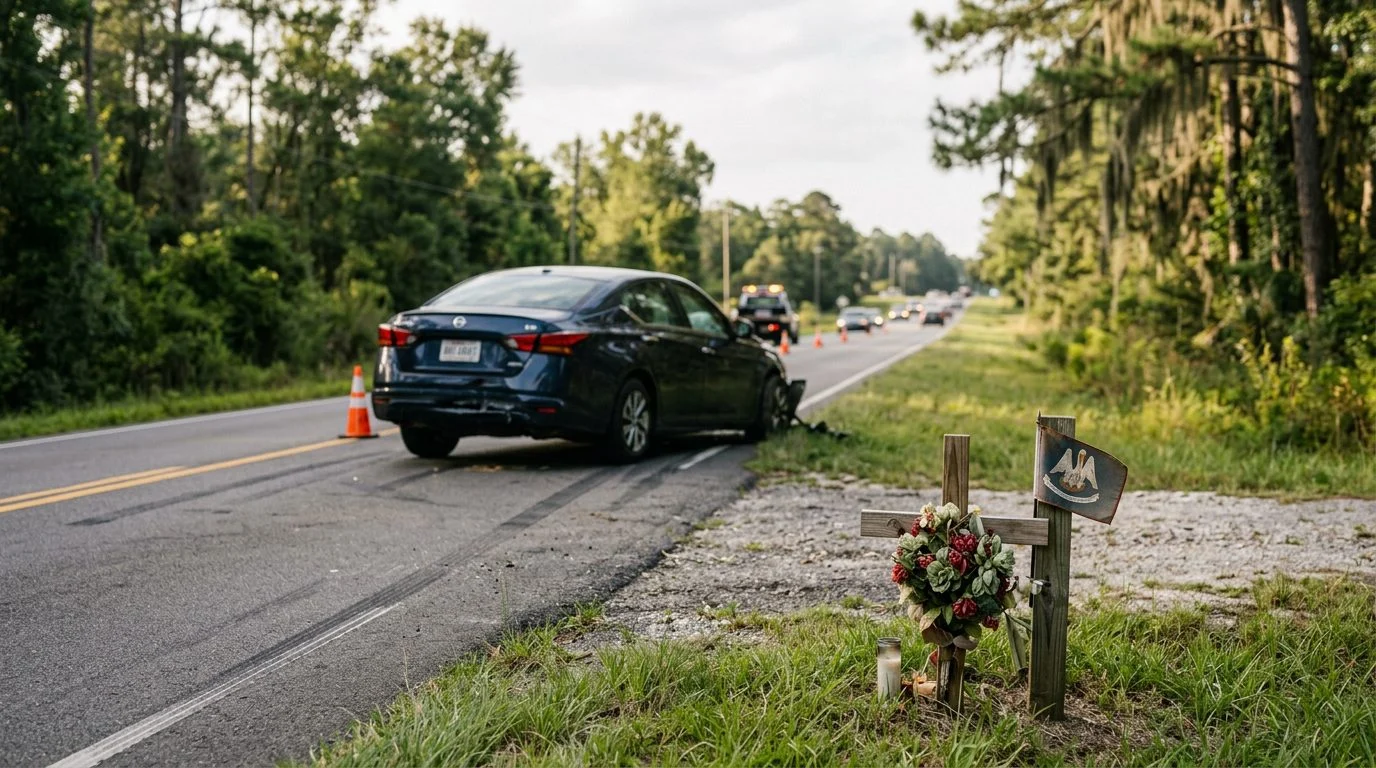
Wrongful Death | New Orleans, Louisiana
Facing Funeral Bills After a Fatal Crash? You Don't Have to Sort It Out Alone
Przemek Lubecki and our team at the New Orleans office help families make sense of the costs and questions that follow the loss of a loved one.
By Przemek Lubecki · Published November 8, 2026
Losing someone in a crash means grief and a stack of bills at the same time. Funeral and medical bills are not paid automatically. In Louisiana, many of them can become part of a legal claim against the party responsible for the crash.
Short Answer: Who Pays Funeral Bills After a Fatal Crash?
Funeral and medical bills usually get paid from one of three places, and each works differently:
- The at-fault party’s liability insurance, through a claim against the person or company responsible for the crash.
- The decedent’s health insurance, if it covers treatment the person received before death.
- The family’s own funds, used while a claim is still pending.
A claim is not the same as an immediate payment. Resolving a claim can take a long time, and the timing varies from case to case. Bills often arrive long before any claim is resolved, so it helps to know which ones may belong to a claim. This page is general information, not legal advice about your family’s situation.
If funeral invoices and hospital statements are piling up after a crash that took a loved one, we can talk through which bills may belong to a claim, at no cost and with no obligation. Talk it through with our team — the first consultation is free, confidential, and carries no obligation.
Two Different Claims That Often Get Mixed Together
Under La. Civ. Code art. 2315.1, if a person injured by an offense or quasi offense dies, the right to recover all damages for injury to that person, his property or otherwise, caused by the offense or quasi offense survives for one year from the death of the deceased or two years from the day that injury or damage is sustained, whichever is longer, in favor of the persons listed in the article. Each covers different losses, so each bill needs to be sorted.
The survival action comes from Louisiana Civil Code art. 2315.1. It covers the right to recover damages for injury to the person who died, caused by the crash. That right passes to listed relatives, such as a surviving spouse and children. If no one in those groups survives, the succession representative may pursue it. Bills for emergency transport and hospital care before death often fit here.
The wrongful death action comes from Louisiana Civil Code art. 2315.2. It lets listed family members sue to recover damages they sustained as a result of the death.
The same bill can fall under different claims. The key questions are who paid it and when it was incurred. A hospital bill from the day of the crash may be presented differently than a funeral invoice a family member paid later.
Funeral and Burial Expenses: What a Family May Recover
Louisiana law lets eligible family members recover the damages they sustained because of the death, under Louisiana Civil Code art. 2315.2.
Start with the paperwork. Keep the funeral home contract, every itemized invoice, and proof of who paid each charge. A canceled check, card receipt, or bank statement can show that. Clear records make it easier to show what was spent and by whom.
Funeral costs are only one part of the picture. Louisiana law also allows damages for loss of consortium, service, and society. These go to the same family members who could bring a wrongful death claim, under Louisiana Civil Code art. 2315. They cover losses of companionship and support, not bills. Keep them in mind when you review your family’s options.
Medical Bills: Emergency Care, Treatment Before Death, and Hospital Charges
Medical bills for care the injured person received before death may fall under the survival action. These can include ambulance rides, emergency room visits, and hospital stays.
The amount printed on a bill is not always the amount that counts. Under La. R.S. 9:2800.27, when health insurance or Medicare paid a contracted provider, recovery of medical expenses is limited to the amount actually paid. It also includes any cost-sharing amounts the claimant paid or owes. It is not the amount billed, but this Section does not apply in cases brought pursuant to R.S. 40:1231.1 et seq. or 1237.1 et seq., or to benefits received under an automobile liability policy that provides medical payments coverage.
In a trial to recover past medical expenses provided by Subsection B of this Section, which covers expenses paid in whole or in part by a health insurance issuer or Medicare to a contracted medical provider, the judge or jury must be told both the amounts billed and the amounts actually paid. Save every itemized hospital statement, ambulance bill, and explanation of benefits (EOB) statement from the insurer. An EOB shows what the insurer paid and what may still be owed.
Do not throw away statements just because they say “not a bill.” They often show the charges and payments that a claim needs.
Who May Bring the Claim and Who May Be Responsible
The people who may bring a wrongful death claim are listed in Louisiana Civil Code art. 2315.2. The surviving spouse and children come first. If none survive, the parents may sue, or either parent if only one of them survives; a father or mother who has abandoned the deceased during his minority is deemed not to have survived him. Then come siblings, and then grandparents, each only if no one in the earlier group survives.
Who may be responsible depends on the facts. A driver can be responsible. So can a company the driver worked for. Louisiana Civil Code art. 2320 says employers are answerable for damage caused by their servants in the exercise of the functions in which they are employed, but responsibility attaches only when the employer might have prevented the act which caused the damage and did not do it.
Truck and commercial vehicle cases often involve more than one party, such as a driver, a motor carrier, a broker, or a vehicle owner. When more than one person is at fault and liability is not solidary, each is not liable for more than their own degree of fault; a person who conspires with another to commit an intentional or willful act is answerable in solido with that person. See Louisiana Civil Code art. 2324.
Many families assume they can sue the at-fault driver’s insurer directly. Louisiana limits that. Under La. R.S. 22:1269, the persons named in the survival and wrongful death articles have no right of direct action against the insurer unless one of the statute’s listed conditions applies.
This firm may associate or refer a case to other law firms.
Bills That Come Due Before a Claim Is Resolved
Families often have to handle bills before any claim is resolved. A few steps can keep things manageable.
Call the hospital, the ambulance service, and the funeral home. Ask what payment arrangements they offer, and ask whether a bill is being sent to insurance. Write down the name of each person you speak with and the date of the call.
Check whether the decedent’s health insurance covers the treatment. Ask the insurer for an EOB for each claim it received. Keep the explanation of benefits with the matching bill.
Make one list with four columns: the date each bill arrived, who it was addressed to, the amount, and whether it has been paid. A single folder, paper or digital, works well. Respond to every collection notice in writing and keep a copy. A clear list makes the claim easier to organize later.
Not sure what your next step is?
Talk it through with our team — the first consultation is free, confidential, and carries no obligation.
Records to Gather Now and Why Deadlines Matter
Gather these records first: the death certificate, the crash report, the funeral contract and invoices, every hospital and ambulance bill, insurance policies and EOB statements, and any photos or notes from the scene.
The crash report is confidential, but certain people can request it. Under La. R.S. 32:398, the report and the information in it are confidential and available only to the parties to the crash, parents or guardians of a minor party, insurers or an insurance support organization under contract to provide claims and underwriting of any party which is the subject of the report, any healthcare provider or their agent that rendered healthcare services to a party, the succession representatives or attorneys of the parties, and a news-gathering organization that requests documents related to a specific crash. Upon request, it must be made available within seven working days after the crash investigation is completed.
Deadlines matter. Under Louisiana Civil Code art. 2315.2, the wrongful death right prescribes one year from the death or two years from the day the injury was sustained, whichever is longer. The survival right under Louisiana Civil Code art. 2315.1 has its own period of one year from death or two years from injury, whichever is longer. A deadline that passes can limit or end a claim.
Frequently Asked Questions
Does a funeral bill get paid automatically after a fatal crash in Louisiana?
No. Funeral and medical bills are not paid automatically, but they may be part of a legal claim depending on the facts.
Can a family sue the at-fault driver’s insurance company directly?
Generally not.
Talk to Us About Your Family’s Bills
If funeral invoices and hospital statements are on the kitchen table after a crash took someone you love, you don’t have to sort out which bill fits which claim alone. Przemek Lubecki, the responsible lawyer for this page, offers a free, confidential first consultation with no obligation to continue. Call 855-LUBECKI or request a free case evaluation. Office in New Orleans.
How We Can Help Your Family
Plain-language guidance
We explain how funeral and medical costs may fit into a wrongful death matter, in terms you can follow during a difficult time.
Help gathering records
We can help you organize funeral invoices, medical bills, and crash and police reports so you have a clear picture of what was spent.
Respect for your family
We understand that you are grieving. Our goal is to take some of the legal weight off your shoulders.
A confidential first step
The first consultation is free, confidential and without obligation to continue.
Important to Know
Funeral and medical bills are not paid automatically after a fatal crash. Whether these costs can be included in a claim depends on the facts of each case. The firm may associate or refer a case to other law firms when that serves the family.
Papers Families Often Keep Together
Funeral and burial invoices
Keep every receipt and statement from the funeral home, cemetery, and any related services.
Medical and hospital bills
Gather bills and statements from the emergency response, hospital, and any treatment connected to the crash.
Crash and police reports
Request copies of the crash report and any other official records, which can help show what happened.
Notes about your loved one
Write down dates, names of people who were involved, and any contact information from insurers or other parties.