
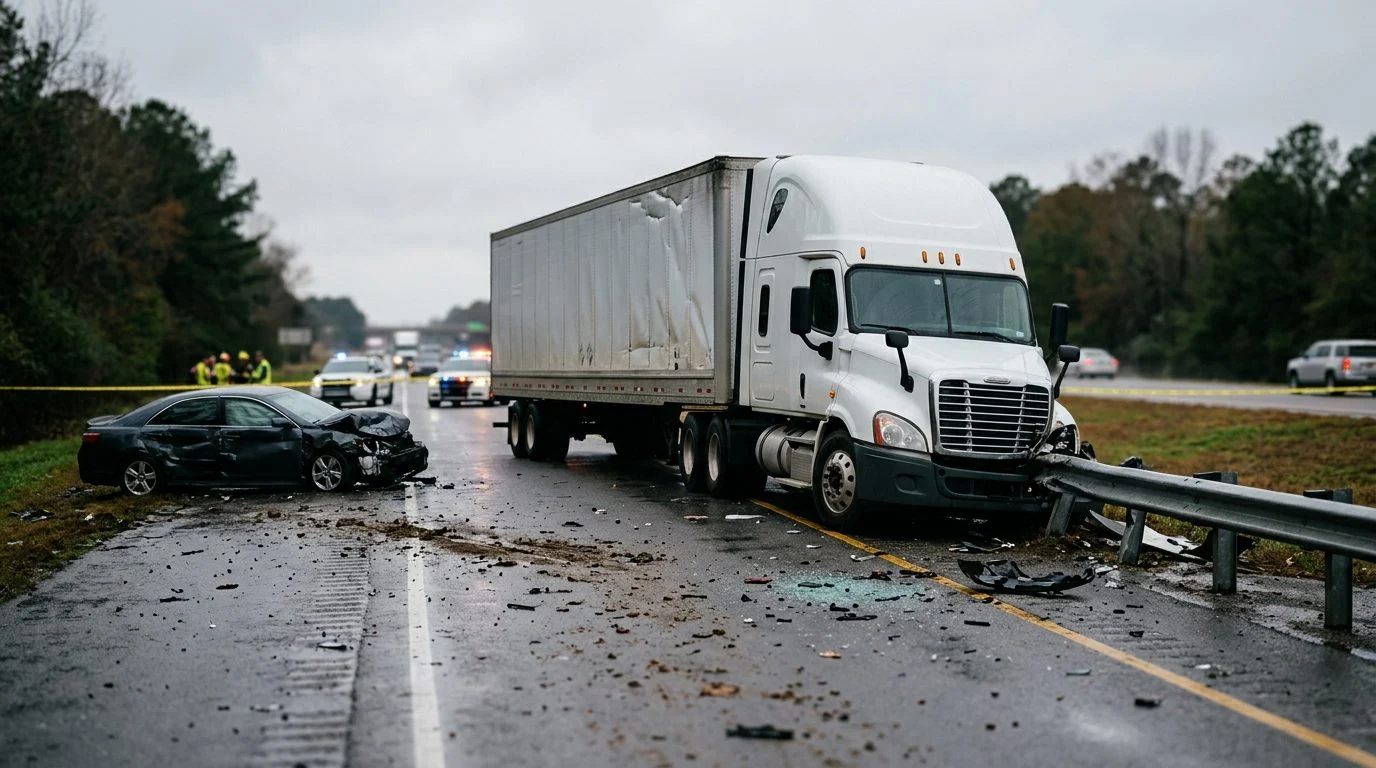
Fatal 18-Wheeler Crash Lawyer in Orleans Parish
By Przemek Lubecki · Published October 17, 2026
Families searching for a fatal 18-wheeler crash lawyer in Orleans Parish often ask one question first: can we bring a claim? Under Louisiana law, certain family members may sue when another party’s fault causes a death. Przemek Lubecki is a trial lawyer in New Orleans who represents families in truck, commercial vehicle, and car crash cases, including wrongful death. This page explains how these claims work and what to expect next.
What a Fatal 18-Wheeler Wrongful Death Claim Is
A wrongful death claim is a legal claim that family members bring when someone dies because of another party’s fault. La. Civ. Code art. 2315.2 sets out who may sue.
An 18-wheeler crash can involve more than one party. The driver, the trucking company, a cargo loader, a maintenance contractor, or an equipment maker may each bear some responsibility. That depends on what happened.
Louisiana law requires the fault of everyone who caused or contributed to a death to be determined. That includes people who are not parties to the lawsuit (La. Civ. Code art. 2323). Generally, each defendant answers for its own share of fault, not someone else’s (La. Civ. Code art. 2324).
This page is for families in Orleans Parish, the New Orleans metro area, and across Louisiana. Its focus is wrongful death after a truck crash. The firm also handles car accident and commercial vehicle cases.
Not sure what your next step is?
Talk it through with our team — the first consultation is free, confidential, and carries no obligation.
Who Can Bring the Claim and What It Can Cover
Louisiana law lists who may sue, based on who survived. A surviving spouse and children may sue. If there is no spouse or child, the surviving father and mother may sue. Brothers, sisters, and then grandparents may sue only when no closer relative survives (La. Civ. Code art. 2315.2). Adopted relatives are included.
If a person dies due to the fault of another, suit may be brought by the following persons to recover damages which they sustained as a result of the death (La. Civ. Code art. 2315.2). A wrongful death claim covers the family’s own losses. A survival action covers the injuries the deceased person suffered before death (La. Civ. Code art. 2315.1). The same family members may bring it.
Families often look at losses such as funeral costs, medical bills from the crash, and lost income and support. Which losses apply depends on the facts of each case.
Louisiana also uses a comparative fault rule, which means shared fault. Under La. Civ. Code art. 2323, if the degree or percentage of negligence attributable to the person suffering injury, death, or loss is equal to or greater than fifty-one percent, that person is not entitled to recover damages. If the degree or percentage of negligence attributable to the person suffering injury, death, or loss is less than fifty-one percent, the amount of damages recoverable is reduced in proportion to that degree or percentage (La. Civ. Code art. 2323). Whether the current version of the rule applies to a claim depends on the date the crash occurred, so the crash date matters.
What Makes Fatal Truck Crashes Different
Truck cases often turn on company records, and those records can be lost if no one asks for them early. Federal rules limit how long a property-carrying truck driver may drive. A driver may not drive without first taking 10 consecutive hours off duty, and may not drive after 14 consecutive hours following coming on duty after 10 consecutive hours off duty. A driver may drive a total of 11 hours during the period specified in paragraph (a)(2) of the regulation (federal hours-of-service regulation).
Drivers must record their duty status. Except for a private motor carrier of passengers (nonbusiness), a motor carrier covered by the federal duty-status rule must require each driver it uses to record the driver’s duty status for each 24-hour period. Subject to limited exceptions that allow manual records, this is done with an electronic logging device (ELD).
When a crash involves a loss of human life, the employer must test surviving drivers for alcohol and controlled substances as soon as practicable. The federal post-accident testing rule addresses alcohol testing of drivers after certain commercial motor vehicle crashes on public roads. It requires testing of surviving drivers when the accident involved a loss of human life, or when a driver receives a citation within 8 hours for a moving traffic violation arising from an accident that involved bodily injury requiring immediate medical treatment away from the scene, or disabling vehicle damage requiring tow-away. The first is when the driver was performing safety-sensitive functions with respect to the vehicle and the accident involved the loss of human life. The second is when the driver receives a citation within 8 hours under State or local law for a moving traffic violation arising from the accident, and the accident involved either bodily injury with immediate medical treatment away from the scene or disabling damage that required a vehicle to be towed away.
Crash reports are another key source. The Louisiana State Police publishes procedures for who may request crash reports and where copies are available (Louisiana State Police). The Insurance Institute for Highway Safety also publishes fatality facts on large trucks (IIHS).
How the Process Works, Step by Step
The process usually moves from a first talk to a records review, then to claims or a lawsuit if needed. Each step depends on the facts.
- First talk. The family shares the basic facts: the date, the location, the truck company if known, and any crash report.
- Case review. The firm reviews the crash facts and identifies the parties who may be responsible.
- Records and evidence. The firm works to request and preserve driver logs, electronic logging device data, maintenance records, and dispatch communications.
- Claims. Insurers and companies are notified, and claims are presented and negotiated.
- Lawsuit if needed. If a fair resolution is not reached, a lawsuit may be filed. The case then moves through discovery toward trial.
Deadlines matter. Louisiana sets time limits for wrongful death and survival claims by statute, so the timing of a claim should be reviewed as early as possible. Families should have their dates reviewed promptly.
Why Families Work With American Trial Lawyer
American Trial Lawyer is led by Przemek Lubecki, a trial lawyer with an office in New Orleans, Louisiana. The firm serves families in Orleans Parish, the New Orleans metro area, including Metairie, Jefferson Parish, Kenner, St. Bernard Parish, and Slidell, and across Louisiana.
The firm’s approach is direct and plain-language. Families hear what each step means before it happens. When a case needs trial preparation, the firm prepares for it. No outcome can be promised, and every case is different.
Claims can involve more than one company. The firm may associate or refer a case to other law firms. Any such arrangement would be handled as the law requires.
Frequently Asked Questions
Who can file a wrongful death claim in Louisiana?
Louisiana lists the eligible family members, starting with a surviving spouse and children. Parents, siblings, and grandparents may sue only when no closer relative survives (La. Civ. Code art. 2315.2).
How long does a family have to file?
Time limits for these claims are set by Louisiana law and can depend on the facts of each case, so it is important to contact a lawyer promptly.
Can a trucking company be responsible for its driver?
Louisiana law can make an employer answerable for work-related damage caused by an employee. It also looks at whether the employer could have prevented the act (La. Civ. Code art. 2320).
Can the family get the crash report?
The Louisiana State Police publishes procedures for who may request crash reports. Those procedures also describe where copies are available (Louisiana State Police).
Does the firm handle cases outside New Orleans?
Yes. The firm serves Orleans Parish, the New Orleans metro area, and clients across Louisiana.
Have questions about what happened?
Ask our team directly. The first conversation is free, confidential, and there is no obligation to continue.
Talk With a New Orleans Trial Lawyer About Your Family’s Loss
If a crash with an 18-wheeler took your loved one, you don’t have to sort out the claim alone. Przemek Lubecki, at the New Orleans office, can review what happened and explain your options. Request a free case evaluation or call 855-LUBECKI.
The first consultation is free and confidential, with no obligation to continue. You may be responsible for case costs and expenses in addition to the fee.