
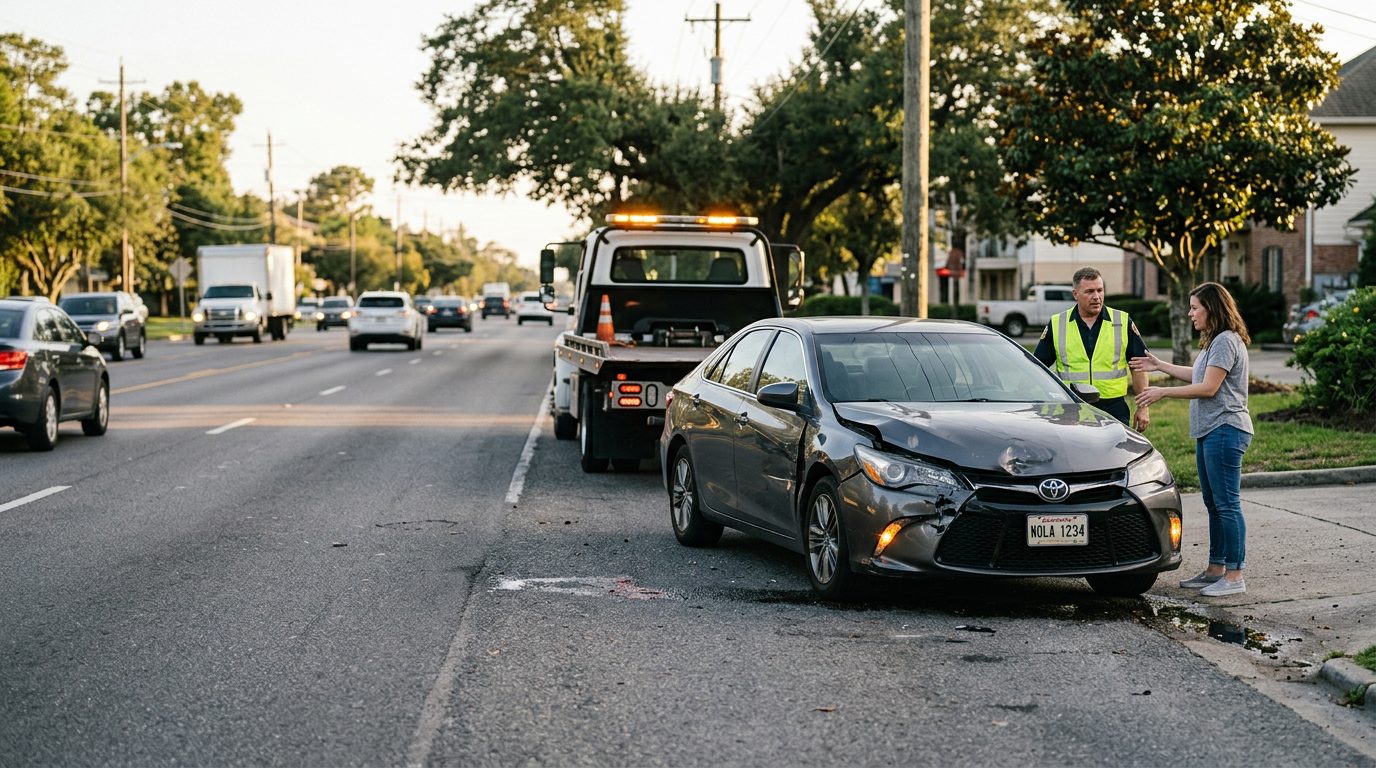
New Orleans Truck Accident Claims: How They Work
By Przemek Lubecki · Published October 17, 2026
Responsible lawyer: Przemek Lubecki, American Trial Lawyer, LLC, New Orleans office.
A truck accident claim in Louisiana asks the people responsible for a crash to pay for the harm it caused. Louisiana’s civil code sets the basic rule. Federal trucking rules add records and deadlines that most car crash cases don’t have. This guide explains how truck accident claims work in Louisiana, step by step. It’s general information, not advice about your case, and reading it doesn’t create a lawyer-client relationship.
Who Is Usually Involved in a Louisiana Truck Accident Claim?
Several parties are often involved, and a claim may reach more than one of them. Louisiana’s basic rule is that whoever’s fault causes damage must repair it. La. Civ. Code art. 2315 says: “Every act whatever of man that causes damage to another obliges him by whose fault it happened to repair it.”
In a truck crash, the list can include the driver, the motor carrier (the company that operates the truck), a company that leased the truck, a cargo loader, a maintenance contractor, and a freight broker who arranged the trip. Each one may have its own insurer. An employer can answer for harm its workers cause on the job. But La. Civ. Code art. 2320 says that responsibility attaches only when the employer might have prevented the act and didn’t. Louisiana also uses joint and divisible liability. Under La. Civ. Code art. 2324, a party generally isn’t liable for more than its own degree of fault.
Fault depends on the facts of the crash. It doesn’t depend on who calls an insurer first or who files first. You can read more about whether you can sue a truck driver and what happens after a semi-truck crash on I-10 in New Orleans.
Not sure what your next step is?
Talk it through with our team — the first consultation is free, confidential, and carries no obligation.
What Does a Truck Accident Claim Have to Prove?
The injured person generally has to show that someone’s negligence caused the crash and caused real harm. Did the other party owe reasonable care? Did they break that duty? Did the break cause the crash? Did the crash cause real losses, such as medical bills, lost income, and pain?
Proof in a truck case often turns on details. These include following distance, speed, lane changes, road conditions, and the driver’s condition. Police reports, photos, witness statements, and the truck’s own records all matter.
Louisiana also applies comparative fault, which means each party’s share of blame counts. Under La. Civ. Code art. 2323, the degree or percentage of fault attributable to all persons causing or contributing to an injury is determined in any action for damages, regardless of whether a person is a party to the action or a nonparty. Under La. Civ. Code art. 2323, the amount of damages recoverable may be reduced in proportion to the degree or percentage of negligence attributable to the injured person. Fault is also assigned to everyone who contributed, even if they aren’t a party to the suit. The current text of this article was amended by Acts 2025, No. 15, effective January 1, 2026. For more on shared blame, read about partial fault in a truck crash.
Does the Filing Deadline Matter, and What Is the Time Limit?
Yes, the deadline matters. Louisiana sets a time limit, called prescription, for filing claims. Missing it can end a claim. Under La. Civ. Code art. 3493.1, delictual actions (fault-based claims for injury) are subject to a two-year period. That period starts on the day the injury or damage is sustained.
Wrongful death claims follow a different schedule. Under La. Civ. Code art. 2315.2, a wrongful death right of action prescribes one year from the death or two years from the injury, whichever is longer.
Filing in the right court also matters. La. Civ. Code art. 3462 says prescription is interrupted when the action is commenced in a court of competent jurisdiction and venue. It limits the effect of a filing in an incompetent court or improper venue.
Don’t assume more time exists. Confirm the deadline for your exact crash date. Waiting also makes evidence harder to keep. Federal rules require carriers to keep driver duty records for at least six months from receipt, so early requests help. For more, see evidence preservation after a truck crash in Orleans Parish.
How Federal Trucking Rules Affect Liability
Federal rules for commercial trucks create records that can show what happened before a crash. These records are often central in a truck case. Federal hours-of-service rules limit how long property-carrying drivers can work and drive.
Carriers must make drivers record their duty status. The federal rule at § 395.8 requires a motor carrier subject to it to have each of its drivers record their duty status for each 24-hour period, generally by using an electronic logging device (ELD), with limited situations in which manual records may be used instead. Electronic logging devices (ELDs) record much of this data. The federal rule at § 395.20 states that its subpart covers ELDs used to record a driver’s hours of service under § 395.8(a), and that an ELD used after December 18, 2017 must meet that subpart’s requirements.
Engine control module (ECM) data is another source. Depending on the truck, an ECM can record data such as speed and braking around a crash. Because it may not last indefinitely, it should be requested promptly.
After certain crashes, federal rules also require drug and alcohol testing. If an alcohol test isn’t given within two hours, the employer records the reasons. Alcohol attempts stop after eight hours. Controlled substance attempts stop after 32 hours.
The Insurance Institute for Highway Safety also publishes research on large truck crash fatalities for background.
How Does the Claim Process Usually Move, Step by Step?
Here is how truck accident claims work in Louisiana, one stage at a time. Each stage runs at its own pace, and the order can shift with the facts.
- Medical care. Evaluation and treatment come first. Those records become part of the claim.
- Reporting and records. The crash report, photos, and witness information should be gathered early.
- Investigation. The review covers fault, the truck’s records, and the driver’s logs.
- Documenting damages. Bills, wage records, and treatment notes show the harm.
- Demand. The claim is presented to the insurers in writing.
- Negotiation. Insurers respond, and the parties may counter.
- Lawsuit, if needed. If talks don’t resolve the claim, a suit may be filed before the deadline.
Many claims resolve without a trial, but some need a lawsuit. No timeline can be promised, and no one can predict how a particular claim will end. For what affects timing, read how long a truck accident lawsuit takes.
What Do Insurance Companies Do Early in a Truck Claim?
Trucking insurers often reach out quickly. They may ask for a recorded statement, and that request deserves care. Under La. R.S. 13:3732, anyone who takes a written, recorded, or transcribed statement from an injured person must furnish a true and complete copy. The copy must be provided within twenty days after a written demand.
The same statute says a statement can’t be used in a related civil action if the holder refuses, after request, to give a copy. That gives you a concrete point to raise before a call.
Early offers may not reflect the full picture. Some injuries take time to understand, so an offer made before treatment ends may not cover what follows. You don’t have to answer questions on the spot. Asking for time to review, and asking for a copy of anything you sign, are reasonable steps. Louisiana’s compulsory insurance rules explain why several insurance policies can be involved in one crash. Learn more about recorded statements from a trucking company’s adjuster and what not to tell your insurance company.
Have questions about what happened?
Ask our team directly. The first conversation is free, confidential, and there is no obligation to continue.
How Are Truck Accident Claims Valued, and What Affects the Timeline?
No one can predict a settlement amount or a timeline from a general guide. Each claim depends on its own injuries, evidence, and fault.
Damages usually fall into groups: medical bills, lost income, and pain and suffering. Louisiana limits one category. Under La. Civ. Code art. 2315, damages don’t include future medical costs unless they are directly related to a manifest physical or mental injury. Keep treatment records and ask your providers to explain any future care they recommend.
Timing often depends on how serious the injuries are, whether treatment is finished, what records are still needed, and how insurers respond. Ask early about any bills tied to your care and whether anyone expects repayment from a settlement. You can read more about medical liens in truck crash claims. Related pages cover how a truck accident claim is valued, how much most truck accident settlements are, and how long a truck accident settlement takes.
How Is a Wrongful Death Truck Claim Different?
Louisiana law lets certain family members bring a claim when a person dies because of another’s fault. Under La. Civ. Code art. 2315.2, a surviving spouse and children come first. If there’s no spouse or child, the surviving parents may bring the claim. Then come siblings, and then grandparents, depending on who survived.
A separate survival claim may also exist. Under La. Civ. Code art. 2315.1, the right to recover damages for injury the person suffered before death survives for one year from death or two years from the injury, whichever is longer. If no listed family class exists, the succession representative may pursue it.
Under La. Civ. Code art. 2315, loss of consortium, service, and society can be recovered by the same people who could bring a wrongful death action. These cases carry grief and practical questions at the same time. Some decisions are time-sensitive, so it helps to learn the deadlines early. For a related example, see a fatal 18-wheeler crash wrongful death case in Orleans Parish.
What Are Common Questions About Fees and Costs?
Lawyers can be paid in different ways. The fee arrangement should be discussed and put in writing before representation begins. Ask about it before you sign anything.
Any fee or free consultation is subject to a cost rule. You may be responsible for case costs and expenses in addition to the fee. Ask how costs are handled and when they are charged. For a common starting question, read about what percentage an accident lawyer takes.
The firm may associate or refer a case to other law firms. If that happens, the firm would disclose the referral arrangement to you.
Where Can Injured People Get Local Help in Louisiana?
Przemek Lubecki is the responsible lawyer, and the firm’s office is in New Orleans, Louisiana. Przemek Lubecki is licensed to practice law in Louisiana. Truck crashes happen across the state, including in Orleans Parish, Jefferson Parish, St. Bernard Parish, Metairie, Kenner, and Slidell.
The firm’s office is in New Orleans. Area pages describe who the firm serves in those places. They don’t mean the firm has an office there. You can explore New Orleans truck crash claims, Orleans Parish, Louisiana, and the Jefferson Parish, Metairie, and Kenner truck accident page. The St. Bernard Parish truck accident page covers that area.
Talk With Przemek Lubecki About Your Truck Crash
If a truck or commercial vehicle crash has left you with open questions about deadlines, insurers, and next steps, you don’t have to decide alone. The questions in this guide are common, and they often come up before anyone knows what the claim is worth.
How long do I have to file a truck accident claim in Louisiana?
Most injury claims have a two-year period that starts on the injury date. Wrongful death claims follow a separate rule, so confirm the deadline for your exact facts.
Do I have to give a recorded statement to the trucking insurer?
You don’t have to answer on the spot. If a recorded statement is taken, Louisiana law requires a copy after a written request.
How do truck accident claims work in Louisiana if I was partly at fault?
Under Louisiana Civil Code article 2323, as amended by Acts 2025, No. 15 with an effective date of January 1, 2026, a person whose own fault is 51% or more may be barred from recovering damages, and for crashes that occurred before that date, the version of the article in effect at the time may apply. Under La. Civ. Code art. 2323, when an injury results partly from the injured person’s own negligence and partly from the fault of another person or persons, the rules in that article apply.
Who pays case costs if I hire a lawyer?
You may be responsible for case costs and expenses in addition to the fee. Get the fee and cost terms in writing before you agree to anything.
Przemek Lubecki can review your facts from the New Orleans office. You can request a free case evaluation or call 855-LUBECKI for a free consultation; you may be responsible for case costs and expenses in addition to the fee. Use the free case evaluation request if that’s easier. The firm may associate or refer a case to other law firms.
Want to know where you stand?
Tell us what happened and our team will walk you through the options available to you, at no cost.
Ready to take the next step?
Related practice areas
- Car Crash New Orleans: What Happens Next
- Semi Truck Accident Lawyer New Orleans | Przemek Lubecki
- What Can I Recover After a Car Accident in Louisiana?