
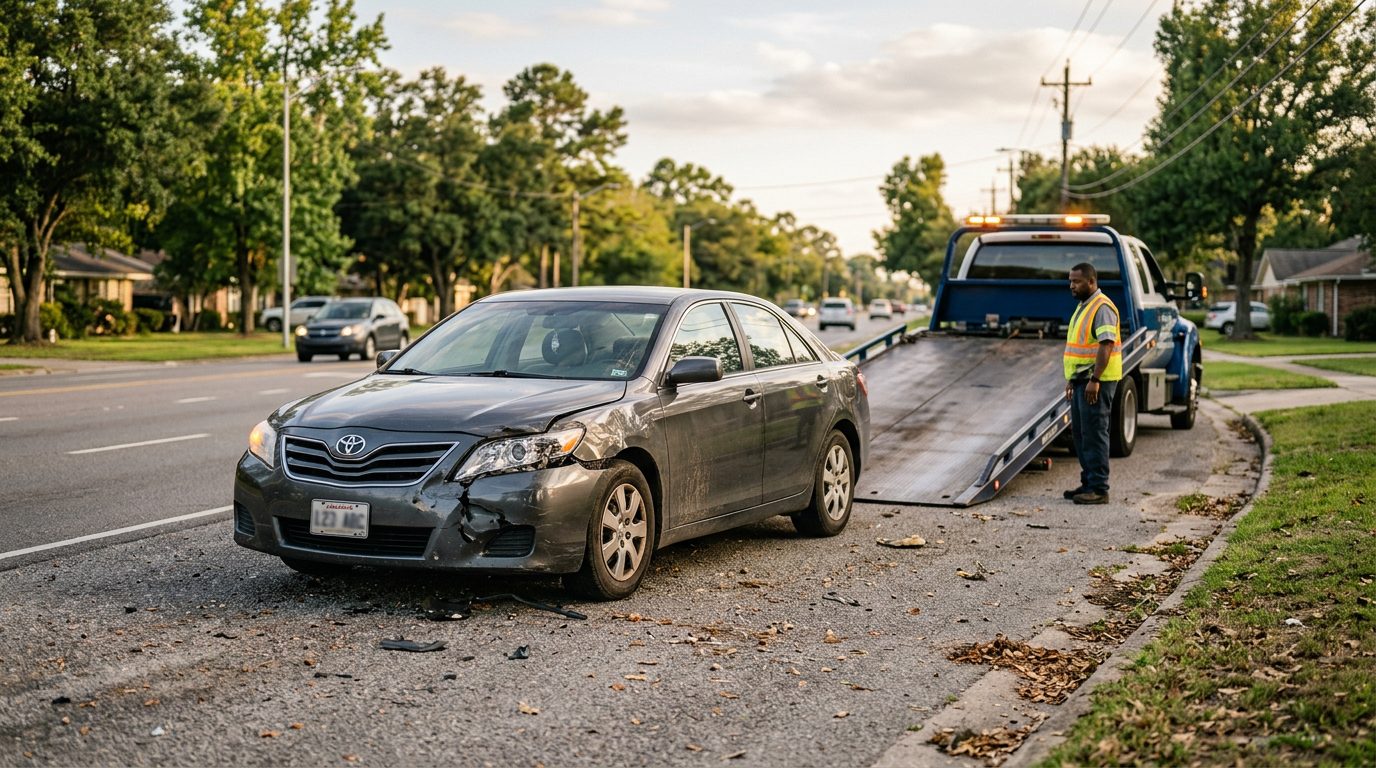
Car Accidents | New Orleans, Louisiana
Hurt in a Crash Where You Were Partly at Fault? Talk It Through With Us First.
Louisiana's fault rules can be hard to sort out after a collision. Przemek Lubecki, responsible lawyer at our New Orleans office, helps people across Orleans Parish, the New Orleans metro and Louisiana understand their options.
By Przemek Lubecki · Published November 7, 2026
Can I sue if I was partly at fault in a car accident in Louisiana? In most cases, yes. Partial fault does not automatically end a claim. Under La. Civ. Code art. 2323, if your own negligence is equal to or greater than fifty-one percent, you are not entitled to recover damages; if it is less than fifty-one percent, any recovery is reduced in proportion to your share of fault.
This page explains how those rules work for people in New Orleans, Metairie, Kenner, Jefferson Parish, St. Bernard Parish, Slidell and across Louisiana.
The Short Answer: Partial Fault Does Not Automatically Bar a Claim
Partial fault does not automatically stop a car accident claim in Louisiana. Your recovery depends on your percentage of fault and the date of the crash. Under La. Civ. Code art. 2323, fault is split among everyone who caused or contributed to the injury.
Under La. Civ. Code art. 2323, as amended effective January 1, 2026, when a person suffers injury, death, or loss partly as the result of his own negligence, a person whose share of negligence is equal to or greater than fifty-one percent is not entitled to recover damages. Your own facts decide which result fits your case.
If you were hurt in a crash and worry that your own share of fault could affect your claim, our team is ready to talk it through with you. Talk it through with our team — the first consultation is free, confidential, and carries no obligation.
How Louisiana Comparative Fault Works
Comparative fault means the degree or percentage of fault attributable to all persons causing or contributing to the injury is determined, and an injured person’s recovery is reduced in proportion to his own share of negligence unless that share is fifty-one percent or more (La. Civ. Code art. 2323). Article 2323 says the degree of fault of all persons who caused or contributed to the injury is determined. That includes people who are not parties to the lawsuit.
Under La. Civ. Code art. 2323, where the person suffering injury, death, or loss has a share of negligence less than fifty-one percent, the amount of damages recoverable is reduced in proportion to that person’s share of negligence. Here is an illustration only, not a prediction. Picture total damages valued at 100 points. If a decision-maker finds you 20% at fault, your recovery is reduced by 20 points, leaving 80.
Fault is decided from the evidence. Police reports, photos, witness accounts and vehicle damage all matter. Insurers and other drivers often disagree about the split. When more than one driver is at fault, La. Civ. Code art. 2324 generally makes each at-fault person liable only for their own degree of fault.
Is Louisiana a No-Fault Insurance State?
No. Louisiana is a fault-based state, not a no-fault state. Under La. Civ. Code art. 2315, a person whose fault caused damage must repair it. Fault is the central question.
The state’s Office of Motor Vehicles compulsory insurance guidance explains those requirements. A claim usually starts with the at-fault driver’s liability coverage.
Your own policy can matter too, especially when the other driver is uninsured. A partial-fault finding changes the amount of your claim. It does not change the fault-based structure of the system.
Will Insurance Pay If the Other Driver Left the Scene?
Coverage may still be available, but it depends on the facts and on your policy. Louisiana auto liability policies must generally include uninsured motorist coverage. That coverage applies to persons insured under the policy who are legally entitled to recover nonpunitive damages from an uninsured or underinsured driver. Any insured named in the policy may reject it, choose lower limits, or choose economic-only coverage, but only on a form prescribed by the insurance commissioner and signed by the named insured or his legal representative, as La. R.S. 22:1295 allows.
Your policy’s uninsured motorist terms decide how this coverage applies to your crash. Hit-and-run crashes often raise these questions.
Under La. R.S. 32:398, a driver in a crash involving injury must give their name, address and vehicle registration number to anyone hurt. Get what you can at the scene and report the crash to police.
Suing the Insurer Directly: Louisiana’s Direct Action Rule
La. R.S. 22:1269 says an injured person has no right of direct action against the insurer unless one of the situations listed in the statute applies. Check whether your situation fits one of those listed situations.
The statute also lets a liability insurer be joined on motion, in those instances where direct action is not otherwise authorized by law, when judgment is to be entered or when a settlement is reached during litigation. Whether that matters in your case depends on the facts and the policy.
Even when direct action is available, partial fault still counts.
Reporting the Accident and Early Steps That Protect a Claim
Under La. R.S. 32:398, the driver of a vehicle involved in a crash resulting in injury to or death of any person, or in property damage above the threshold set in the statute, must give his name, address, and the registration number of the vehicle he was driving. Under La. R.S. 32:398, crash reports are confidential. Upon request, reports are made available within seven working days after the investigation is completed, but only to the people the statute lists, such as the parties to the crash, parents or guardians of a minor party, insurers, healthcare providers who treated a party, and the parties’ attorneys.
Police can charge a fee for copies.
Write down what you remember and photograph the scene if you can. Get medical care and keep every record. A medical check after a crash can matter even when you feel fine. You can read more on medical evaluation after a crash.
Not sure what your next step is?
Talk it through with our team — the first consultation is free, confidential, and carries no obligation.
Louisiana Filing Deadlines for Car Accident Claims
For most injury claims, the deadline is two years. Under La. Civ. Code art. 3493.1, delictual (tort) actions are subject to a two-year liberative prescription. That time runs from the day the injury is sustained. The statute has exceptions, so the facts of your case matter.
Uninsured motorist claims follow a different clock. La. R.S. 9:5629 says those actions are prescribed by two years from the date of the accident.
Filing a lawsuit in a court of competent jurisdiction and venue can interrupt prescription, as La. Civ. Code art. 3462 explains. Waiting while you sort out fault can cost you time.
When to Talk With a Trial Lawyer About a Partial-Fault Crash
Anyone may contact the firm when one of three things happens. Liability is in dispute. A settlement offer seems too low. Or the filing deadline is getting close.
A trial lawyer can review the fault evidence, the policy limits and the timeline. Our team can help you understand how the comparative fault rule may apply to your facts.
American Trial Lawyer, LLC may associate or refer a case to other law firms. Passengers who were riding in a vehicle can read about passenger injury claims. Readers whose claim turns on a signal violation can see red light crash claims.
Quick Answers
Can I sue if I was partly at fault in a car accident in Louisiana?
Often yes. Under La. Civ. Code art. 2323, if the degree or percentage of negligence attributable to the person suffering injury, death, or loss is equal to or greater than fifty-one percent, that person shall not be entitled to recover damages.
Is Louisiana a no-fault state?
No. Louisiana is a fault-based state.
How long do I have to file?
For most injury claims, the deadline is generally two years (La. Civ. Code art. 3493.1).

Talk With Our Team About Your Crash
If you were hit by a driver and now wonder whether your own share of blame still leaves you a claim, you don’t have to sort it out alone. Our team can look at your crash with you, including the fault evidence, your policy and your timeline.
Przemek Lubecki is the responsible lawyer for this page. Call 855-LUBECKI (Office in New Orleans) or request a free case evaluation. The first consultation is free, confidential and carries no obligation to continue.
American Trial Lawyer, LLC. Office: New Orleans, Louisiana.
How we approach your case
A responsible lawyer you can reach
Przemek Lubecki is the lawyer responsible for this page's content and leads our work on car crash claims from our New Orleans office.
Plain answers about your situation
We explain how shared fault can affect a claim in clear terms, so you can make decisions with the facts in front of you.
Careful with insurers
Insurance companies may contact you soon after a crash. We can help you decide how to respond to them.
Attention to the whole picture
Injuries, medical care, lost work and family stress all matter. We listen to how the crash has affected your life.
Referrals when they make sense
We may associate with or refer a case to other law firms. We will tell you clearly if that happens.
Before you give a statement
Insurance adjusters may ask you to describe what happened in a recorded statement. Talking with a lawyer first can help you avoid misunderstandings about how the crash happened.
What to gather before your consultation
The crash report
If you have a copy of the police report or the report number, bring it along.
Photos and video
Pictures of the vehicles, the road, traffic signals and your injuries can help show what happened.
Medical records and bills
Keep records of every visit, prescription and treatment, including follow-up appointments.
Names and contact details
Note any witnesses, other drivers and insurance information you were given at the scene.
Have questions about fault after a Louisiana car crash?
Talk with us in a free, confidential consultation, with no obligation to continue.