
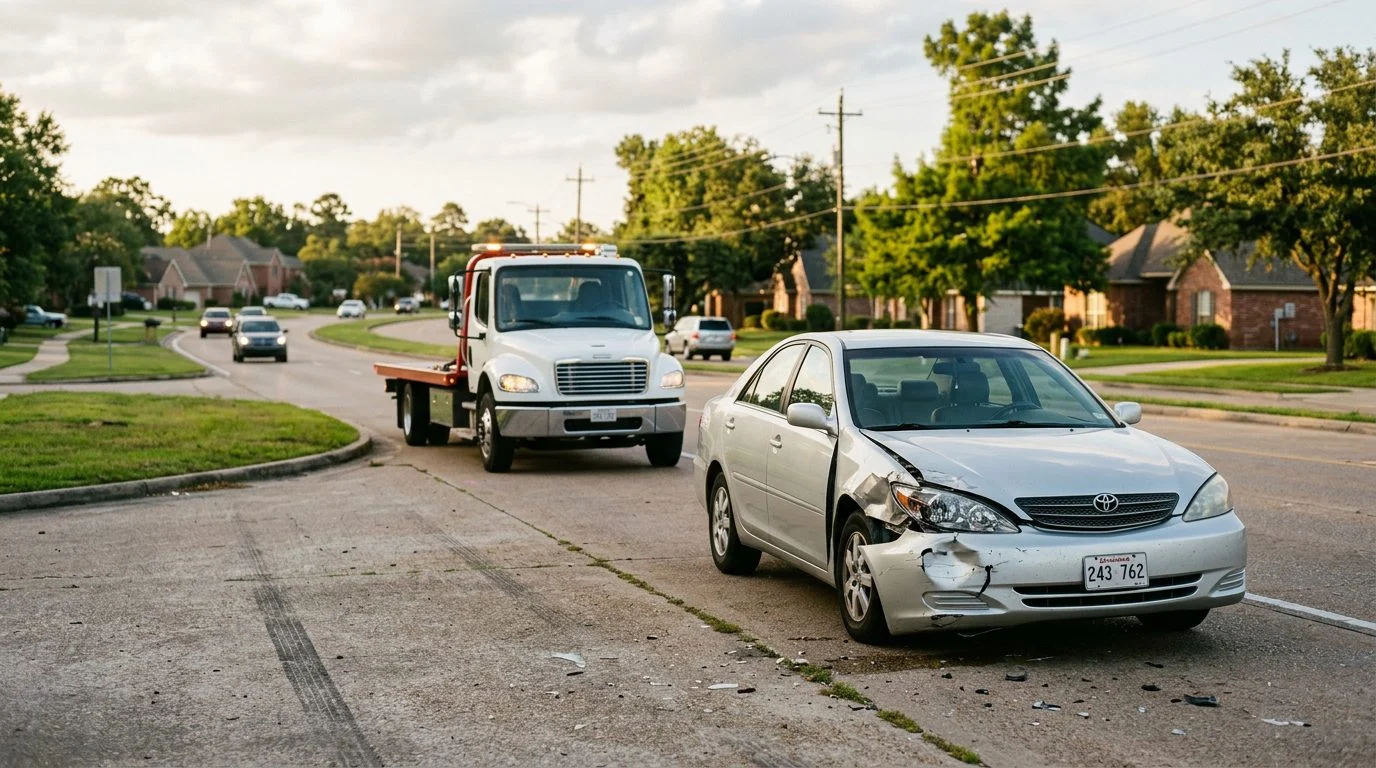
Car Accidents | New Orleans, Louisiana
Hurt on the Job and in a Car Crash? Your Third-Party Claim Can Be Separate
When another driver caused the crash that hurt you at work, you may have a claim against that driver, apart from your workers' compensation claim. Przemek Lubecki and our team at our New Orleans office can explain your options.
By Przemek Lubecki · Published October 26, 2026
If you were hurt in a work car accident, a work car accident third party claim in Louisiana may be available. It is a claim against someone other than your employer, and it can run alongside a workers’ compensation claim. This guide explains how these claims work, which Louisiana rules shape them, and what to think about early. Przemek Lubecki is the responsible lawyer for this page, and the New Orleans office serves people across Orleans Parish and Louisiana.
What a Work Vehicle Third-Party Claim Is and Who It Is For
A third-party claim is a claim against a driver or company other than your employer, usually the at-fault driver of another vehicle. It asks that person to answer for the harm the crash caused.
Work vehicle crashes take many forms. You might have been driving a company car, van or truck. You might have been a passenger, or a worker struck by a vehicle while on the job. The key question is who else caused the crash.
A workers’ compensation claim works differently. It is a separate system for work injuries, and it is not a claim against the other driver.
This type of claim often fits:
- Drivers and passengers hurt in a company vehicle when another driver caused the crash.
- Workers struck by a car or commercial truck while doing their job.
- Family members of a worker who died in a work vehicle crash.
Each claim still turns on the facts of how the crash happened.
If a work car accident left you hurt or a family grieving, you may have a claim against someone other than your employer, and we can review it with you. Talk it through with our team — the first consultation is free, confidential, and carries no obligation.
Louisiana Car Crash Claims Turn on Fault
Louisiana car crash claims are based on fault. Under Louisiana Civil Code article 2315, the person whose fault caused damage must repair it. In practice, a claim against the at-fault driver and that driver’s insurer is often the main path to recovery.
Your own share of fault matters too. Under Louisiana Civil Code article 2323, if the degree or percentage of negligence attributable to the person suffering injury, death, or loss is equal to or greater than fifty-one percent, then that person shall not be entitled to recover damages, unless the injury, death, or loss results partly from the fault of an intentional tortfeasor, in which case the claim for recovery of damages shall not be reduced. If the degree or percentage of negligence attributable to the person suffering injury, death, or loss is less than fifty-one percent, the amount of damages recoverable shall be reduced in proportion to the degree or percentage of negligence attributable to that person, as set out in Louisiana Civil Code article 2323. This is called comparative fault (shared fault). The fault of every person who contributed is determined, even if that person isn’t a party to the case. See Louisiana Civil Code article 2323.
If the at-fault driver has little or no insurance, your own policy may matter. See La. R.S. 22:1295. Ask about this coverage early.
Workers’ Compensation and a Third-Party Claim Can Run Side by Side
They are separate claims against different parties.
Workers’ compensation is generally paid through the employer’s coverage. It does not decide whether another driver owes you damages. A third-party claim looks at the other driver and that driver’s insurer. How benefits and a third-party recovery interact depends on the facts, so it’s worth sorting out early.
Your employer can also face claims. Under Louisiana Civil Code article 2320, employers answer for damage caused by employees in the exercise of their work. The article also says responsibility attaches only when the employer might have prevented the act which caused the damage and did not do it.
The Louisiana Supreme Court discussed these claims in Martin v. Thomas.
How Adjusters and Investigators Figure Out Fault
Insurers and investigators decide fault by reviewing evidence from the scene and the records that follow. Commonly reviewed evidence includes:
- The crash report from the investigating agency.
- Photos and video, including dash-camera footage.
- Vehicle damage and where each vehicle came to rest.
- Witness statements and phone records, where available.
- Traffic signals, signs, and road conditions.
Commercial vehicles add more records. A carrier may hold driver logs, maintenance files, dispatch messages, and company safety policies. These records can show what the driver was doing and how the trip was supervised.
See Montgomery v. Caribe Transport II.
Early conclusions from an insurer are not final. Think carefully before giving a recorded statement, and ask questions before you answer. Medical records that tie your injuries to the crash also matter, because they connect the harm to the event.
Crash Reports and Filing Deadlines to Keep in Mind
For most injury claims, Louisiana gives two years to file, starting the day the injury happens. Under Louisiana Civil Code article 3493.1, delictual (tort) actions are subject to a two-year liberative prescription (filing deadline). That period runs from the day injury or damage is sustained. The statute includes exceptions, so timing should be reviewed early.
A wrongful death claim has its own rule under Louisiana Civil Code article 2315.2. That right of action prescribes one year from the death or two years from the day that injury or damage is sustained, whichever is longer, but for medical malpractice actions it prescribes one year from the death of the deceased.
Louisiana’s crash statute, La. R.S. 32:398, requires the driver of a vehicle involved in a crash resulting in injury to or death of any person, or property damage in excess of five hundred dollars, to give the driver’s name, address, and the registration number of the vehicle the driver was driving. La. R.S. 32:398(J) provides that, when a person is involved in a crash resulting in injury or death, or property damage over five hundred dollars, and the investigating officer has reason to believe a medical condition exists that is cause for license revocation or suspension, notice of that condition goes to the medical/conviction unit of the Department of Public Safety and Corrections, office of motor vehicles, “provided that the law enforcement officer first consults with his superior officer as to his specific observations and his superior officer concurs with the issuing officer’s belief.” Crash reports are confidential. They are available only to the parties to the crash, parents or guardians of a minor who is a party to the crash, their attorneys, insurers or insurance support organizations under contract to provide claims and underwriting, succession representatives, healthcare providers who treated a party, and news-gathering organizations that request documents related to a specific crash. Upon request, they are made available within seven working days after the crash investigation is completed.
Don’t assume your workers’ compensation deadline and your third-party deadline are the same. They are separate rules.
What to Expect: The Steps From First Call to Filing
Your case moves from a first conversation to records, insurers, and, if needed, a lawsuit. Here is the general sequence.
- Free first call. You describe the crash, your injuries, and your work status. The first consultation is free, confidential, and without obligation to continue.
- Gather records. This includes the crash report, employer incident report, workers’ compensation file, medical records, wage records, and any photos or video.
- Identify who may be responsible. This can include the at-fault driver, the vehicle owner or employer, and any commercial carrier and its insurer.
- Coordinate the workers’ compensation claim. Review how any benefits may affect a third-party recovery.
- Present the claim. The claim goes to insurers, with negotiation where appropriate.
- File suit if needed. If claims cannot be resolved, a lawsuit is filed within Louisiana’s deadlines and prepared for trial. Timelines vary from case to case.
Not sure what your next step is?
Talk it through with our team — the first consultation is free, confidential, and carries no obligation.
Why Work With American Trial Lawyer in New Orleans
Przemek Lubecki is the responsible lawyer for this page. The New Orleans office handles work vehicle, car, truck, commercial vehicle, and wrongful death matters for clients in Louisiana.
Our approach is to prepare each case as if it may go to trial. Support staff help manage records, deadlines, and communication with insurers.
We serve people in Orleans Parish, the New Orleans metro, Metairie, Kenner, Jefferson Parish, St. Bernard Parish, Slidell, and across Louisiana.
The first consultation is free, confidential, and without obligation to continue. Call 855-LUBECKI (Office in New Orleans).
The firm may associate or refer a case to other law firms.
Common Questions About Work Vehicle Crash Claims
A work car accident third party claim in Louisiana usually turns on fault, deadlines, and the facts of the crash.
Can I file a third-party claim and a workers’ compensation claim for the same crash?
Often yes. They are separate claims against different parties, and each has its own process and paperwork.
Does my own partial fault stop my claim?
Not always.
What if the other driver was in a commercial truck?
Commercial carriers and their insurers may be involved. Driver logs, maintenance files, and dispatch records can matter.
What if a worker was killed in the crash?
Louisiana sets out who may bring a wrongful death claim, starting with a surviving spouse and children. The wrongful death article also sets its own deadline.
Is the consultation free?
Yes. The first consultation is free, confidential, and without obligation to continue.
If a work car accident has left you hurt or a family grieving, you may have a claim against someone other than your employer, and we can review it with you. Request a free case evaluation.
Why Talk With Our Team Early
Clear Explanation
We explain how a third-party claim differs from a workers' compensation claim, and how the two can work side by side.
Careful Documentation
Crash reports, medical records, wage information and photos all matter. We help you organize them from the start.
Protecting Your Position
Insurance adjusters may contact you quickly. We can handle those communications so you can focus on recovering.
Confidential Conversation
Your first consultation is free, confidential and without obligation to continue.
Before You Speak With an Insurer
Recorded statements and quick settlement offers from another driver's insurance company can affect your claim. Talk with a lawyer before you give a statement or sign any release.
Gathering Information for Your Claim
The Crash Report
Keep a copy of the police or crash report, including the other driver's name, insurer and vehicle details.
Medical Records
Follow your treatment plan and keep records of every visit, test, prescription and referral.
Work and Wage Records
Save pay stubs, work status notes and any communication with your employer about time missed.
Photos and Witnesses
Photos of the vehicles, the scene and your injuries, along with witness names, can help tell what happened.