
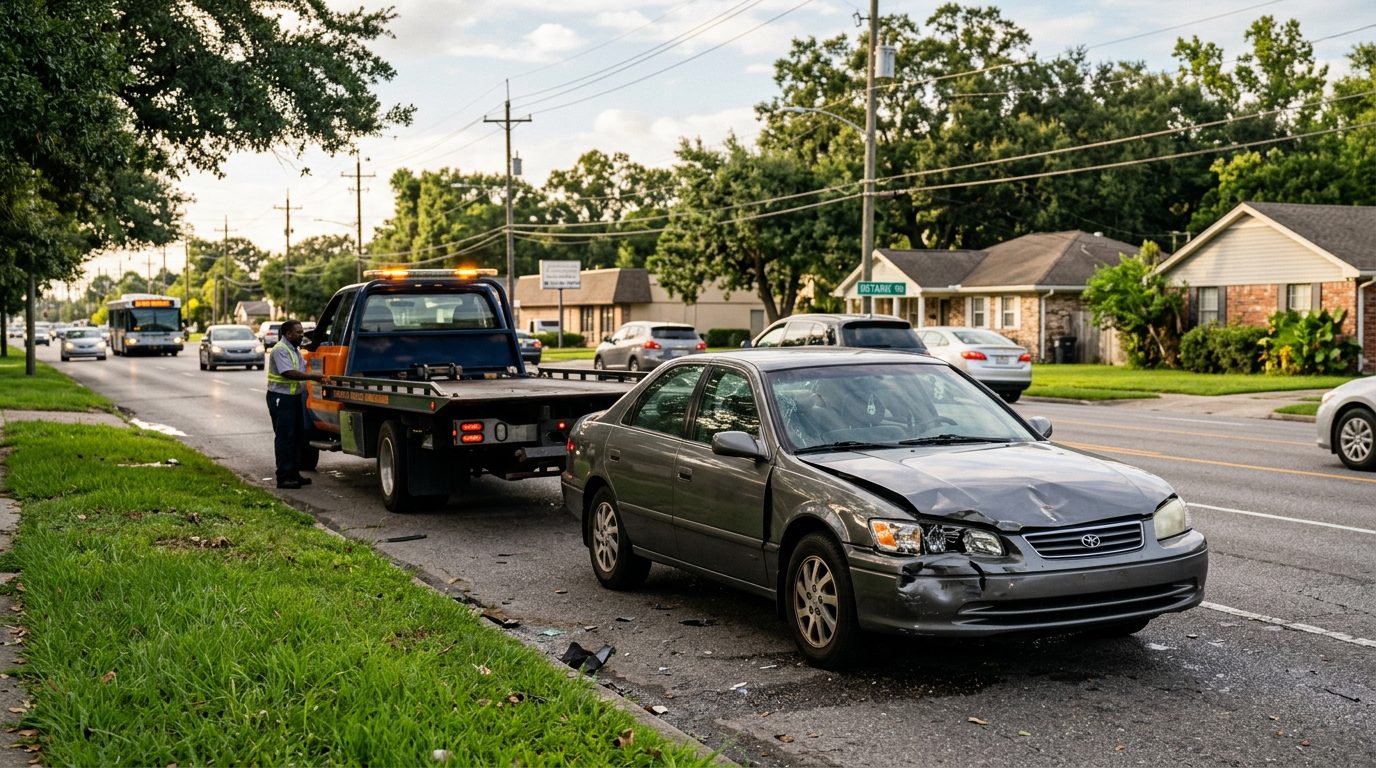
Car Accidents | New Orleans, Louisiana
Hurt in a Crash With an Ambulance, Police Car or Fire Truck?
These crashes raise questions that an ordinary fender-bender does not. Przemek Lubecki and our team at our New Orleans office can talk through what happened and what your options may be.
By Przemek Lubecki · Published November 14, 2026
A crash with an ambulance, police cruiser, or fire truck can leave you hurt and unsure what comes next. Many of these crashes can support a claim, but the steps often differ from an ordinary car crash.
Can You Make a Claim After a Crash Involving an Emergency Vehicle in New Orleans?
Yes, many crashes involving an emergency vehicle can support a claim, but the process may differ from an ordinary car crash. The three differences that matter most are public-entity rules, filing and notice steps, and records that come from an agency or dispatch center. American Trial Lawyer’s New Orleans office handles car accident claims, and Przemek Lubecki is the responsible lawyer for this page.
Medical care comes first. Asking about deadlines should not wait, because the clock on a Louisiana injury claim can start on the day of injury.
If an ambulance, police cruiser or fire truck was part of your crash, we can talk through whether a claim is possible and what to do next. Talk it through with our team — the first consultation is free, confidential, and carries no obligation.
What Vehicular Negligence Means When the Driver Was Responding to an Emergency
Vehicular negligence means a driver’s careless driving caused a crash and harm to someone else. Louisiana law says every person is responsible for damage caused by their negligence, imprudence, or want of skill (Louisiana Civil Code art. 2316). Anyone operating a motor vehicle on a public road must drive in a careful and prudent manner (La. R.S. 32:58).
An emergency driver is still a driver. That general duty to drive carefully applies, and whether it was met turns on the facts. Those facts often include speed, traffic signals, right of way, road conditions, and what the driver did in the seconds before impact.
Fault is often shared. Louisiana uses comparative fault. For crashes on or after January 1, 2026, a person found 51% or more at fault recovers no damages. A person found less than 51% at fault has damages reduced in proportion to their share (Louisiana Civil Code art. 2323).
A common mistake is assuming the emergency vehicle is automatically at fault, or automatically not. Neither is true by default. Write down what you saw and heard as soon as you can.
Why a Crash With a City-Owned or State-Owned Vehicle Is Handled Differently
When a government entity owns or operates the vehicle, the claim can involve public-entity rules that a private driver claim does not. Louisiana law says no suit against the state, a state agency, or a political subdivision can be brought in any court other than a Louisiana state court (La. R.S. 13:5106). That is one reason the choice of court matters.
Some policy and discretionary decisions by public entities are shielded from liability. Some policy and discretionary decisions by public entities or their officers and employees are shielded from liability when such acts are within the course and scope of their lawful powers and duties, but that protection does not cover acts or omissions not reasonably related to the legitimate governmental objective for which the power exists, or criminal, fraudulent, malicious, intentional, willful, outrageous, reckless, or flagrant misconduct (La. R.S. 9:2798.1). Employers can also answer for damage caused by employees while doing the work they were hired to do, but responsibility only attaches when the employer might have prevented the act which caused the damage and did not do it (Louisiana Civil Code art. 2320).
Ownership matters. An ambulance may be run by a city agency or a private company. Police and fire vehicles usually belong to the agency that operates them. Who owns the vehicle and who employed the driver shapes where a claim goes. These details turn on the entity and the facts. For more on claims against state and local bodies, see our government entity claims page.
Key Deadlines, Notice Rules, and How Long You Have to Act
For most Louisiana injury claims from a car crash, the general rule is two years. Delictual actions are subject to a two-year prescription that starts when the injury or damage is sustained (Louisiana Civil Code art. 3493.1). Some exceptions apply, so the timing for your case should be checked early.
Wrongful death has its own timing. A right of action for a death prescribes one year from the death or two years from the injury, whichever is longer, except that a medical malpractice action prescribes one year from the death (Louisiana Civil Code art. 2315.2).
Filing matters too. If a suit is filed in an incompetent court or improper venue, prescription is interrupted only as to a defendant served within the prescriptive period; if the court is competent but the venue is improper, prescription is suspended for seven days as to a defendant not served in time (Louisiana Civil Code art. 3462). Claims against public entities can add steps, so write down the date of the crash from day one.
Records That Matter After a Crash Involving Emergency Responders
The main records are the crash report, photos or video, and the details of everyone involved. Under Louisiana law, a driver in a crash causing injury or property damage over five hundred dollars must give their name, address, and vehicle registration number (La. R.S. 32:398). Subsection J of La. R.S. 32:398 concerns notification to the Department of Public Safety and Corrections, office of motor vehicles, when a law enforcement officer investigating a crash has reason to believe a medical condition exists that is cause for revocation or suspension of a license. It requires that the officer first consult with a superior officer about the specific observations, and that the superior officer concur with the issuing officer’s belief.
Police, sheriff’s, and state police offices must provide crash report copies for limited fees. The fee is capped at five dollars for a report of two pages or less, and at twenty dollars, inclusive of all service fees and other charges, for a longer report. Photos, video, and audio go to any interested person on request, for a reasonable fee. The agency that created a report owns its data.
Other records, such as 911 call logs and emergency medical run reports, may sit with different agencies and need separate requests. That split is one reason the process differs from an ordinary crash. Keep copies of medical bills, photos, witness names, and any letters from an agency or insurer.
Talk to Przemek Lubecki About Your Crash
The first steps are getting medical care, writing down what you remember, and being careful before giving a recorded statement to anyone. Medical records help show what injuries were found and when, so keep every visit documented.
Przemek Lubecki is the responsible lawyer for this page. The firm’s New Orleans office handles car accident, wrongful death, and related claims. This firm may associate or refer a case to other law firms.
Can I make a claim after a crash with an ambulance?
Many crashes involving an ambulance can support a claim, depending on the facts and who owned and operated the vehicle.
How long do I have to file a Louisiana car accident claim?
For most injury claims, the general rule is two years from the day of injury, and some exceptions apply (La. Civ. Code art. 3493.1).
Can I get a copy of the police crash report?
Yes, the police or sheriff’s office can provide copies for a fee set by La. R.S. 32:398.
If an ambulance, police cruiser, or fire truck was part of your crash, and you’re weighing whether to pursue a claim, you don’t have to sort out the public-entity steps alone. Call 855-LUBECKI (Office in New Orleans) or request a free case evaluation. The first consultation is free, confidential, and without obligation.
How We Approach an Emergency Vehicle Crash
Reviewing the Facts
We look at the crash scene, the vehicles involved and the circumstances of the emergency response, including what was happening at the time.
Focusing on Your Recovery
Serious injuries take time to heal. We keep your medical needs and your daily life at the center of every conversation.
Supporting Families
When a crash has changed a family's life, we take the time to explain each step in plain language.
Clear Communication
You will hear from us in plain language about where your case stands and what comes next.
Speak With a Lawyer Before Giving Statements
Insurance adjusters work for the insurance company, not for you. We may associate or refer a case to other law firms.
Helpful Steps After a Crash
Get Medical Care
Seek evaluation promptly, even if your injuries do not seem serious right away. Keep every appointment and record.
Keep Your Records
Save crash reports, photos, bills, prescriptions and notes about how you feel each day.
Note the Details
Write down what you remember about the crash, including the vehicles, the location and the people who were present.
Talk With Our Team
Przemek Lubecki and our team can review your situation in a free, confidential consultation with no obligation to continue.
Talk With Przemek Lubecki About Your Crash. The First Consultation Is Free, Confidential and Without Obligation.
Related practice areas
- Car Accident Claims in Orleans Parish
- New Orleans Car Accident: What to Say to the Other Driver