
Car Accidents | New Orleans, Louisiana
Hit in a Parking Lot? Here's What Comes Next
Low-speed crashes can still leave real damage, real injuries and real questions. Here is how to protect yourself and your claim from the first minutes after the impact.
By Przemek Lubecki · Published November 21, 2026
You come back to your car and find a fresh dent, a scrape, or a note under the wiper. When another driver hits your parked car in a parking lot, it can leave you with questions about what to do next.
In short, a parking lot crash is still a car crash. If another driver’s fault caused the damage, Louisiana law says that driver must repair it (La. Civ. Code art. 2315). The steps below cover what to do at the scene, when small damage is worth reporting, and when a claim needs a closer look.
Why a parking lot crash still counts as a car accident
A crash in a parking lot or garage is still a collision between vehicles, so the same core questions apply. Who caused the damage? What will it cost to fix? Was anyone hurt?
Louisiana law makes a person responsible for the damage they cause through negligence, which means carelessness, imprudence, or lack of skill (La. Civ. Code art. 2316). In a lot, fault often turns on small details. Who was backing out? Who had room to move? Were there painted lines or signs that mattered?
Those facts decide responsibility. They are easiest to pin down while the scene is still fresh. Photos, a police report, and the names of anyone who saw the crash all help. Waiting until the cars are gone makes each of those harder to get.
If your parked car was hit and an insurer's calls or a new ache have you unsure what comes next, our team is glad to talk it through with you. Talk it through with our team — the first consultation is free, confidential, and carries no obligation.
What to do if someone hits your parked car and leaves a note
A note on your windshield gives you a name or phone number to start with. It does not prove who was driving.
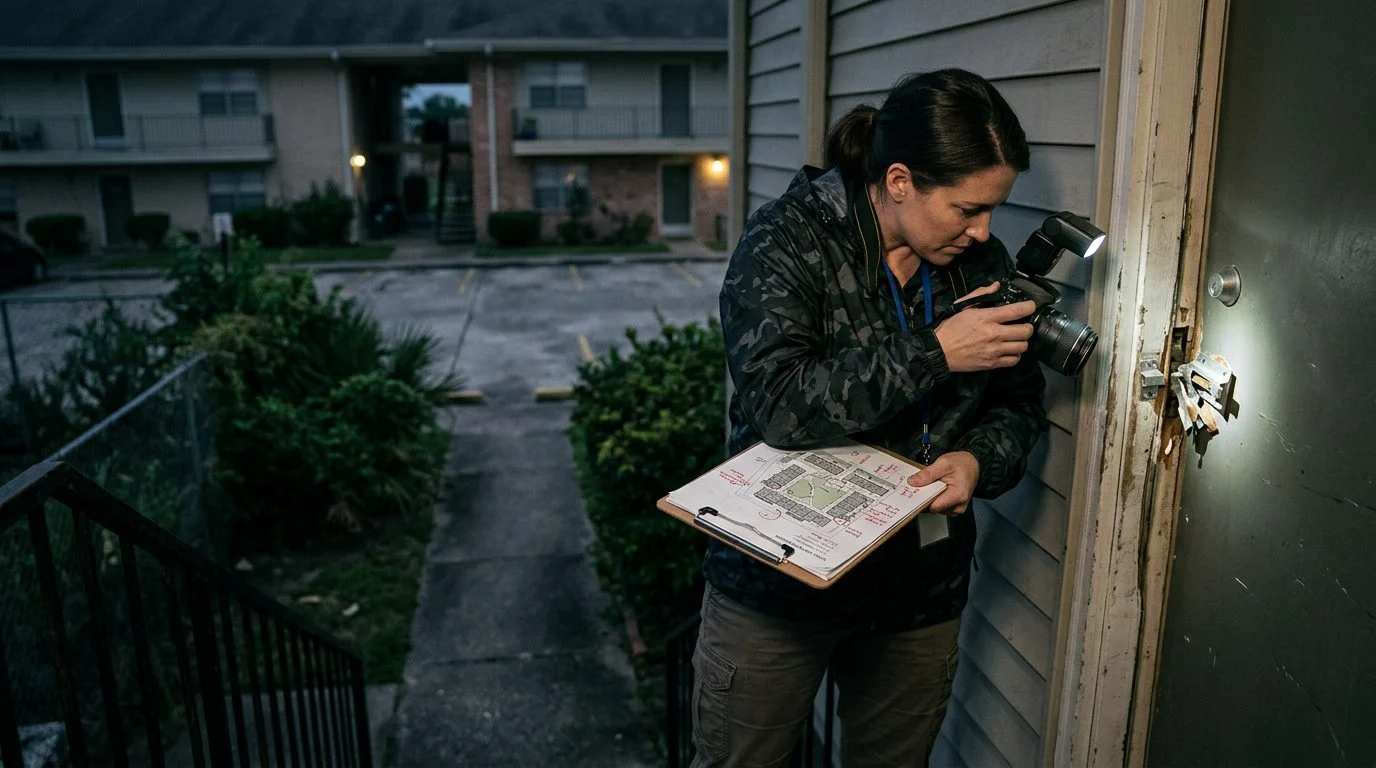
Photograph the note before you touch it. Then photograph the damage, the spot where your car sat, the lines and signs around it, and nearby cars. Wide shots show the layout. Close-ups show the damage.
Ask nearby businesses whether their cameras cover the lot. Many camera systems record over older footage on a schedule, so ask soon, not next week.
Call the police, even if a note was left. Police investigate crashes inside city limits, and state police or the sheriff’s office handle crashes outside them (La. R.S. 32:398). Under La. R.S. 32:398, the driver of a vehicle involved in a crash that causes injury or death, or property damage in excess of five hundred dollars, must give the other party their name and address and the vehicle’s registration number, and must show a license or permit on request if one is available. If the crash occurs in a geographical area under an order of evacuation by a competent authority, or is under a declared state of emergency, the driver must comply with the requirements of Paragraphs (1) and (2) of that Subsection within seventy-two hours after the crash occurs. Keep a written log of every call, date, name, and report number.
Steps to take right away after a parking lot collision
Check for injuries first. If anyone feels hurt, even a little, say so and ask for medical help. Then move both cars out of traffic lanes if it’s safe to do so.
Call the police if anyone is hurt, if a driver leaves, or if the damage looks significant. Ask the officer for the report number. The investigating officer must instruct each driver to report the vehicle’s liability carrier, and the insurance agent who procured the policy with that agent’s name, address, and telephone number, to all parties suffering injury or property damage as an apparent result of the crash (La. R.S. 32:398).
Exchange names, phone numbers, insurance details, and plate numbers. Note the other car’s make, model, and color. Take wide and close-up photos.
Crash reports are confidential and are made available only to the parties to the crash, their insurers and attorneys, and a few other listed groups.
Don’t sign a statement admitting fault at the scene. Don’t accept a cash offer until you know what the repairs will cost.
Is minor damage to a parked car worth reporting?
Reporting small damage is worth the few minutes it takes. A report and saved photos create a record while the scene is still clear.
A scratch can look like nothing and still cost money to repair. Some damage hides behind the surface. Bumpers, parking sensors, lights, and mounting brackets can be harder to see than they look, and the real cost often shows up on a repair estimate. Paint transfer from the other car is another clue.
Keep the photos and the estimate even if you decide not to file right away. The damage may look larger later.
How a claim might affect your premiums depends on your policy and your insurer’s rules. Ask your insurer how it treats a claim like this before you file.
Injuries that can appear after a low-speed parking lot impact
Some people feel fine at the scene. Then they notice neck, back, or shoulder pain hours or days later.
A bump that felt minor can still leave you sore. See a medical provider after any new pain, even if it seems mild. Keep records of visits, prescriptions, and time missed from work.
Head injury symptoms need prompt evaluation. These include headache, dizziness, confusion, and memory trouble. If you notice them, get checked right away. You can read more about brain injury.
If you have Medicare, its rules apply. Medicare pays secondary to no-fault or liability insurance for accident-related care. It may make a conditional payment that must be repaid from a later settlement (CMS, Medicare secondary payer overview).
How insurance and fault usually come into a parking lot claim
Insurers usually start by asking who was at fault. Louisiana uses a modified comparative fault rule, and that rule can matter in a lot claim (La. Civ. Code art. 2323).
For accidents on or after January 1, 2026, a person whose own negligence is found to be 51% or more of the fault recovers no damages, unless the injury, death, or loss resulted partly from his own negligence and partly from the fault of an intentional tortfeasor, in which case his claim for recovery of damages is not reduced (La. Civ. Code art. 2323). A person found less than 51% at fault has damages reduced in proportion to their share (La. Civ. Code art. 2323). Shared fault can change the result, so the facts matter.
Your own collision coverage, if you carry it, can pay for repairs to your car through your own insurer. The other driver’s liability coverage applies to damage that driver caused.
A settlement for property damage under a vehicle liability policy is not an admission of liability for other claims from the same accident (La. R.S. 22:1290).
If the other driver has no insurance, your own uninsured motorist coverage may apply. Under La. R.S. 22:1295, where an automobile policy does not afford collision coverage and the named insured has not rejected uninsured motorist coverage, property damage coverage for an uninsured motor vehicle is subject to a deductible of two hundred fifty dollars for any one accident. On the named insured’s written request, the insurer must provide coverage in the amount of the vehicle’s actual cash value or the minimum property damage liability amount required by law, whichever is less, and this coverage does not provide protection for loss of use of a motor vehicle or for damages which are paid or payable under any other property insurance. It also generally does not cover damage without actual physical contact between the vehicles, unless the statute’s witness exception applies. La. R.S. 22:1295 reads: “(i) Damage where there is no actual physical contact between the covered motor vehicle and an uninsured motor vehicle, unless the injured party can show, by an independent and disinterested witness, that the injury was the result of the actions of the driver of another vehicle whose identity is unknown or who is uninsured or underinsured.”
Before you give a statement about fault or injuries, know your rights. Under La. R.S. 13:3732, a person who takes a written, recorded, or transcribed statement from an injured person must furnish the person who made it a true and complete copy, but no more than two copies are required. Any person who has taken or has possession of such a statement or a copy must, on written demand by the person who made it, furnish a true and complete copy within twenty days. If a person with possession of the statement refuses that request, the statement cannot be admitted in evidence or otherwise used in a civil action relating to its subject matter.
Not sure what your next step is?
Talk it through with our team — the first consultation is free, confidential, and carries no obligation.
When a parking lot claim needs a closer look
A parking lot claim needs a closer look when someone is hurt, fault is disputed, or the other driver cannot be identified.
Louisiana’s general deadline for delictual (tort) actions is two years from the day the injury or damage is sustained (La. Civ. Code art. 3493.1). Certain claims under uninsured motorist provisions also run two years from the accident (La. R.S. 9:5629). The Louisiana claim deadline guide covers the general rules, and the Orleans Parish car accident claims page gives a broader overview.
Is a parking lot crash a car accident in Louisiana?
Yes. A crash between vehicles in a parking lot is still a car accident, and fault and damage questions still apply.
What if the driver who hit my car left a note and can’t be found?
Keep the note, the photos, and the police report number. Remember that the general two-year deadline still applies (La. Civ. Code art. 3493.1).
Do I have to give a recorded statement?
Louisiana law gives you the right to a copy of a written or recorded statement you gave after an injury, within twenty days after written demand.
Przemek Lubecki is the responsible lawyer for this page. The firm’s office is in New Orleans. The initial consultation is free, confidential, and without obligation to continue. This firm may associate or refer a case to other law firms.
If your parked car was hit and an insurer’s calls or a new ache have you unsure what comes next, you can request a free case evaluation or call 855-LUBECKI.
How our team approaches parking lot crashes
Your health comes first
Some injuries show up hours or days after a crash. We encourage you to get checked by a medical provider and to keep records of every visit.
Clear records of what happened
Photos, witness names, the other driver's details and any police report number help explain how the crash occurred.
Plain-language answers
We explain your options in everyday terms so you can make decisions with confidence.
Protecting your interests
Insurance adjusters may contact you quickly. We can handle those conversations so you can focus on recovering.
Be careful what you sign or say
Before you give a recorded statement, sign a release or accept an offer from an insurance company, talk with a lawyer. Once you agree to a settlement, it can be hard to reopen the matter.
Steps to take after a parking lot crash
Check for injuries
Call for medical help if anyone is hurt, even if the injuries seem minor at first.
Document the scene
Take photos of both vehicles, the location, nearby signs and any damage, from several angles.
Exchange information
Get the other driver's name, insurance details, license plate and contact information. Ask for witnesses too.
Report the crash
Contact the police and keep the report number. If the driver left the scene, write down everything you remember right away.