
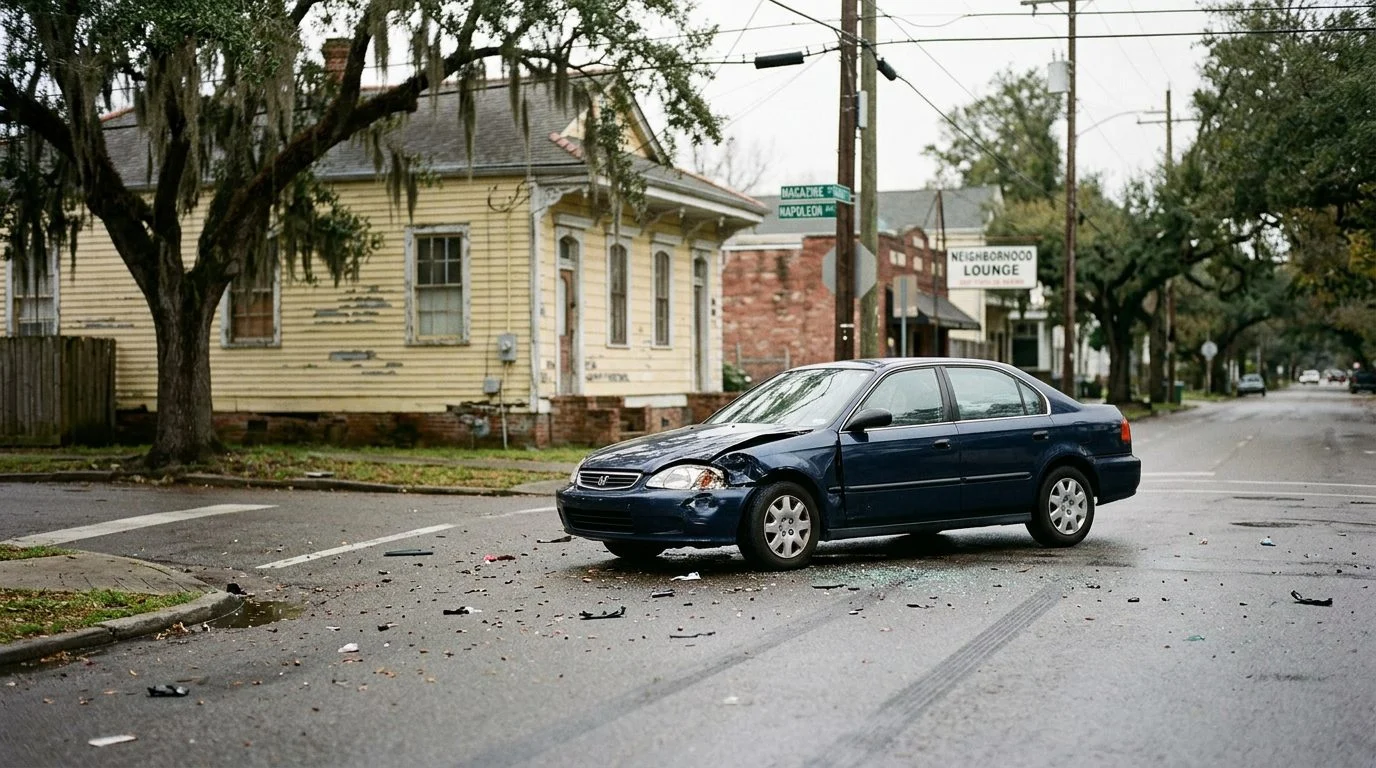
Louisiana drunk driver crashes | New Orleans
Hurt by an Impaired Driver? Learn Who May Be Held Responsible
Przemek Lubecki and the New Orleans office help families understand their options after impaired-driving crashes across Louisiana.
By Przemek Lubecki · Published November 15, 2026
If a driver who had been drinking hit you or a family member, you may be asking whether the bar that served that driver can be held responsible. In Louisiana, a seller can be sued after a drunk driving crash, but only in narrow cases that state law sets out.
Most of these claims start with the driver. The claim against a seller turns on specific facts, so the details matter a great deal.
Can a Bar Be Held Liable for a Drunk Driver’s Crash in Louisiana?
Sometimes, but the rule is narrow. Under Louisiana law (R.S. 9:2800.1), a licensed seller of alcohol that serves a person of lawful drinking age is not liable for injuries suffered off the premises because of that person’s intoxication. La. R.S. 9:2800.1 sets out this protection for permit holders, their employees, and social hosts.
The driver stands in a different position. Under La. Civ. Code art. 2315, a person whose fault causes damage to another must repair it. Article 2316 adds that a person is responsible for harm caused by negligence, imprudence, or want of skill. A driver who crashed while intoxicated can face a claim under these general rules. A claim against the seller is a separate and more limited question.
If a driver who had been drinking hurt you or someone you love, you may wonder whether the bar that served them shares responsibility. We're glad to talk through the facts with you. Talk it through with our team — the first consultation is free, confidential, and carries no obligation.
How Louisiana Law Treats Intoxication and Off-Premises Injuries
La. R.S. 9:2800.1 states that the legislature finds that the consumption of intoxicating beverages, rather than the sale or serving or furnishing of such beverages, is the proximate cause of injury inflicted by an intoxicated person, and it limits certain sellers’ and social hosts’ liability for such injuries, subject to the exceptions stated in the section. Louisiana’s statute treats drinking alcohol, not selling or serving it, as the cause of injuries an intoxicated person causes. The statute starts with a finding. It says that drinking, not selling or serving, is the proximate cause (the legal cause) of harm an intoxicated person inflicts.
The protection has clear limits. Subsection B covers service to a person “over the age for the lawful purchase” of alcohol. It also covers only injuries suffered off the premises. A claim involving service to a minor, or an injury on the premises, does not fit that shield.
Subsection E removes the protection from anyone who causes or contributes to drinking by force. It also does not protect someone who falsely says a drink has no alcohol.
Why These Claims Are Narrow and Fact-Specific
Who was served, how old that person was, where the drinks were served, and when they were served all matter.
Evidence often includes receipts or tab records, a timeline of drinking, and witness accounts of how the driver looked and acted. Crash records and medical records can also show the timing of events.
Crash reports are a key source. Under La. R.S. 32:398, crash reports are confidential. Only the parties, parents or guardians of a minor party, their attorneys, their insurers or insurance support organizations under contract to provide claims and underwriting, their healthcare providers or agents, succession representatives, and news-gathering organizations that request documents related to a specific crash can get them. Upon request, a report must be made available within seven working days after the investigation is complete. Police may charge no more than five dollars for a report of two pages or less, and no more than twenty dollars, including all service fees, for a longer one.
The fact that a drunk driver caused a crash does not, by itself, show that a bar is responsible.
Who Can Be Named in a Claim
The driver who caused the crash is the most direct party to a claim. Under La. Civ. Code art. 2315.4, exemplary damages (extra damages meant to punish) may be awarded. That requires proof that the driver’s intoxication was a cause of the injuries and that the driver showed wanton or reckless disregard for others’ safety.
Under La. R.S. 9:2800.1(D), the insurer of the intoxicated person is primarily liable for injuries to third persons.
When more than one person is at fault, each generally answers for its own share. Article 2324(B) says that, if liability is not solidary under Paragraph A (conspiracy with another person to commit an intentional or willful act), a joint tortfeasor (a person who shares fault for the same harm) is not liable for more than its own degree of fault.
Louisiana also uses comparative fault. Under La. Civ. Code art. 2323, as amended in 2025, damages are reduced in proportion to the injured person’s own fault. A person who is 51 percent or more at fault cannot recover damages.
Deadlines and Why Timing Matters
Louisiana generally gives two years to file a delictual (tort) action. Under La. Civ. Code art. 3493.1, that two-year period, called prescription, starts on the day the injury or damage is sustained.
Other rules can change how the deadline runs. For that reason, write down the crash date and keep it with your records from the start.
Waiting can also make the case harder to build. Receipts, video, and witness memories can be harder to get as time passes. Early review of the facts helps protect that evidence.
Injuries That Can Appear Days After a Crash
Some injuries do not cause clear symptoms right away. Neck and back pain can appear hours or days after a serious crash. A medical evaluation after any crash supports your health and creates a record of what happened.
Keep copies of every visit, referral, and prescription. Those records help show how an injury developed over time.
Our page on delayed neck and back pain after a car accident explains how these symptoms can show up later. For more on car accident claims in Orleans Parish, see car accident claims in Orleans Parish.
Not sure what your next step is?
Talk it through with our team — the first consultation is free, confidential, and carries no obligation.
Talk With Przemek Lubecki About Your Crash
If a driver who had been drinking hit you or a family member, a free consultation can help you sort out whether the seller might share responsibility. Przemek Lubecki is the responsible lawyer for this page.
To talk about your crash, call 855-LUBECKI (Office in New Orleans) or request a free case evaluation. The first consultation is free, confidential, and without obligation to continue.
American Trial Lawyer, LLC may associate or refer a case to other law firms. No outcome is promised for any case.

Frequently Asked Questions
Can I sue the drunk driver who caused my car accident in Louisiana?
Yes. A driver who causes a crash while impaired can generally be held responsible for injuries and losses caused by their negligence. Your options depend on the facts of your crash, and a consultation with the firm’s New Orleans office can help you understand them.
Can I sue the bar or business that served the driver?
The firm’s initial consultation is free, confidential, and without obligation to continue.
How long do I have to file a lawsuit after a drunk driving crash in Louisiana?
Louisiana sets filing deadlines for injury claims, and the general deadline is two years from the date of injury. Deadlines can be affected by the facts of a case, so it is important to act promptly.
Can I still recover compensation if I was partly at fault for the crash?
Under Louisiana’s comparative fault rule, an injured person’s damages are generally reduced in proportion to his or her own share of negligence, and someone whose own negligence is found to be 51 percent or more is generally barred from recovering. There are exceptions, such as when another party acted intentionally. The firm may associate or refer a case to other law firms, and you can contact the New Orleans office to discuss your situation.
Parties That May Be Part of an Impaired-Driving Case
The impaired driver
The person who was driving under the influence is often the first party people think of, and the facts of the crash guide what comes next.
Establishments that served alcohol
In some situations, a bar, restaurant or other business that served alcohol may be part of the picture. Whether it is involved depends on the specific facts.
Vehicle owners
Who owned or controlled the vehicle can matter, particularly when the driver was not the owner.
Employers and commercial operators
When an impaired driver was working, driving a company vehicle or on the job, the employer's role may need to be reviewed.
Please Note
Every crash is different, and the information on this page is general. It is not a promise of any particular result. The firm may associate or refer a case to other law firms.
What to Bring to Your Consultation
Crash details
Date, location, police report number and the names of everyone involved, if you have them.
Evidence of impairment
Any citations, arrest information, witness names or photos that relate to the driver's condition.
Your losses
Medical records, bills, repair estimates, and notes about lost work or daily activities.
Insurance information
Policy details and any letters or claim numbers from insurers involved in the crash.