
Wrongful Death | New Orleans, Louisiana
When a Shooting at an Apartment Takes a Loved One, Families Deserve Answers
Przemek Lubecki, a New Orleans trial lawyer, represents families in wrongful death cases arising from shootings on residential property. Office in New Orleans. Serving Orleans Parish, the New Orleans metro and Louisiana.
By Przemek Lubecki · Published October 31, 2026
When a Shooting on Private Property Leads to a Wrongful Death Claim
A family may have a claim against a property owner or manager when a deadly shooting on the property was linked to a failure to take reasonable steps to keep people safe.
If you’re asking whether a family can sue an apartment complex after a shooting death in New Orleans, it’s a fair question. Losing someone suddenly is painful, and many questions come before any decision feels clear.
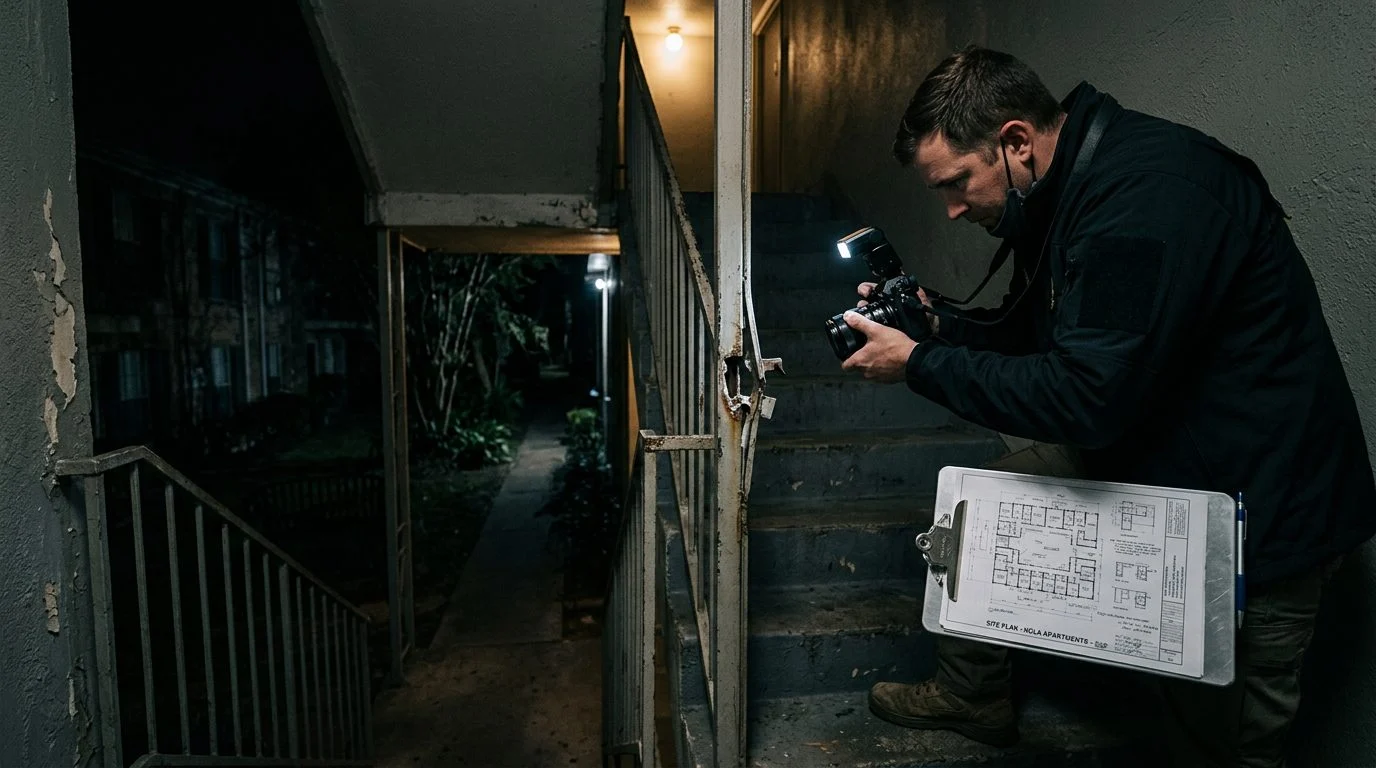
A negligent security claim says the property’s own failures helped make a violent act possible. Examples include broken locks, dark parking areas, or ignored reports of crime. The shooter’s own conduct is a separate question. A claim against the property focuses on what the owner or manager knew and did.
These claims often arise after shootings or assaults at apartment complexes, hotels, parking lots, and other private premises in New Orleans and Orleans Parish. Each claim turns on its own facts. This page explains the framework, but no outcome can be predicted from general information.
If someone you love died in a shooting on private property, you may have questions about who is responsible, and our team can talk them through with you. Talk it through with our team — the first consultation is free, confidential, and carries no obligation.
What a Family Typically Has to Show in a Negligent Security Case
Questions in a negligent security matter often concern what steps a property took to address security risks.
Louisiana’s general negligence rule makes a person responsible for damage caused by “his negligence, his imprudence, or his want of skill” (La. Civ. Code art. 2316). In a security case, that idea usually breaks into four questions:
- Duty: Did the owner or manager owe people on the property a duty to take reasonable precautions?
- Warning signs: Were there earlier break-ins, assaults, police calls, or resident complaints that put the owner on notice?
- Precautions: Were locks, gates, lighting, entry controls, cameras, or patrols in place, working, and kept up?
- Causation: Did the lack of reasonable security connect to the act that caused the death?
Responsibility can be shared. Louisiana’s comparative fault rule looks at the fault of everyone who contributed, including the assailant, owner, manager, or security contractor (La. Civ. Code art. 2323). Under the joint liability rule, a party generally answers only for its own degree of fault, but one who conspires with another person to commit an intentional or willful act is answerable, in solido, with that person, for the damage caused by such act (La. Civ. Code art. 2324).
Who Can File a Wrongful Death Lawsuit in Louisiana
Under Louisiana law, certain surviving family members may file a wrongful death suit, and the law sets out who they are in order (La. Civ. Code art. 2315.2).
- The surviving spouse and child or children.
- The surviving father and mother, or either of them, if the person left no spouse or child. A father or mother who abandoned the deceased during his minority is deemed not to have survived him.
- The surviving brothers and sisters, if the person left no spouse, child, or parent.
- The surviving grandfathers and grandmothers, if the person left no spouse, child, parent, or sibling.
Adoptive relationships count under the same article.
Two claims are often discussed together. A wrongful death claim covers the survivors’ own losses.
Deadlines matter. The wrongful death right of action prescribes one year from the death or two years from the injury, whichever is longer (La. Civ. Code art. 2315.2). Bring family relationships and the date and place of the incident to your consultation.
Damages a Family May Pursue After a Death
Families may seek losses tied to the death and, in some cases, the person’s own suffering before death.
Louisiana law lets damages include loss of consortium, service, and society. Those damages are recoverable by the same categories of people who may bring a wrongful death claim (La. Civ. Code art. 2315).
The review also looks at losses connected to the death. Damages do not include costs for future medical treatment, services, surveillance, or procedures of any kind unless such treatment, services, surveillance, or procedures are directly related to a manifest physical or mental injury or disease (La. Civ. Code art. 2315).
Louisiana law also leaves much discretion to the judge or jury in assessing damages (La. Civ. Code art. 2324.1). No amount can be predicted from general information like this.
Evidence and Records Families Should Start Gathering
Start with the police report number, the lease or property rules, and any record of earlier incidents at the property. Hold off on posting details publicly until you’ve talked with a lawyer.
- Police reports: Keep the report number, the responding agency, and any later supplemental reports.
- Property papers: Keep the lease, rental agreement, property rules, and any written security promises made to residents or guests.
- Prior incidents: Record complaints, police calls, break-ins, or violent incidents at the property. These can show what the owner knew.
- Scene evidence: Save photos and video of the lighting, gates, locks, and entrances, plus any surveillance footage the family knows exists.
- Witnesses and messages: Write down names and contact details for witnesses and neighbors. Keep texts, emails, or social media posts about the property’s security.
- Medical and funeral papers: Keep them together. Louisiana Department of Health coroners resource states the Bureau of Family Health does not release autopsy or other death-investigation records.
How a Negligent Security Wrongful Death Case Usually Moves Forward
Most cases move through a consultation, an investigation, a claim to the responsible parties, and, if needed, a lawsuit.
- Consultation. The family shares the facts, and the lawyer reviews questions about the property’s security and who may bring a claim.
- Investigation. Evidence is preserved, reports and records are requested, and the owner, manager, and any security provider are identified.
- Claim. The claim is presented to the responsible parties and their insurers, followed by settlement talks where appropriate.
- Lawsuit. If the claim cannot be resolved, a suit may be filed in the proper Louisiana court.
- Litigation. Documents are exchanged, witnesses may be questioned under oath, and motions are filed. Outside reviewers, such as security or medical professionals, may be consulted. This stage can take months or longer.
Timing is the reason to move early. Some claims tied to a crime of violence carry a two-year deadline (La. Civ. Code art. 3493.3). Ask about timing early, because deadlines can be short.
Not sure what your next step is?
Talk it through with our team — the first consultation is free, confidential, and carries no obligation.
Why Families Work With American Trial Lawyer
American Trial Lawyer is a trial law firm with its office in New Orleans, Louisiana. Przemek Lubecki is the responsible lawyer for this page.
- Responsible lawyer: Przemek Lubecki, a trial lawyer, handles wrongful death and negligent security matters.
- Office: The firm’s office is in New Orleans. It serves people in Orleans Parish and the New Orleans metro area from that office.
- First consultation: The first consultation is free, confidential, and carries no obligation to continue.
- Referrals: The firm may associate or refer a case to other law firms. If that happens, the family would be told.
Common Questions About Negligent Security Wrongful Death Claims
Can a family sue an apartment complex after a shooting death in New Orleans?
A family may be able to bring that claim when security failures at the property are linked to the death. Each claim is reviewed on its own facts.
Can we sue if the shooter was never caught or charged?
A civil claim is separate from any criminal case.
Ask about timing early.
Will we have to go to court?
Some claims settle before trial. Others move forward through a lawsuit, so families should be prepared for that possibility.
What does the free consultation involve?
The consultation is free and confidential, with no obligation to continue. It gives your family a chance to share the facts and ask questions.
Talk With Przemek Lubecki About Your Family’s Situation
You may be reading this for someone you lost, in the middle of a situation you never expected. The decision in front of you is whether the property’s security and the death raise questions worth reviewing before any deadline passes. If that’s your situation, you can request a free case evaluation or call 855-LUBECKI for a free consultation at the New Orleans office of Przemek Lubecki.
How We Approach These Cases
Focus on security
We look at whether locks, lighting, gates, cameras and patrols at the property were adequate for the risks known to the owner and manager.
Review the records
Leases, prior police reports, maintenance requests and past complaints about crime on the property can reveal what the owner knew.
Care for the family
Losing someone in a violent act is devastating. We explain each step in plain language so families can focus on one another.
Respect for your loss
Every case involves a real person. We approach each family with patience, honesty and respect.
Act Early to Protect Evidence
Security camera footage, incident reports and witness names can be lost or overwritten over time. Contacting a lawyer early can help preserve what matters for your family's case.
Questions Families Often Ask
Can a family sue an apartment complex after a shooting death?
A family may be able to bring a claim when security failures at the property are linked to the death. Each claim is reviewed on its own facts.
Does the shooter need to be caught or charged?
A civil claim is separate from any criminal case. Families can ask about their options even if no one has been arrested or charged.
Who might be part of a review?
Depending on the facts, property owners, management companies and security contractors may all be part of an investigation.
How may our case be handled?
Przemek Lubecki and American Trial Lawyer may associate or refer a case to other law firms when that serves the family. Any such arrangement is discussed with you.