
Wrongful Death | New Orleans, Louisiana
When a Trucking Company's Decisions Lead to a Loss, Families Deserve Answers
Przemek Lubecki and the American Trial Lawyer team represent families in Louisiana wrongful death cases that involve trucking companies, including claims that a company failed to properly hire, screen, train or supervise the driver. Our office is in New Orleans.
By Przemek Lubecki · Published October 26, 2026
Trucking company negligent hiring wrongful death claims in Louisiana look at the carrier’s own decisions, not only the driver’s mistakes. When a commercial truck crash causes a death, the company’s choices about who drives, how drivers are checked, and how long they can drive may matter. This page explains those ideas in plain language. American Trial Lawyer, LLC has its office in New Orleans, and Przemek Lubecki is the responsible lawyer for this page.
What a Negligent Hiring or Driver Fatigue Wrongful Death Claim Is
A wrongful death claim is a suit brought by certain family members after someone dies because of another person’s fault. Louisiana law says every person is responsible for damage caused by negligence, imprudence, or want of skill (La. Civ. Code art. 2316). That general rule is why a company’s own careless decisions can become part of a claim.
This page is written for families in the weeks after a death. You may be asking whether a claim is possible at all. You may be reading a crash report that raises questions you did not expect.
Louisiana sets time limits for these claims. They can run from the date of death or the date of injury. Because of that, it helps to raise timing questions early.
If a truck crash has left your family facing a sudden death, you do not have to sort out the questions alone. The first consultation is free, confidential and without obligation. Talk it through with our team — the first consultation is free, confidential, and carries no obligation.

Negligent Hiring, Retention, Supervision and Entrustment Explained
Several related ideas also describe the company’s own fault.
- Negligent hiring: the company did not check a driver’s record, qualifications or fitness before hiring.
- Negligent entrustment: the company gave a vehicle to a driver it knew, or should have known, was unfit.
Federal rules offer a benchmark for what a carrier should check. Under 49 C.F.R. § 391.51, each motor carrier must keep a driver qualification file. Under 49 C.F.R. § 391.21, a person may not drive a commercial motor vehicle unless he or she has completed and furnished the motor carrier that employs him or her with an application for employment that meets the section’s requirements.
Records worth asking about include prior incident reports, drug and alcohol testing records, and training documents.
Driver Fatigue, Hours-of-Service Rules and Electronic Logging Records
Federal rules limit driving time and require rest, and carriers must track whether drivers follow them. Fatigue is a safety issue for drivers and companies alike.
Under 49 C.F.R. § 392.3, no driver may operate a commercial motor vehicle when fatigue, illness, or any other cause impairs, or is likely to impair, his or her ability or alertness so as to make it unsafe. A motor carrier may not require or permit that.
The hours limits appear in 49 C.F.R. § 395.3. A driver may not drive without first taking 10 consecutive hours off duty. Under 49 C.F.R. § 395.3(a)(3)(ii), driving is not permitted if more than 8 hours of driving time have passed without at least a consecutive 30-minute interruption in driving status, except for drivers who qualify for either of the short-haul exceptions in § 395.1(e)(1) or (2).
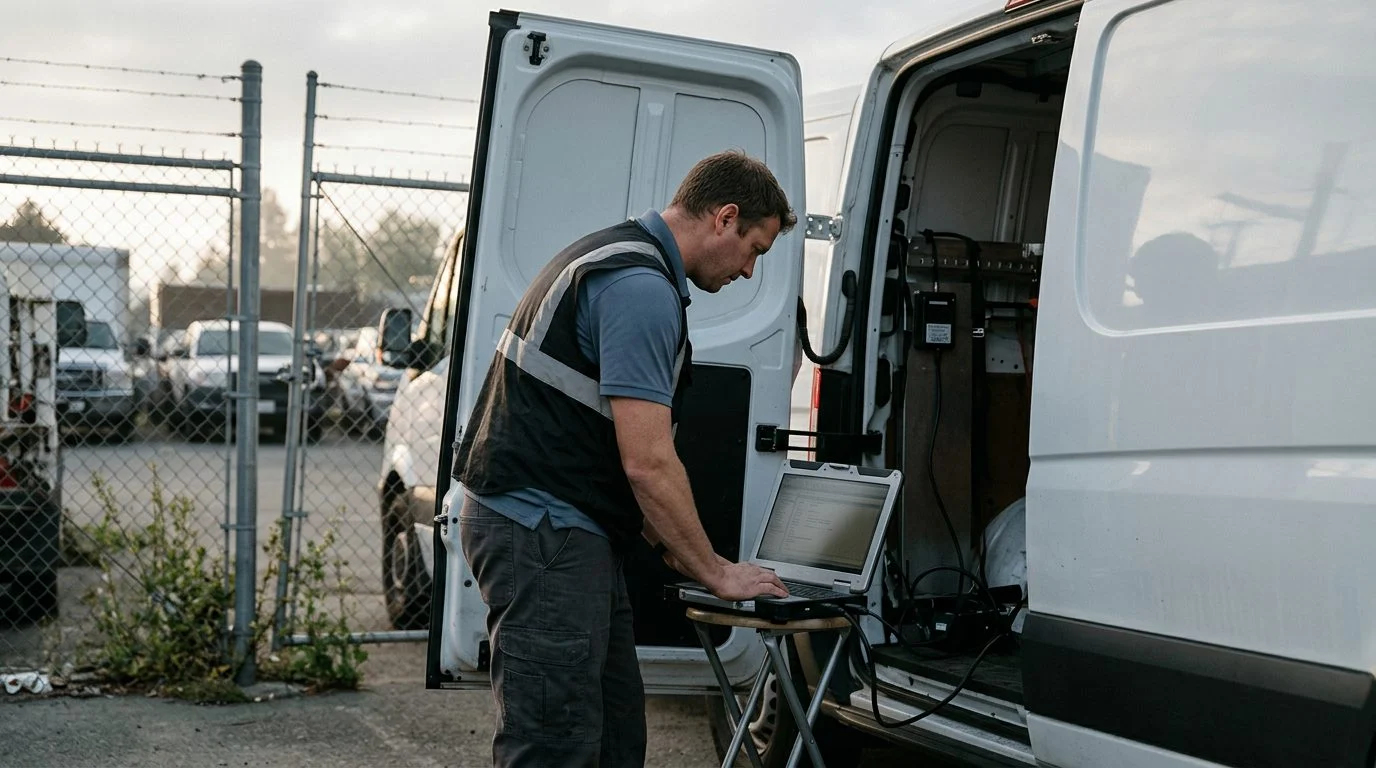
Electronic logging devices, or ELDs, record much of this. Under 49 C.F.R. § 395.8, carriers must keep these records for at least six months from the date they receive them. An ELD automatically records items such as date, time, location, engine hours and vehicle miles (49 C.F.R. § 395.26).
Dispatch records and load assignments can also show how much driving a company planned. Asking for these records early helps make sure they are kept.
Vicarious Liability and Direct Claims Against a Trucking Company in Louisiana
Vicarious liability holds an employer answerable for an employee’s wrongful acts. A direct claim targets the company’s own fault.
Under La. Civ. Code art. 2320, masters and employers are answerable for damage their servants cause while doing their jobs. The same article says responsibility attaches only when the employer might have prevented the act and did not.
Whether a company admits the driver was working for it can change how a case is presented. That point turns on the facts and the court’s rulings. Other parties, such as a vehicle owner or maintenance contractor, may also be involved in some crashes.
Who Can Bring the Claim and What It May Seek
Under Louisiana law, certain surviving relatives may bring a wrongful death suit. La. Civ. Code art. 2315.2 sets the order:
- A surviving spouse and child or children, or either of them.
- A surviving father and mother, if there is no spouse or child.
- Surviving brothers and sisters, if there is no spouse, child or parent.
- Surviving grandfathers and grandmothers, if there is no spouse, child, parent or sibling.
Adoptive relatives are included. The time limit is one year from the death or two years from the day the injury was sustained, whichever is longer.
For injuries the person suffered before dying, a survival claim may exist. Under La. Civ. Code art. 2315.1, the claim for those damages survives in favor of the classes of relatives listed in paragraph A, within the period set out in the article, and if no class of beneficiary exists, the succession representative may urge it under paragraph B.
The damages a family may seek depend on the facts and the law that applies. Fault rules can also affect recovery, so the facts of each crash matter. No outcome can be predicted at the start.
What to Expect: Steps and Timeline
The process usually begins with a free first consultation, followed by evidence requests and investigation.
- First consultation. The first consultation is free, confidential and without obligation to continue. You can share the crash details, the death and your questions.
- Evidence requests. Letters can ask for records of duty status and supporting documents, which carriers must retain for not less than 6 months from the date of receipt, while that retention period is running.
- Investigation. The review can include the crash report, records and, where appropriate, input from accident reconstruction professionals.
- Evaluation. Before any suit, the lawyer reviews liability and damages and discusses how the family wants to proceed.
- Filing. If a suit is filed in a Louisiana court, the case moves through discovery, the exchange of records and sworn testimony. Motions, trial or settlement may follow.
These cases can take many months, and sometimes longer. Timing varies with the court’s calendar and the evidence.
Not sure what your next step is?
Talk it through with our team — the first consultation is free, confidential, and carries no obligation.
Why Families Work With American Trial Lawyer
American Trial Lawyer, LLC has its office in New Orleans. Przemek Lubecki is the responsible lawyer for this page.
- Service area. The firm serves Orleans Parish, the New Orleans metro area and Louisiana, including Jefferson Parish, Metairie, Kenner, St. Bernard Parish and Slidell.
- Trial focus. Przemek Lubecki is a trial lawyer. Evidence such as hiring files and hours-of-service logs can be important in evaluating a crash claim.
- Plain language. The firm aims to explain each step in words that do not require legal training.
- Other law firms. The firm may associate or refer a case to other law firms.
Frequently Asked Questions
Can we sue the trucking company if the driver was not at fault?
A direct claim against the company over its own hiring, supervision or dispatch decisions may be possible, depending on the facts of each case and what the evidence shows.
Can a driver’s record support a negligent hiring claim?
What is the difference between negligent hiring and negligent supervision?
Negligent hiring looks at what a company checked before putting a driver on the road. Negligent supervision looks at what it did to monitor the driver afterward.
What if the driver was over the hours-of-service limit but the company says it did not know?
Company knowledge is one question. ELD data and dispatch records can show what the company had access to and how its schedules were set.
Who can file a wrongful death claim in Louisiana?
Under Louisiana law, the surviving spouse and children may sue first. Parents, siblings and grandparents may sue only in the order the statute sets.
Does filing with a lawyer mean we must go to trial?
No. Whether a case goes to trial cannot be predicted at the start.
Is the first consultation free, and is there any obligation?
Yes. The first consultation is free, confidential and without obligation to continue.
If a commercial truck crash has left your family facing a sudden death, you do not have to work through the questions alone. Call 855-LUBECKI or request a free case evaluation.
Reviewing the Company's Records
We look at the hiring file, driver qualification records, prior violations, training and supervision practices, and the company's dispatch decisions to understand what was known and what was checked.
Looking Beyond the Driver
A claim against the trucking company over its own decisions may be possible, depending on the facts of each case and what the evidence shows.
Focused on Families
Wrongful death cases are filed on behalf of surviving family members. We keep families informed in plain language and explain each step as the case moves forward.
Working With Other Firms
The firm may associate or refer a case to other law firms. If that happens, we will explain the arrangement to you before you decide how to proceed.
Your First Consultation Is Free
If you have lost a loved one in a crash involving a commercial truck, the first consultation is free, confidential and without obligation. Call 855-LUBECKI or request a free case evaluation to talk with Przemek Lubecki about what happened.
Questions Families Often Ask
What is negligent hiring?
Negligent hiring focuses on whether a company checked a driver's background, qualifications and driving history before putting that driver on the road.
How is it different from negligent supervision?
Negligent supervision looks at what a company did after hiring, including monitoring, training, hours-of-service oversight and response to warning signs.
Can the company be responsible if the driver was not at fault?
A direct claim against the company over its own decisions may be possible in some cases. Each case depends on its facts and the evidence.
Where does the firm handle these cases?
The office is in New Orleans. We represent families across Orleans Parish, the New Orleans metro area and throughout Louisiana.
Talk With Przemek Lubecki About Your Family's Situation
Related practice areas
- How to File a Wrongful Death Lawsuit in Orleans Parish: A Family’s Step-by-Step Guide