
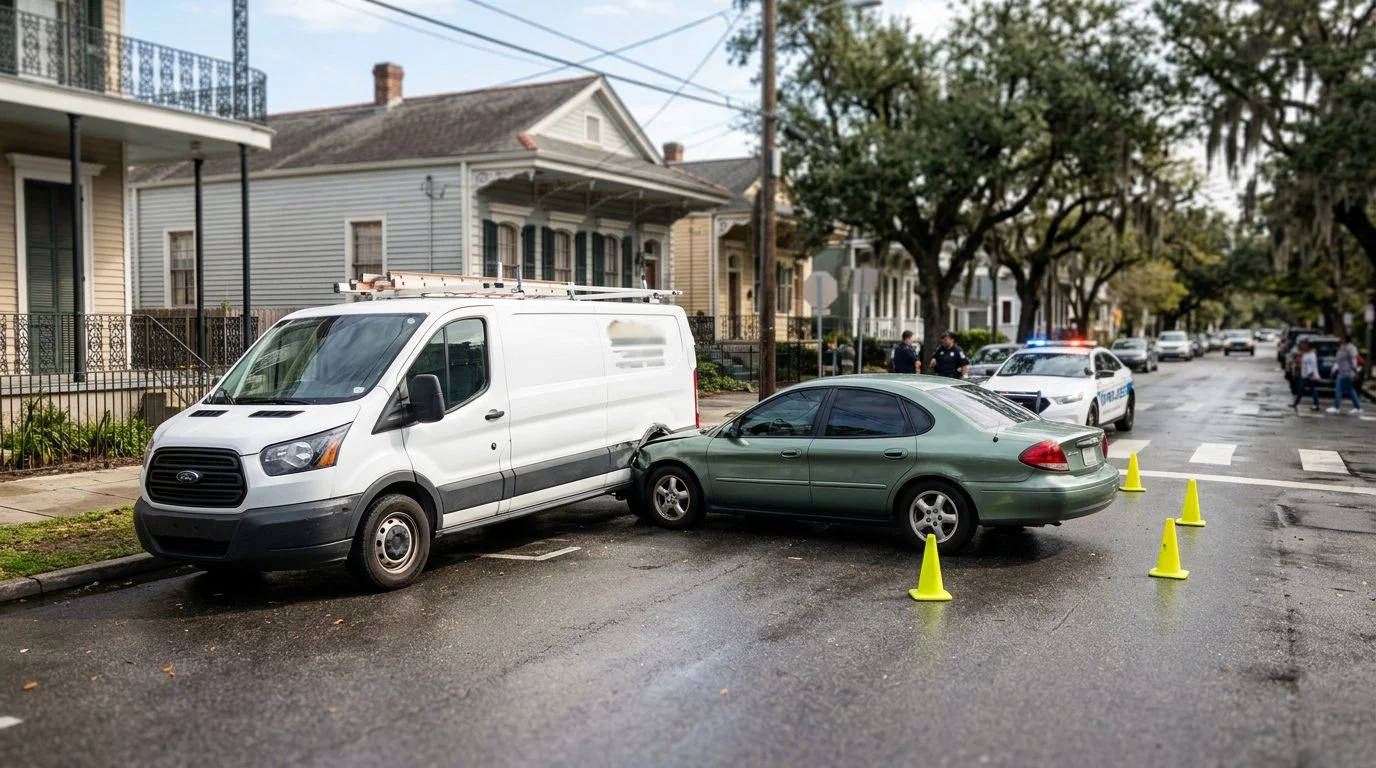
Commercial Vehicle Crashes | New Orleans
Hurt by a Company Vehicle in New Orleans? Find Out Who May Be Responsible
Przemek Lubecki, responsible lawyer at American Trial Lawyer, helps people injured by company trucks, vans and fleet vehicles understand who may be accountable. Office in New Orleans.
Questions That Shape a Company Vehicle Crash Claim
Who was behind the wheel
The driver's identity, employment and training are often central to understanding what happened.
Whose vehicle and whose job
Ownership, leasing and the purpose of the trip can affect which companies and parties are involved.
What the company knew
Maintenance records, hiring practices and safety policies may matter to the case.
Which insurance applies
Commercial policies can be different from personal auto coverage, and the policies involved need careful review.
By Przemek Lubecki · Published November 5, 2026
Short answer: who can be held responsible
Company vehicle crash New Orleans cases often raise one question: who is liable? In Louisiana, the driver, the company that employs the driver, and sometimes another party can each be responsible. Which one applies turns on the facts.
Louisiana law says a person whose fault causes harm must repair it. La. Civ. Code art. 2315 states it this way: “Every act whatever of man that causes damage to another obliges him by whose fault it happened to repair it.”
That means a claim is not always against only the driver. The company may answer for the driver’s work-related conduct. The company may also have its own role in the crash.
Passengers can have their own claims. That includes coworkers riding along in a company van. Family members of someone who was killed may also have claims. For more on passengers, read our car accident passenger claims page.
If a company van or delivery vehicle crash left you or a family member hurt, we can review the facts with you in a free, confidential first consultation, with no obligation to continue. Talk it through with our team — the first consultation is free, confidential, and carries no obligation.

How Louisiana decides fault
Louisiana injury claims are based on fault.
Four basic ideas guide the analysis. The break caused the crash, and the crash caused real losses, such as medical bills, lost pay, and pain.
A crash report is one piece of evidence. Under La. R.S. 32:398, crash reports are confidential. They are available to parties to the crash, their attorneys, and their insurers, among others. Upon request, they are made available within seven working days after the investigation is complete.
For crashes on or after January 1, 2026, the comparative fault rule works this way. Under La. Civ. Code art. 2323, if a person suffers harm partly from his own negligence and partly from another’s fault, and his own negligence is equal to or greater than fifty-one percent, he shall not be entitled to recover damages; but if the other fault is that of an intentional tortfeasor, his claim for recovery of damages shall not be reduced. Under the same article, if that degree or percentage of negligence is less than fifty-one percent, the amount of damages recoverable is reduced in proportion to it.
Article 2323 also looks at everyone who contributed to the harm, even people who are not parties to the case. When more than one person is liable and liability is not solidary, La. Civ. Code art. 2324 says each is liable only for its own degree of fault.
When the employer answers for the driver
An employer can answer for harm a worker causes on the job. La. Civ. Code art. 2320 says, “Masters and employers are answerable for the damage occasioned by their servants and overseers, in the exercise of the functions in which they are employed.”
The key question is what the driver was doing. Was the driver on a delivery route, running an assigned errand, or driving between stops? A personal trip or unauthorized use of the vehicle may lead to a different answer.
Article 2320 also says the employer’s responsibility attaches only when it might have prevented the act and did not. Courts look at how closely that conduct connects to the job.
Whether a driver is an employee or an independent contractor is often disputed in delivery cases.
Claims against the company itself
A company can also be responsible for its own negligence. These claims focus on what the company did, or failed to do, before the crash. Common examples include:
- hiring or screening a driver without proper checks
- weak training or supervision
- giving a vehicle to someone unfit to drive it
- poor vehicle maintenance
- delivery schedules that push drivers to speed or skip rest
These claims depend on evidence. Useful records include driver files, training records, and maintenance logs. Company-fault claims are often pursued alongside the claim based on the employer’s responsibility for its driver.
Commercial and delivery vehicle rules and records to preserve
Some commercial vehicles follow federal safety rules. Which rules apply depends on the vehicle, its weight, and how it is used. A company van may be a passenger vehicle, a box truck, or a larger commercial vehicle, and the rules differ for each.
Where federal rules apply, they create records. 49 CFR 395.8 requires a motor carrier to have each driver record duty status for each 24-hour period. No driver or motor carrier may make a false report about duty status.
49 CFR 396.3 requires motor carriers to systematically inspect, repair, and maintain vehicles under their control. Those records must be kept for one year where the vehicle is housed or maintained, and for six months after the vehicle leaves the carrier’s control.
49 CFR 391.51 requires a driver qualification file for each driver. That file is kept while the driver is employed and for three years after.
Records worth preserving include driver qualification files, duty-status logs, maintenance records, dispatch and route data, and delivery app or GPS data. Some records are kept only for limited periods. Acting early can help protect them.
Evidence, insurance, and time limits
Start gathering evidence now. Useful items include photos of the vehicle and any company markings, photos of the scene, the police report number, witness names, dashcam or phone video, and medical records that link your injuries to the crash.
Louisiana requires motor vehicle liability insurance. The Louisiana compulsory insurance rules set out those requirements. Company vehicles may be covered by a commercial auto policy.
If the at-fault driver is uninsured or underinsured, your own policy may matter. La. R.S. 22:1295 covers uninsured motorist coverage for persons insured under the policy who are legally entitled to recover nonpunitive damages from uninsured or underinsured vehicle owners or operators, but the coverage is not required when any insured named in the policy rejects coverage, selects lower limits, or selects economic-only coverage.
Louisiana generally allows two years to file. La. Civ. Code art. 3493.1 sets a two-year period for delictual actions (injury claims), and it starts on the day the injury or damage occurs. It does not run against minors or interdicts in actions involving permanent disability brought under the Louisiana Products Liability Act or state law governing product liability actions. The article has exceptions, so check the timing early. For related topics, see our pages on lost wages after a car accident in Louisiana and the value of a car accident claim in Louisiana.
Not sure what your next step is?
Talk it through with our team — the first consultation is free, confidential, and carries no obligation.
If a company van was involved in your crash
If a company van or delivery vehicle hit you or someone in your family, the first questions are who was driving, who the driver worked for, and what records exist. Those answers can be hard to pin down quickly.
American Trial Lawyer, LLC is led by responsible lawyer Przemek Lubecki, from our New Orleans office. Our team handles car and commercial vehicle cases. The firm may associate or refer a case to other law firms.
If a company vehicle left you hurt, you don’t have to sort out the questions alone. Request a free case evaluation through our contact page or call 855-LUBECKI.
Frequently asked questions
Can you sue a company if its delivery driver caused a crash in Louisiana?
Louisiana law says an employer can answer for harm its employee causes in the work they were hired to do. Whether a particular company is responsible depends on the driver’s role at the time.
How long do you have to file a claim?
Louisiana generally allows two years from the day of injury under La. Civ. Code art. 3493.1. That article has exceptions, so check the timing early.
Is Louisiana a fault-based state for car crash claims?
Yes. Under La. Civ. Code art. 2315, a person whose fault causes damage must repair it.
Protect Your Evidence Early
Photos, the crash report number, witness names and medical records can help a lawyer understand what happened. Speak with a lawyer before giving a recorded statement to any insurance company.
Parties That May Be Involved
The driver
The person operating the truck or vehicle at the time of the crash may be part of the claim.
The employer or company
A business may answer for harm connected to its drivers and the work they were doing.
The vehicle owner or fleet operator
Who owns, leases or maintains the vehicle can change who needs to be examined.
Working with other law firms
American Trial Lawyer may associate or refer a case to other law firms. If that happens, we will let you know.