
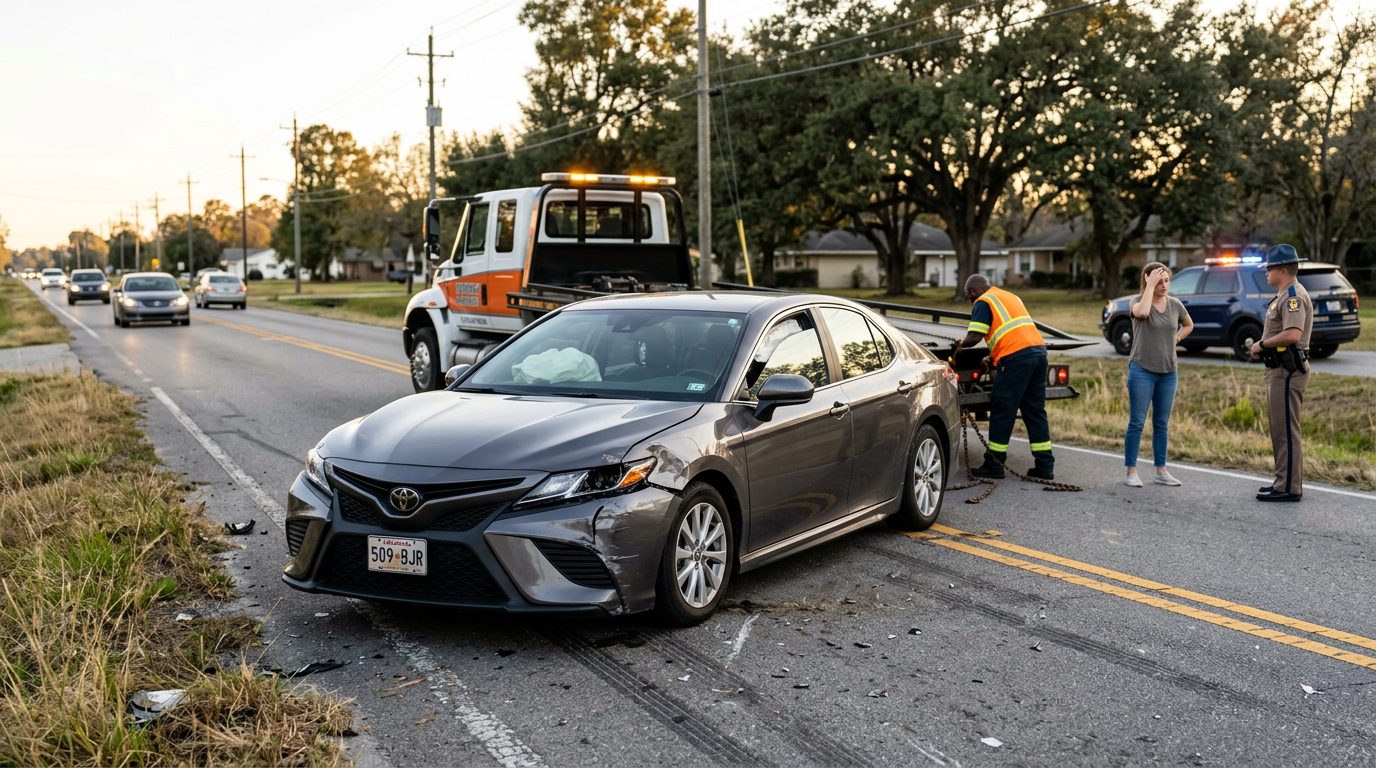
Car Accident Claims | New Orleans, Louisiana
What Affects Car Accident Claim Value in Louisiana?
Przemek Lubecki, responsible lawyer at the New Orleans office, explains the factors that often shape car accident claims across Orleans Parish, the New Orleans metro and Louisiana.
By Przemek Lubecki · Published November 4, 2026
What “Claim Value” Means and Why No Number Can Be Predicted From General Information
Claim value is the compensation a person may seek for losses a crash caused, and no general guide can predict its dollar amount. A claim is a request for repayment of real losses, not a fixed price or a set payout.
If you were hurt in a crash in New Orleans or elsewhere in Louisiana, you may wonder what your claim is worth. That is a fair question. The losses in a claim can include medical care, lost income, vehicle damage and, in some cases, the effect of an injury on family life.
Every claim is built from its own facts. Those facts include how the crash happened, how the injury is documented, who was at fault and what insurance is available. Because those facts differ from one case to the next, general information cannot forecast a dollar amount.
This page gives no figures and no settlement examples. It explains the main factors that shape claim value under Louisiana law. Each section covers one factor, and the sections build on each other. For the wider picture of recovering after a crash, read the parent guide on Louisiana car accident claims.
If a Louisiana crash left you hurt, missing paychecks and still getting medical bills, you may have a claim worth reviewing. Our team can talk through your facts in a free consultation. Talk it through with our team — the first consultation is free, confidential, and carries no obligation.

Medical Treatment and Medical Bills
Medical treatment is one of the main ways a claim shows what your injury was and how it has changed over time. Your records tell that story.
Care after a crash often starts in the emergency room. It can continue with follow-up visits, imaging such as X-rays or MRIs, and physical therapy, along with referrals to other doctors. Each step adds to the record of the injury and its course.
Gaps in treatment can raise questions. If you miss appointments or stop following medical advice, an insurer may ask why. Keeping your appointments and following your doctor’s plan helps your records stay clear.
Medical bills are one part of your economic losses. How those bills are paid matters too. Under Louisiana law, when a health insurer or Medicare has paid a contracted medical provider, your recovery of medical expenses is limited to the amount actually paid, plus any cost-sharing you paid or owe. It is not limited to the amount billed (La. R.S. 9:2800.27).
That same statute says that in a trial over those past medical expenses, the jury must be told both the amounts billed and the amounts actually paid (La. R.S. 9:2800.27). Save every bill, explanation of benefits and payment receipt. These papers show what was billed and what was paid.
Lost Income and Lost Earning Capacity
Lost income covers the wages you missed while you healed. It can also cover a drop in your ability to earn money over time.
These are two different losses. Past lost wages are the paychecks you missed because you could not work. Lost earning capacity is the reduced ability to earn in the future, when an injury limits the work you can do.
Records support both. Pay stubs, employer letters, W-2 forms, tax returns and your work schedule all help show what you earned before the crash and what changed after it. A letter from your employer that lists missed shifts and any change in your duties can be especially useful.
Self-employed people and gig workers often document income differently. They may rely on invoices, bank deposits, booking records, mileage logs and tax filings. If you drive for a rideshare app, your trip and earnings history may serve as income records.
An injury can affect a job even when few days are missed. A nurse who can no longer lift patients, or a driver who cannot sit for long hours, may face real limits at work. Those limits are worth describing in your records.
Future Medical Care and Long-Term Effects
Future medical care can be part of a claim, but Louisiana law limits when it counts. Future treatment must be directly related to a manifest physical or mental injury or disease.
Under Louisiana Civil Code article 2315, damages do not include costs for future medical treatment unless that treatment is directly related to a manifest physical or mental injury or disease (La. Civ. Code art. 2315). This is one reason the medical record matters from the first visit.
Future care can include surgery, rehabilitation, medication, or assistive devices such as a wheelchair or brace. The need for these items usually has to be documented by the treating doctor. A doctor’s notes about prognosis, meaning the expected course of the injury, often carry weight.
Ongoing pain, limits on daily activities and the need for help at home are also part of the picture. Keep a simple log of what you can no longer do, such as cooking, driving, lifting a child or sleeping through the night. Dated notes make these changes easier to explain.
The Nature and Severity of the Injury
The seriousness of an injury, whether it is lasting, and how it affects daily life are central to claim value. These points come from the medical record, not from a guess.
Some injuries are easy to see, such as broken bones or deep cuts. Others are harder to see, such as soft tissue injuries, nerve damage or head injuries. Doctors use testing and follow-up care to document both kinds.
Spinal injuries deserve special attention. MedlinePlus notes that spinal cord injuries can result from motor vehicle accidents and that they require immediate medical attention (MedlinePlus). The National Institute of Neurological Disorders and Stroke explains that the spinal cord has three layers of protective tissue, and cerebrospinal fluid surrounds it to cushion against shock or injury (NINDS).
Head and brain injuries need careful documentation too. Early medical evaluation creates a record of how you were hurt right after the crash. That record is often the starting point for everything that follows. The firm’s brain injury practice area covers these claims in more detail.
Fault and Comparative Fault Under Louisiana Law
Your share of fault can reduce what you recover. Article 2323 provides that if a person suffers injury partly from his own negligence and partly from the fault of another person, a person whose degree or percentage of negligence is equal to or greater than fifty-one percent is not entitled to recover damages (La. Civ. Code art. 2323). Article 2323 provides that if a person suffers injury partly from his own negligence and partly from the fault of another person, and the degree or percentage of negligence attributable to the injured person is less than fifty-one percent, the amount of damages recoverable is reduced in proportion to that percentage (La. Civ. Code art. 2323).
The date of your crash matters, so check which rule applies to your facts.
Article 2323 also says the fault of all persons who caused or contributed to the injury is determined. That includes people who are not parties to the lawsuit, whether or not they are insolvent or have immunity, and whether or not their identity is known (La. Civ. Code art. 2323).
Louisiana law also makes a person responsible for damage caused by negligence, imprudence or want of skill, not only by a deliberate act (La. Civ. Code art. 2316). Common fault disputes include who had the green light, whether a driver changed lanes safely and how much following distance was kept.
Crashes with commercial vehicles can involve more parties. Under La. Civ. Code art. 2320, employers are answerable for damage caused by their employees and overseers while those workers carry out the duties of their work. Teachers and artisans are answerable for damage caused by their students or apprentices while those students or apprentices are under their supervision. In those cases, responsibility attaches only when the employer, teacher or artisan might have prevented the act that caused the damage and did not do so. Federal rules also limit driving time for property-carrying commercial drivers, including an 11-hour driving limit and a 14-hour window (49 CFR § 395.3). The Federal Motor Carrier Safety Administration summarizes these hours-of-service limits and required rest breaks for truck drivers (FMCSA hours-of-service summary).
Not sure what your next step is?
Talk it through with our team — the first consultation is free, confidential, and carries no obligation.
Insurance Coverage and Policy Limits
Available insurance is a practical limit on what can be collected from a policy. The at-fault driver’s coverage matters, and so does your own coverage.
Under the motor vehicle security statute, a vehicle registered in Louisiana must be covered by a liability policy with limits set under R.S. 32:900, or by another allowed form of security; a motor vehicle liability bond, for example, must cover not less than fifteen thousand dollars for injury to or death of any one person (La. R.S. 32:861). Many claims involve more serious injuries than that minimum covers.
When the at-fault driver has little or no coverage, your own uninsured motorist coverage may apply. Louisiana law says uninsured motorist coverage must be provided in not less than the bodily injury liability limits, unless the named insured rejects it, selects lower limits or selects economic-only coverage (La. R.S. 22:1295). Your policy declarations page shows what you chose.
A single crash can involve more than one policy. Under La. R.S. 22:1295, uninsured motorist limits are not increased because a policy covers multiple vehicles or because the insured has more than one uninsured motorist policy. However, for bodily injury to a person occupying an automobile not owned by that person, a resident spouse or a resident relative, the uninsured motorist coverage on the occupied vehicle is primary. If that primary coverage is exhausted, the injured occupant may recover as excess from other uninsured motorist coverage available to him, but from no more than one other policy. Reviewing which policies apply is part of evaluating a claim. Keep copies of every policy and claim number you receive.
Vehicle Damage, Diminished Value and Other Losses
Vehicle repair or replacement, personal property and documented out-of-pocket costs are separate losses from the injury itself. Each one should be tracked on its own.
Vehicle damage covers repair or replacement of the car. Personal items such as phones, laptops, car seats or medical devices damaged in the crash are also losses. Keep receipts, repair estimates and photos of the damage.
Diminished value describes the reduced market value a vehicle may keep after a documented repair. Even a well-repaired car may sell for less than it did before the crash. Diminished value is usually evaluated separately from injury losses, so ask about it early.
Out-of-pocket costs can include rides to medical visits, home help during recovery, and medical supplies. Save the receipts and write down the mileage and dates for each trip.
A settlement can carry its own rule. Louisiana law says a settlement under a vehicle liability policy for damage to another person’s property is not an admission of liability by the insured on any other claim from the same accident (La. R.S. 22:1290). Read any settlement paperwork carefully before you sign.
Family members may have their own claims. Louisiana Civil Code article 2315 says damages may include loss of consortium, service and society. La. Civ. Code art. 2315 reads: “Damages do not include costs for future medical treatment, services, surveillance, or procedures of any kind unless such treatment, services, surveillance, or procedures are directly related to a manifest physical or mental injury or disease.” These damages are recoverable by the same categories of persons who could bring a wrongful death action for an injured person (La. Civ. Code art. 2315). Whether a family member qualifies depends on the facts and the family relationship.
Documentation and Evidence That Supports a Claim
Good records make a claim easier to explain. The core records are the crash report, photos, witness names, medical records, bills and insurance claim numbers.
Louisiana law requires a driver in a crash with injury, death or property damage over five hundred dollars to immediately notify police, and to give his name, address and vehicle registration to any person injured in the crash or to the driver, occupant or person attending any vehicle or other property damaged in the crash (La. R.S. 32:398). Crash reports are confidential, but they are made available to the parties to the crash, their attorneys, their insurers and certain others.
Statements matter too. Louisiana law says a person who takes a written or recorded statement from an injured person must furnish a true and complete copy. That copy must be provided within twenty days after written demand (La. R.S. 13:3732). If an insurer or other party takes your statement, ask for a copy.
A daily journal helps too. Write down your pain level, what you could not do, missed events and visits to the doctor. Dated notes made close to the events are easier to rely on than memories written months later.
Electronic data can also matter in some crashes. Dash camera footage, phone records and vehicle data may help show what happened. Preserve these items early, because they can be lost or overwritten.
How Long You Have to File a Lawsuit in Louisiana
For most car accident injury claims, Louisiana gives two years to file suit. The period starts on the day the injury or damage occurred (La. Civ. Code art. 3493.1).
That deadline is called prescription. The two-year rule was set by an act effective July 1, 2024. Some exceptions can apply, so the details of your case matter.
Under Louisiana Civil Code article 3462, unless otherwise expressly provided by legislation, prescription is interrupted when the owner commences action against the possessor, or when the obligee commences action against the obligor, in a court of competent jurisdiction and venue (La. Civ. Code art. 3462). Rules for improper venue and for defendants not served in time are also part of that article.
Waiting can make evidence harder to gather. Witnesses move, footage is erased and records become harder to obtain. Acting early keeps more options open.
Talk With Przemek Lubecki About the Facts of Your Crash
If you are dealing with injuries, missed work, medical bills still arriving, and a decision about whether to pursue a claim, Przemek Lubecki can review your facts. He is the responsible lawyer for this page. American Trial Lawyer, LLC has its office in New Orleans, Louisiana.
Frequently Asked Questions
Does Louisiana still use comparative fault for car accidents?
Yes. Under La. Civ. Code art. 2323, if a person suffers injury, death, or loss partly as the result of his own negligence and partly as a result of the fault of another person or persons, the person suffering the injury, death, or loss shall not be entitled to recover damages if the degree or percentage of negligence attributable to that person is equal to or greater than fifty-one percent. If his negligence is less than fifty-one percent, the damages recoverable are reduced in proportion to that degree or percentage.
How long do you have to sue after a car accident in Louisiana?
Generally two years from the date of injury, though some exceptions can apply (La. Civ. Code art. 3493.1).
Can a spouse or family member make a claim?
Louisiana law allows loss of consortium damages for the same categories of people who could bring a wrongful death action. Whether a particular person qualifies depends on the facts.
What is the minimum liability insurance in Louisiana?
The required coverage includes at least fifteen thousand dollars for injury or death to any one person.
Call 855-LUBECKI or request a free case evaluation through the contact page to speak with our team at the New Orleans office. The first consultation is free, confidential and without obligation. If you retain the firm, any fee is set out in writing, and you may be responsible for case costs and expenses in addition to the fee. The firm may associate or refer a case to other law firms.
Common factors in car accident claims
Injuries and medical treatment
The nature and severity of injuries, the treatment needed, and how recovery is progressing often play a central role in how a claim is evaluated.
Lost income and daily life
Time missed from work, reduced earning ability, and the everyday tasks an injury makes harder can all become part of the discussion.
Fault and the facts of the crash
Police reports, photos, witness accounts and vehicle damage help show how the collision happened and who was involved.
Insurance coverage and available sources
Policy limits, the number of insurers involved and any additional coverage can affect what options are available for a claim.
How our office approaches your claim
Clear communication
We explain each step in plain language so you know what is happening and why.
Careful documentation
We work to gather and organize the records, reports and evidence that matter to your claim.
Straight answers
You can ask questions about your situation at any point, and we will tell you what we know and what we do not yet know.
Be careful with insurance adjusters
An insurance company may contact you soon after a crash and ask for a recorded statement. Talk with a lawyer before you give one. Some cases may be associated with or referred to other law firms.
Talk with Przemek Lubecki about your car accident. Office in New Orleans. The first consultation is free, confidential and without obligation.
Related practice areas
- Car Accident Help in New Orleans: Your Questions Answered, From Orleans Parish Outward
- Wrongful Death Deadline for Car Crashes in Louisiana