
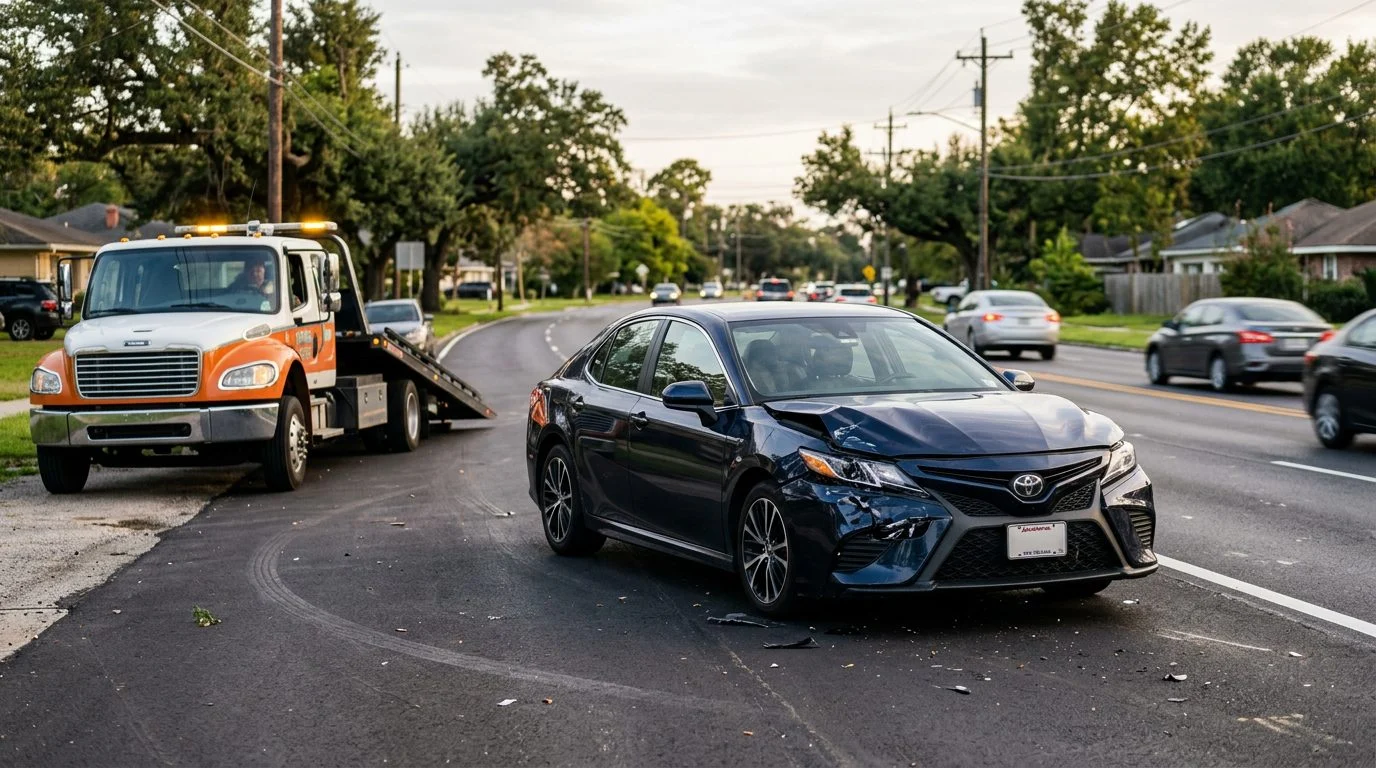
Car Accidents | New Orleans, Louisiana
Hurt in a Car Accident? Get Clear Answers From a New Orleans Trial Lawyer
Office in New Orleans. Przemek Lubecki answers common questions about car crashes, injuries, insurance calls and wrongful death. Your first consultation is free and confidential, with no obligation to continue. You may be responsible for case costs and expenses in addition to the fee.
By Przemek Lubecki · Published October 17, 2026
Car Accident New Orleans Questions, Answered
After a car accident in New Orleans, the most important first steps are to check for injuries, call 911, and stay at the scene until authorities release you. This guide answers the car accident New Orleans questions people ask most often, in the order they usually come up.
Most people look for these answers late at night. They’re sore, worried about money, and fielding calls from insurers. You don’t need to know insurance or Louisiana law well to understand the basics. This page explains them in plain words.
Przemek Lubecki is the responsible lawyer for the content on this page. Our office is in New Orleans.
If you were hurt in a crash recently and you're deciding whether to talk with the other driver's insurer or a lawyer, you don't have to sort it out alone. Talk it through with our team — the first consultation is free, confidential, and carries no obligation.
Where This Guide Starts: Orleans Parish First, Then the Metro and Louisiana
This guide starts in Orleans Parish and moves outward to the New Orleans metro and the rest of Louisiana. It’s written for adults hurt in a car, truck, commercial vehicle, rideshare, or motorcycle crash, and for families who have lost someone in a crash.
The early examples focus on the city itself. The guide also speaks to readers in Metairie, Jefferson Parish, Kenner, St. Bernard Parish, and Slidell, because crashes cross these lines every day. The rules in Louisiana apply across all of them.
Each section gives a direct answer first, then explains the reasoning. Where a topic needs more depth, our related guides cover it. Those include concussions after a car accident, partly at fault crashes, Louisiana claim deadlines, and wrongful death cases in Jefferson Parish.
This page is general information. It doesn’t apply the law to your facts. For that, you’ll want to talk with a lawyer about your own crash.
What Should I Do First at the Scene of a New Orleans Car Accident?
Check for injuries first, move to safety if you can, call 911, and stay at the scene until authorities release you. Your safety and the safety of others come before anything else.
If someone is hurt, say so when you call. Turn on your hazard lights if your car still runs. Don’t move a seriously injured person.
Louisiana law requires a driver in a crash that causes injury, death, or property damage over five hundred dollars to share certain details. The driver must give their name, address, and vehicle registration number. On request, the driver must also show a license or permit to anyone injured or to the owner of damaged property. La. R.S. 32:398 sets out this duty.
Get the other driver’s name, phone number, insurer, policy number, license, and plate number. Write them down or take a photo of each card. Ask nearby drivers and pedestrians for their names too, because witnesses often leave before police arrive.
Take photos of where the cars stopped, the damage, road conditions, traffic signals, skid marks, and any visible injuries. The most common mistake is guessing. Stick to what you saw and felt, and don’t debate fault at the scene.
Do I Need to Call the Police After a Crash in Louisiana?
Call the police after any crash with an injury, significant damage, or a disagreement about what happened. An officer’s report creates an official record that you can use later.
The report usually lists the location, the vehicles, the drivers, and the officer’s observations. These details can shape how insurers and others view the crash. Errors happen, so read the report carefully and compare it with your photos and notes.
Louisiana treats crash reports as confidential. Under La. R.S. 32:398, the information goes to the parties, their attorneys, and insurers, generally within seven working days after the investigation is complete. Police agencies can charge for copies. The statute caps the fee at five dollars for reports of two pages or less, and at twenty dollars for longer reports, including all service fees.
Before you leave the scene, ask the officer for the report number. Write down the officer’s name, agency, and badge number. Keep a note of the time you called. These small details make the official record easier to find later.
Should I See a Doctor If I Feel Fine After a Car Accident?
Yes. Get checked by a medical provider after a crash, even if you feel fine. Some injuries aren’t obvious right away, and a medical record ties your symptoms to the crash.
Tell the doctor about every symptom, including ones that seem minor. Headaches, neck or back pain, dizziness, sleep trouble, and changes in memory or mood are all worth mentioning. Describe when each one started and how it affects your day.
Get emergency care right away for severe signs. These include a severe headache, confusion, repeated vomiting, weakness, trouble breathing, or loss of consciousness. Don’t wait for a scheduled appointment in those cases.
Keep your appointments and follow your doctor’s advice. Keep copies of bills, prescriptions, and discharge papers too. Your care records are part of your claim, and they tell the story of your injury.
Head injuries deserve extra attention. Our related guide on concussions after a car accident in New Orleans covers the warning signs in more detail.
Who Is Usually at Fault in a Rear-End Collision?
Fault in a rear-end collision depends on the facts of that crash. Being hit from behind doesn’t settle who caused it, and neither does being the car in front.
Louisiana holds people responsible for damage caused by their negligence, imprudence, or want of skill. La. Civil Code art. 2316 states that rule. Under La. Civil Code art. 2315, the person whose fault caused the damage must repair it.
Common rear-end scenarios vary. A lead driver may brake hard for no clear reason. A car may change lanes into a gap. A driver may back out of a space without looking. In a chain of cars, one impact can push the next car into another.
Evidence can clarify who did what. Dashcam video, skid marks, witness statements, photos of lane positions, and vehicle data may all help. Ask early about any video or records, because they’re easier to get soon after a crash.
Many crashes involve more than one person at fault. Louisiana’s shared-fault rule, covered in the next section, can apply. A free first consultation can review the details of your crash. You may owe case costs and expenses in addition to any fee.
Not sure what your next step is?
Talk it through with our team — the first consultation is free, confidential, and carries no obligation.
What Are the Current Car Accident Laws in Louisiana?
Louisiana uses comparative fault (La. Civ. Code art. 2323). Under La. Civ. Code art. 2323, for claims arising on or after January 1, 2026, a share of fault of fifty-one percent or more bars recovery. For accidents and injuries occurring before January 1, 2026, Louisiana’s fault rule reduced a recovery by the injured person’s share of fault but never barred it entirely. A smaller share of fault reduces the amount they can recover.
La. Civil Code art. 2323 says the fault of every person who caused or contributed to an injury is determined. That includes people who are not parties to the lawsuit. If you’re partly at fault, your recovery is reduced by your percentage of fault.
Louisiana also sets time limits for filing injury claims. These deadlines can be short, so don’t wait to learn yours. Section 11 explains the timing rule for wrongful death claims.
Truck and commercial vehicle crashes may involve federal rules. Under the federal hours-of-service rule for property-carrying commercial motor vehicles, a driver may not drive at the start of a work shift without first taking 10 consecutive hours off duty, and no motor carrier may permit or require a driver to drive otherwise. The federal hours-of-service rule limits a property-carrying commercial motor vehicle driver to a total of 11 hours of driving time within the 14 consecutive hours after coming on duty following 10 consecutive hours off duty.
Laws change. Article 2323 was amended effective January 1, 2026. Our related guides on partly at fault crashes and vehicular negligence cover more of these rules.
Do I Still Need a Lawyer If I Already Have Insurance?
Having insurance doesn’t decide who pays for your injuries. Your own policy and the other driver’s policy work differently, and an insurer’s goals may not match yours.
Your own auto policy may include medical payments coverage. Louisiana also governs uninsured motorist coverage. La. R.S. 22:1295 requires that this coverage be offered unless an insured rejects it, selects lower limits, or selects economic-only coverage as the statute allows. Economic-only coverage excludes noneconomic loss, such as pain and suffering.
Check which options you chose. If primary uninsured coverage runs out, the statute allows recovery as excess from other uninsured coverage.
People often talk with a lawyer when fault is disputed, injuries are serious, an offer seems low, or a claim is denied. Those are common reasons to ask questions. They don’t predict any result.
A free first consultation is confidential and carries no obligation to continue. You may owe case costs and expenses in addition to any fee. This firm may associate or refer a case to other law firms.
What Should I Say to the Other Driver’s Insurance Adjuster?
Be polite, share basic facts, and don’t give a recorded statement until you understand your rights and injuries. You can take time to think before you answer.
Adjusters often ask about prior injuries, social media, daily activities, and how you feel. Early answers can be used later, even if they came up in a casual call. Keep answers short and factual. A fair reply is, “I’m still getting medical care, and I’ll follow up when I have more information.”
Louisiana gives injured people a right to their own statement. Under La. R.S. 13:3732, a person who takes a written, recorded, or transcribed statement from an injured person must provide a true and complete copy. The copy is due within twenty days after a written demand.
The same statute says that if the person holding the statement refuses a copy after a request, the statement cannot be used in a related civil action. Keep your own notes of every call and letter.
A recorded statement is a choice. You can ask for the request in writing, ask for time, and ask for a copy. Read any form before you sign it.
What About My Car, a Rental Car, and Lost Wages?
Document vehicle damage, keep rental receipts, and track missed work from the first day. These records support every part of your claim.
Get at least one written repair estimate, and photograph the damage before repairs begin. If your car is a total loss, keep the title, any valuation paperwork, and every letter from the insurer.
Rental cars are a common question. Whether the cost of a rental while your car is repaired is covered depends on your policy and the facts of your crash. Keep every receipt and rental agreement, even while coverage is still unclear.
Lost income needs records too. Save pay stubs, ask your employer for a letter that lists missed shifts, and keep a log of time off for appointments and recovery.
Medical bills raise a Louisiana rule. Under La. R.S. 9:2800.27, when a health insurer or Medicare paid a contracted provider, recovery of medical expenses is limited to the amount actually paid, plus cost sharing. It is not based on the amount billed. Keep your insurance statements with your bills.
What Affects the Value of a Car Accident Injury Claim?
The value of a claim depends on the injuries, the treatment, the bills, lost income, the effect on daily life, and the evidence about fault. No one can predict an amount from general information.
Medical records matter most. They show diagnosis, treatment, how long care lasted, and what doctors say about cause. Describe your symptoms honestly and consistently, because others may question any gaps or changes in your account.
Pain and suffering is part of many claims. It’s harder to measure than a bill, and each person’s experience is different. Two people with similar injuries can have very different daily lives.
Louisiana law also limits some claims. Under La. Civil Code art. 2315, damages do not include costs for future medical treatment unless that treatment is directly related to a manifest physical or mental injury or disease.
Every claim is different. We can review your own facts, but we can’t promise any result or amount.
Have questions about what happened?
Ask our team directly. The first conversation is free, confidential, and there is no obligation to continue.
What Questions Do Families Ask After a Fatal Crash?
Under Louisiana law, certain surviving family members may bring a wrongful death claim when a person dies due to another’s fault. This claim has its own deadline, so act early.
La. Civil Code art. 2315.2 lists who may sue. A surviving spouse and child or children may sue. If there’s no spouse or child, the surviving father and mother may. Siblings and grandparents may sue in certain cases, as the article describes.
The same article sets the time limit. The right of action prescribes one year from the death or two years from the day injury or damage was sustained, whichever is longer. “Prescribes” means the time to file runs out.
La. Civil Code art. 2315.1 covers a survival action. The right to recover damages for the injury to the person who died can survive for the same period, in favor of the listed family members. Where no listed beneficiary exists, the succession representative may pursue it.
Families often ask what to keep. Save the crash report, witness names, photos, medical records, and letters from insurers. Under La. R.S. 32:398, crash reports are available to the parties’ attorneys and succession representatives, among others.
Grief makes these questions hard. Take your time. Our related guide on wrongful death in Jefferson Parish covers these steps in more detail.
How a Free First Consultation Works, and What It Costs to Proceed
The first consultation is free, confidential, and carries no obligation to continue. You may owe case costs and expenses in addition to any fee.
During a call or visit, we review the facts of your crash, the deadlines that may apply, and the next steps open to you. Bring photos, the crash report, medical bills, and insurer letters if you have them. The decision to go forward is yours alone.
If your case is likely to be referred, we’ll tell you. This firm may associate or refer a case to other law firms.
Przemek Lubecki is the responsible lawyer for this page. Our office is in New Orleans.
Frequently Asked Questions
What should I do first after a car accident in New Orleans?
Check for injuries, call 911, and stay at the scene until authorities release you. Then exchange driver details and take photos.
Do I have to share my information after a crash in Louisiana?
In a qualifying crash, Louisiana law requires a driver to give their name, address, and registration number. A license must be shown on request.
Can I recover damages if I was partly at fault?
Under La. Civ. Code art. 2323, the fifty-one percent bar applies only to claims arising on or after January 1, 2026. Injuries from earlier crashes are governed by the prior comparative fault rule, which may still allow a reduced recovery for a person more than 50% at fault. A smaller share of fault reduces what you can recover.
How long do families have to file a wrongful death claim?
The right of action generally prescribes one year from death or two years from the injury, whichever is longer.
Does a free consultation mean there are no costs?
The first consultation is free, but you may owe case costs and expenses in addition to any fee.
If you were hurt in a crash recently and you’re deciding whether to talk with the other driver’s insurer or a lawyer, you don’t have to sort it out alone. Request a free case evaluation at our contact page or call 855-LUBECKI. You may owe case costs and expenses in addition to any fee.
Why Reach Out to Our Office
A Trial Lawyer Leads Your Case
Przemek Lubecki, the responsible lawyer, handles serious car, truck and commercial vehicle crash cases from our New Orleans office.
Focused on Seriously Injured People
We represent people with serious injuries and families facing wrongful death, including people hurt in crashes across Orleans Parish, the New Orleans metro and Louisiana.
Plain-Language Answers
Our team explains each step in terms you can follow, so you know what to expect while you focus on recovering.
Organized Case Handling
Our support staff helps gather accident reports, medical records and other documents that matter to your claim.
Transparent Next Steps
We may associate or refer a case to other law firms. If that is a possibility for your matter, we will discuss it with you before you decide.
Common Questions About Car Accidents in New Orleans
What should I do right after a crash?
Check for injuries and call 911. Stay at the scene until authorities release you, then exchange driver details and photograph the vehicles, roadway and any visible injuries.
Should I talk to the other driver's insurer?
Insurance adjusters may ask for a recorded statement early on. Speaking with a lawyer first can help you understand what to say and what to hold back.
What if the crash injured me more than I first thought?
Some injuries, including brain injuries, may not show symptoms for days. Getting medical care promptly protects your health and documents what happened.
Can a car accident lead to a wrongful death claim?
When a crash causes a death, surviving family members may have questions about the loss. Our New Orleans office can talk through those questions in a confidential consultation.
Key Tip: Be Careful With Early Statements
Before speaking with an insurance company about fault or injuries, consider talking with a lawyer. Written or recorded statements can be used later in your claim.
Talk With Przemek Lubecki About Your Car Accident
Related practice areas
- Truck Accidents Attorney Orleans Parish | Przemek Lubecki