
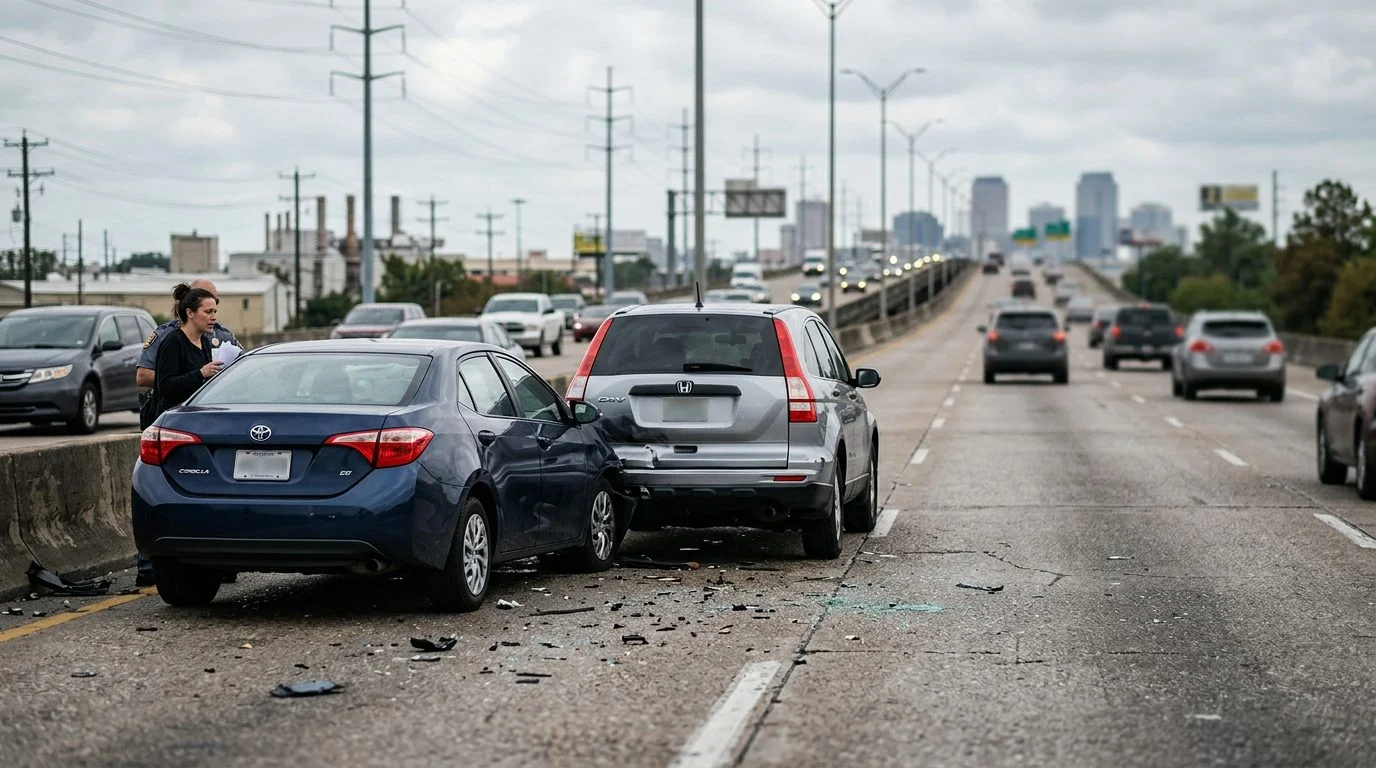
Westbank Expressway Car Accident Claim: Louisiana Guide
A Westbank Expressway car accident claim is a request for payment from the at-fault driver and their insurer. It covers losses the crash caused, such as medical bills and lost pay. If you were hurt on the Westbank Expressway in Jefferson Parish, this guide explains how Louisiana law may apply. Every claim turns on its own facts, so treat this as general information.
Who this page is for and what a car accident injury claim is
A car accident injury claim asks the person who caused your crash, and their insurer, to pay for the harm the crash caused. This page is for drivers, passengers and pedestrians hurt on the Westbank Expressway. It also serves communities nearby, including Harvey, Marrero and Gretna. Family members helping an injured person are welcome here too.
Many readers are still in treatment. Their car may be in a repair shop, and insurance adjusters may be calling. That mix is hard, and it’s normal to feel unsure about what comes next.
If someone died in the crash, a wrongful death claim is a separate type of claim. The firm’s wrongful death page covers it in more detail. The firm’s Orleans Parish car crash page covers the New Orleans metro area.
What a car accident injury claim can cover
A claim may seek payment for medical care, lost income and other losses caused by the crash. Losses usually fall into two groups:
- Economic losses: bills and wages you can document, such as ambulance rides, hospital care, medicine and time off work.
- Non-economic losses: physical pain, emotional distress and loss of enjoyment of life.
Vehicle damage is a separate item. Family members may also have claims for loss of consortium, service and society. La. Civ. Code art. 2315 allows those damages, recoverable by the same respective categories of persons who would have had a cause of action for wrongful death of an injured person. The same article says future medical costs are not included unless they are directly related to a manifest physical or mental injury or disease.
Insurance policy limits matter. So does whether other parties share fault. What a claim is worth depends on the facts: your injuries, your treatment and the evidence. No general page can predict an amount.
Crashes on the Westbank Expressway: common causes and evidence to preserve
Evidence gathered early helps answer later questions about how the crash happened. Busy multi-lane roads often see sudden stops in traffic, lane changes, left turns and rear-end impacts. Wet pavement and debris add risk.
Heavy traffic and detours can make a scene hard to revisit later. Useful evidence includes:
- The crash report from the investigating agency.
- Photos of the vehicles, the road and any signs or signals.
- Names and phone numbers for witnesses.
- Video from nearby businesses or traffic cameras, if it exists.
- Medical records that link your injuries to the crash.
- Repair estimates, receipts and bills.
Under La. R.S. 32:398, crash reports are confidential. They are available only to the parties, parents or guardians of a minor who is a party, insurers or an insurance support organization under contract to provide claims and underwriting, any healthcare provider or agent that rendered services to a party, the succession representatives and attorneys of the parties, and news-gathering organizations requesting a specific crash, and upon request within seven working days after the investigation is completed.
Keep a simple journal of symptoms, appointments and missed work. Short notes help when memories fade.
How fault works in Louisiana
Louisiana uses comparative fault, which divides blame by percentage. Under La. Civ. Code art. 2323, if the degree or percentage of negligence attributable to the person suffering injury, death, or loss is equal to or greater than fifty-one percent, that person shall not be entitled to recover damages. If the degree or percentage of negligence attributable to the person suffering injury, death, or loss is less than fifty-one percent, the amount of damages recoverable shall be reduced in proportion to that degree or percentage of negligence.
The amended text took effect January 1, 2026. Note the exact date of your crash, because that date can matter.
Fault is assigned to everyone who contributed, whether or not they are a party to the case. Under La. Civ. Code art. 2324, a defendant who is not solidarily liable is responsible only for their own degree of fault.
Insurers often dispute speed, lane position and right of way. Documentation helps answer those arguments.
Louisiana also limits when you can sue an insurer directly. Under La. R.S. 22:1269, in those instances where direct action is not otherwise authorized by law, a liability insurer may be joined on motion of any party as a party defendant for the purposes of entering final judgment or enforcing a settlement, at the time a judgment is to be entered or a settlement is reached during the pendency of litigation, and these provisions are subject to the terms and limits of the policy and do not apply if the insurer timely denied coverage or reserved rights under Subsection E of the statute, unless there has been an adjudication in favor of coverage. For more detail, see the firm’s page on suing an insurance company directly in Louisiana.
If a government entity is involved, La. R.S. 13:5106 sets different rules, including a cap on total liability for one person’s personal injury, with exceptions listed in the statute.
How the claim process works: steps and timeline
A claim usually moves from medical care to investigation, then a demand to the insurer, then settlement talks or a lawsuit. A typical path looks like this:
- Get medical care. Follow your treatment plan and keep every record.
- Document the crash. Gather the crash report (available only to the parties to the crash and the others the law names), photos and contact details.
- Consult. Review the facts, injuries and papers with a lawyer.
- Investigate and present. Records are gathered and a demand goes to the insurer. If needed, a lawsuit is filed in the proper Louisiana court.
- Negotiate or prepare for trial. Many claims resolve before trial. Timelines vary and cannot be promised.
Be careful with insurer calls. If you give a written or recorded statement, La. R.S. 13:3732 requires the person who took it to give you a true and complete copy. That copy is due within twenty days after your written demand.
Filing deadlines and why timing matters
Louisiana generally gives two years from the day of injury to file a delictual (tort) claim. That is the rule in La. Civ. Code art. 3493.1, as amended effective July 1, 2024. The statute has a narrow exception: it does not run against minors or interdicts in actions involving permanent disability and brought pursuant to the Louisiana Products Liability Act or state law governing product liability in effect at the time of the injury or damage.
For a wrongful death claim, La. Civ. Code art. 2315.2 says the right of action prescribes one year from death or two years from the day of injury, whichever is longer, except that for medical malpractice actions it prescribes one year from the death of the deceased.
Claims against government entities can follow different rules, so don’t assume the standard deadline applies. Early review helps, because records, witness memories and video can be hard to recover later.
Why American Trial Lawyer and how the firm works with you
Przemek Lubecki is the responsible lawyer for this page. The firm’s office is in New Orleans. You can reach the firm at 855-LUBECKI. Lawyers with American Trial Lawyer, LLC are licensed to practice law in Louisiana.
Our team includes support staff, such as assistants and office staff, who help with records, bills and scheduling. The firm prepares each case as though it may need to be tried. It also explains your options in plain language so you can decide what fits.
The firm may associate with or refer a case to other law firms. Any such arrangement is disclosed to you.
The first consultation is free, confidential and without obligation. If the firm is retained on a contingency fee, you may owe case costs and expenses in addition to the fee.
Frequently asked questions
Do I have to go to court?
Many claims end before trial. The firm prepares each case for trial, but no outcome can be predicted.
What if I was partly at fault?
Under La. Civ. Code art. 2323, a person who suffers injury partly from their own negligence is not entitled to recover damages if that negligence is equal to or greater than fifty-one percent. Below that, damages are reduced by your share of fault (La. Civ. Code art. 2323).
Can I talk with the insurance adjuster?
You decide what to say. Recorded statements can affect a claim, so take time to understand the process first.
What if the other driver had no insurance?
Your own uninsured motorist coverage may apply.
Can a family member start a claim?
Louisiana law sets an order for who may sue after a death. It starts with a surviving spouse and children.
Is the consultation free?
Yes. The first consultation is free, confidential and without obligation.
If a crash on the Westbank Expressway left you hurt or grieving, you don’t have to sort out the claim alone. Request a free case evaluation or call 855-LUBECKI for a free consultation.