
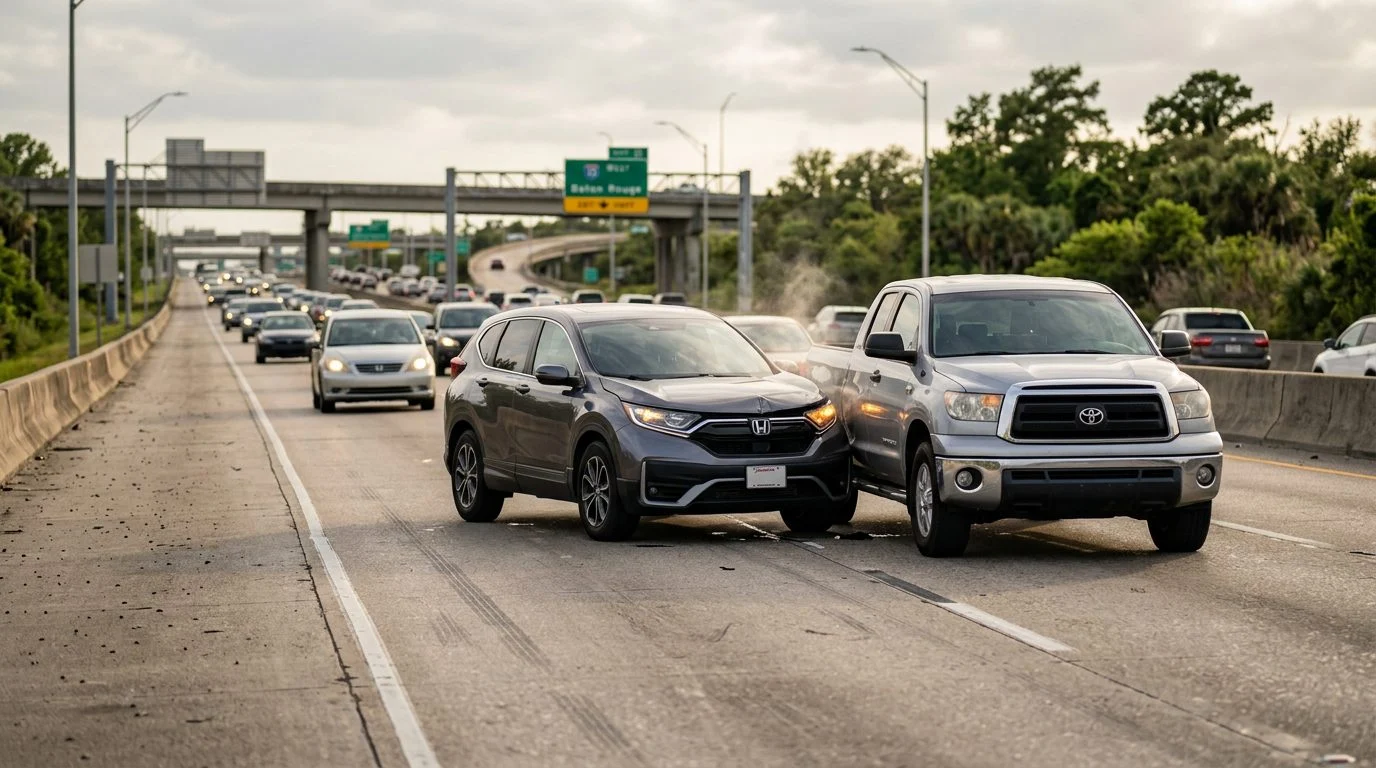
Interstate Crashes | New Orleans, Louisiana
Hit by a Sudden Stop on the Interstate? Talk With a Trial Lawyer Who Focuses on Crash Cases
Przemek Lubecki and our team represent people seriously hurt in car, truck and commercial vehicle crashes, and families in wrongful death cases, across Orleans Parish and Louisiana.
By Przemek Lubecki · Published November 16, 2026
Being hurt when the car ahead of you stops without warning on the interstate is frightening. Many people then wonder who pays for the medical bills, the lost time at work, and the damage to their lives.
Short Answer: Can You Sue a Driver Who Stopped Suddenly on the Interstate?
Yes, in many cases you can bring a claim against a driver who follows too closely or stops without warning and causes a crash that injures you. That claim is against the at-fault driver, and in practice it usually proceeds against that driver’s liability insurance. Whether a claim holds up depends on the facts of the crash, and the sections below explain which facts usually matter most.
If another driver stopped short in front of you on the interstate and you're still dealing with injuries, we're glad to talk through whether a claim against that driver makes sense for you. Talk it through with our team — the first consultation is free, confidential, and carries no obligation.
What a Sudden Stop Crash Claim Has to Show
Every crash case is different, and the specific facts of each collision are what shape how it is reviewed. Louisiana’s civil code says a person is responsible for damage caused by negligence, imprudence, or want of skill. It also says that an act causing damage to another obliges the person whose fault it was to repair it, under La. Civ. Code art. 2315.
Following too closely is one of the clearest examples. La. R.S. 32:81 says a driver shall not follow another vehicle more closely than is reasonable and prudent. The driver must consider the speed of that vehicle and the traffic and condition of the road.
Road conditions and the circumstances at the time of a crash, including sudden stops, are among the facts reviewed in a case. A driver who brakes hard for no clear reason, or who fails to keep a proper lookout, may be found at fault.
Claims usually cover medical bills, lost income, and pain and suffering. Art. 2315 limits some future medical costs to those directly related to a manifest physical or mental injury, so the medical picture matters.
How Louisiana’s At-Fault System Affects Your Claim
Louisiana looks at fault, not at a no-fault payout. The driver whose fault caused the crash is the one answerable for the harm, which is why the other driver’s conduct is the center of the case.
Fault can also be shared. La. Civ. Code art. 2323 changed for accidents and injuries on or after January 1, 2026. Under the current text, a person found 51 percent or more at fault cannot recover damages. A person found less than 51 percent at fault has damages reduced in proportion to their own share of fault. The earlier version of the article applied a different rule, so the crash date matters.
A driver may argue that a hazard forced a sudden stop, such as debris or a vehicle cutting in. The facts of the stop, the traffic, and the following distance are weighed against that argument. Art. 2323 also says fault is assigned to everyone who contributed, whether or not they are a party to the case.
Evidence That Shows Who Caused the Sudden Stop
The evidence that matters most shows how the vehicles moved in the seconds before impact. Start with the crash report. Under La. R.S. 32:398, crash reports are confidential. Under La. R.S. 32:398, crash reports are confidential and are made available only to the parties to the crash, parents or guardians of a minor who is a party to the crash, insurers or an insurance support organization under contract to provide claims and underwriting of any party which is the subject of the report, healthcare providers or their agents who rendered healthcare services to a party which is the subject of the report, succession representatives, the attorneys of the parties or succession representatives, and news-gathering organizations that request documents related to a specific crash; upon request, crash reports are made available to these persons within seven working days following the completion of the crash investigation.
Photos and video matter too. The same statute says law enforcement agencies must provide copies of crash photographs and video to any interested person on request, and they may charge a reasonable fee.
Other useful evidence includes:
- Names and contact details of witnesses, including passengers and other drivers who saw the stop.
- Dashcam footage and nearby business or traffic camera video, which are often overwritten on a schedule, so ask early.
- Vehicle damage patterns and braking marks that show the order of impacts.
- Medical records that tie your injuries to the crash.
If the other driver’s insurer asks for a recorded statement, be careful.
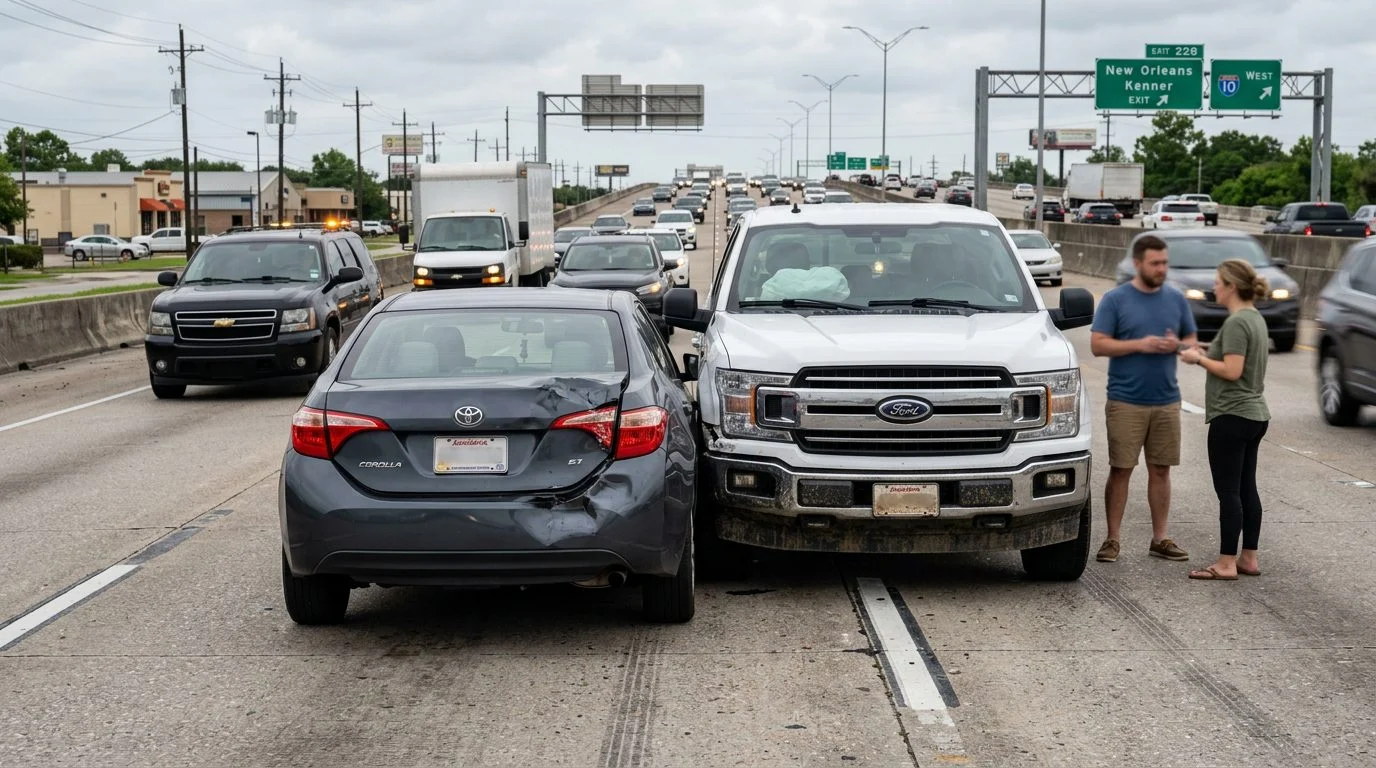
Interstate Chain-Reaction and Multi-Vehicle Crashes
In a chain-reaction crash, more than one driver may share responsibility. Each driver’s conduct is weighed on its own facts. Under La. Civ. Code art. 2324, liability for damages caused by two or more persons is a joint and divisible obligation. A joint tortfeasor is not liable for more than their own degree of fault.
Interstate traffic moves fast, and that speed affects how following distance is judged. This matters on routes such as I-10 and I-610 in Orleans Parish, where traffic can slow quickly and without much warning.
Trucks change the analysis. For a motor truck on a highway outside a business or residential area, La. R.S. 32:81 says the driver shall not follow another motor truck within four hundred feet. If a commercial vehicle is part of the chain, the claim may involve different insurance and rules. American Trial Lawyer, LLC handles truck and commercial vehicle accident claims, and it may associate or refer a case to other law firms.
Insurance Coverage, Limits, and Uninsured Drivers
Louisiana requires every self-propelled motor vehicle registered in this state, except agricultural or forest vehicles during seasons when they are not used on the highway, certain exhibit, parade, and lease-bound mobile rig hauler vehicles, to be covered by liability security, such as an automobile liability policy or bond. Under La. R.S. 32:861, a “motor vehicle liability bond” must cover at least fifteen thousand dollars for injury to or death of any one person and thirty thousand dollars for injury to or death of more than one person in a single accident, while policy liability limits are defined by R.S. 32:900(B)(2) or 900(M).
Those minimums can be far below the cost of a serious injury. That gap is why the at-fault driver’s coverage is only one part of the picture.
Uninsured motorist coverage can help when the at-fault driver has no insurance or too little of it. Under La. R.S. 22:1295, automobile liability policies for any motor vehicle designed for use on public highways and required to be registered in this state must include uninsured motorist coverage unless any insured named in the policy rejects it, selects lower limits, or selects economic-only coverage. Check your own policy’s declarations page to see what you have.
Not sure what your next step is?
Talk it through with our team — the first consultation is free, confidential, and carries no obligation.
Louisiana Filing Deadline and Documenting Your Injuries
Louisiana sets a short deadline for injury claims. Under La. Civ. Code art. 3493.1, delictual actions are subject to a liberative prescription of two years. That period starts running from the day the injury or damage is sustained.
The statute also contains exceptions for certain cases, so timing in any one claim needs a close look. Delay also makes evidence harder to gather, so do not wait to start.
Keep records of every medical visit, prescription, missed workday, and out-of-pocket cost. Note any follow-up care a medical provider recommends.
If you are on Medicare, coordination rules apply. CMS explains that when a person entitled to Medicare was in an accident involving liability insurance, that insurance pays first for accident-related care, and Medicare pays second. If a settlement is reached, Medicare conditional payments must be repaid.
If the crash caused a death, a family may have its own claim. Our wrongful death practice area covers those cases.
Next Steps After a Sudden Stop Crash
The next steps are to get medical care, preserve evidence, and track your deadlines. Get checked even if you feel you can walk it off, because some injuries appear hours or days later.
Report the crash, and write down the other driver’s name, insurer, and plate number. Save photos, texts, and receipts. Be careful with any recorded statement, and request a copy under the statute if you give one.
If you were hurt when a car ahead of you stopped suddenly on the interstate, you don’t have to sort out the insurance, the evidence, and the deadline on your own. Request a free case evaluation through our contact page or call 855-LUBECKI. The first consultation is free, confidential, and without obligation to continue.
Przemek Lubecki is the responsible lawyer for this page, and the firm’s office is in New Orleans. American Trial Lawyer, LLC may associate or refer a case to other law firms.
Frequently Asked Questions
Can I sue a driver who stopped suddenly in front of me?
Yes, a claim may be possible when the driver’s fault caused the crash and your injuries. The facts of the stop decide the outcome.
Does Louisiana use no-fault insurance for car crashes?
No, Louisiana looks at which driver’s fault caused the harm. Fault can be shared, and the 2026 rule on shared fault turns on a 51 percent line.
How long do I have to file?
Under Louisiana law, delictual actions generally have a two-year period that starts from the day of injury, with some exceptions.
How our firm approaches a sudden stop crash
Careful review of the facts
Every interstate crash has its own details. We look closely at the traffic conditions, the vehicles involved and the sequence of events before discussing what may come next.
Attention to evidence
Photos, dashcam footage, vehicle damage and witness information can be important. We help people understand what to keep and why it may matter.
Families included
When a crash causes a death, we focus on the needs of the surviving family members in wrongful death matters.
Rooted in Louisiana
Our office is in New Orleans, and we represent people across Orleans Parish, the New Orleans metro and throughout Louisiana.
Before you speak with an insurance company
Adjusters may ask for a recorded statement or a quick settlement soon after a crash. You do not have to answer those questions alone. Talking with a lawyer first can help you understand your options. Our firm may associate or refer a case to other law firms.
Details that are often reviewed after a sudden stop
Following distance
How far back vehicles were traveling, and whether there was time to react, is often examined in these crashes.
Reason for the stop
Traffic, debris, a disabled vehicle or a sudden lane change can each lead to very different questions.
Vehicles involved
Passenger cars, trucks and commercial vehicles may carry different records, equipment and insurance.
Medical records
Records from the first days after a crash help document injuries, including head and brain injuries that may not show right away.