
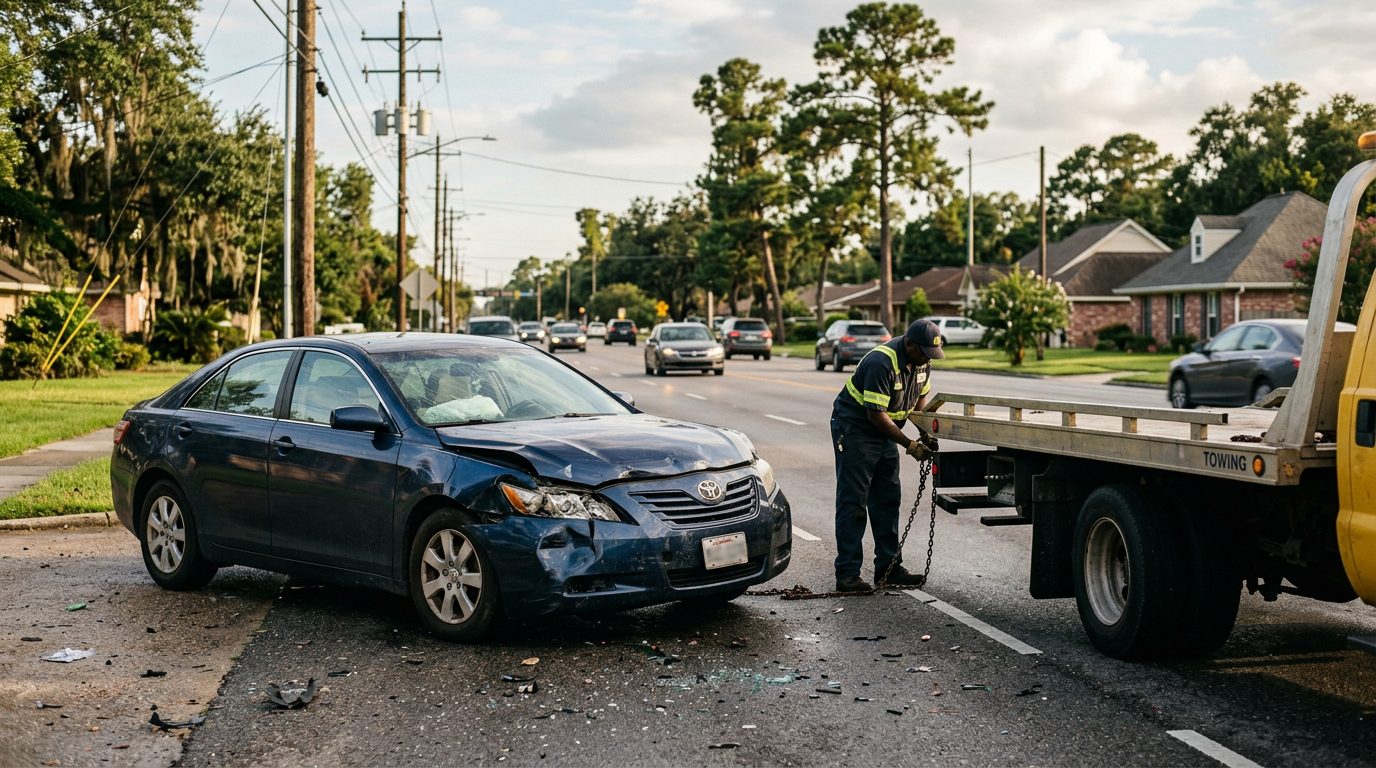
Car Accidents | New Orleans, Louisiana
Louisiana Car Accident Insurance Notice: Know the Steps Before You Call
Conversations with insurance companies after a crash can shape what happens next. Przemek Lubecki and the team at American Trial Lawyer, LLC explain the questions to think about early.
By Przemek Lubecki · Published November 11, 2026
A car crash can leave you with a damaged vehicle, new pain, and an insurance company asking questions, all at once. If you are asking about the deadline to notify insurance after a car accident in Louisiana, you are really asking two questions. Your own policy sets when you must report the crash to your insurer. Louisiana law sets a two-year deadline for filing a lawsuit over injury or damage (La. Civ. Code art. 3493.1). This page explains each one in plain terms, so you can tell which clock is which.
Two Different Clocks: Notifying Your Insurer vs. Filing a Lawsuit
Notifying your insurer and filing a lawsuit are separate duties with separate timing. Your policy’s notice wording controls the first. Louisiana’s filing rules control the second, and a claim sent to an insurer is not a lawsuit. This page covers your policy’s notice clause, the two-year filing period, the other driver’s insurer, medical payments coverage, what to say, rear-end fault, and common questions. For the wider process, read our guide to car accident claims in Orleans Parish.
Not sure what your next step is?
Talk it through with our team — the first consultation is free, confidential, and carries no obligation.

What Your Policy’s Notice Clause Requires
Your policy’s notice clause decides when and how you must report the crash to your own insurer. Notice wording varies from policy to policy, so the language in your policy is the controlling text. Many notice clauses ask for prompt notice of an accident or a claim. That duty can apply even if no lawsuit has been filed.
Prompt notice usually means giving your insurer the basic facts. Include the date, time, and location of the crash, the drivers and vehicles involved, and any injuries or property damage you know about. Louisiana law also sets duties at the scene. Under La. R.S. 32:398, a driver involved in a crash resulting in injury to or death of any person, or property damage in excess of five hundred dollars, must give his name, address, and the registration number of the vehicle he was driving. Under La. R.S. 32:398(J), when a law enforcement officer has reason to believe that a person involved in a crash has a medical condition that may be cause for revocation or suspension of a license, notification of that condition is made to the medical/conviction unit of the Department of Public Safety and Corrections, office of motor vehicles, but only after the officer first consults with a superior officer about the specific observations and the superior officer concurs with the issuing officer’s belief. On request, and if one is available, the driver must also show a driver’s license to any person injured in the crash, to the driver or occupant of or person attending any vehicle or other property damaged in the crash, or to any police officer at the scene or investigating the crash.
The same statute covers crash reports. Upon request by the parties to the crash and the other persons the statute lists, they are available within seven working days after the crash investigation is complete. Delay in reporting can lead to questions about coverage, so reporting promptly is the safer course.
Louisiana’s Deadline to File a Lawsuit: Two Years
Under La. Civ. Code art. 3493.1, delictual (tort) actions are subject to a two-year liberative prescription. Prescription here means a filing deadline. The period starts to run on the day the injury or damage is sustained. The current text was enacted by Acts 2024, No. 423, effective July 1, 2024.
That start date matters. The clock runs from the day of the injury or damage, not the day you first called an insurer or spoke with a lawyer. The statute also contains exceptions, so the deadline depends on the facts of your claim.
Under La. Civ. Code art. 3493.1, delictual actions are subject to a two-year liberative prescription that runs from the day injury or damage is sustained; how filing a suit interrupts prescription is governed by a different article, La. Civ. Code art. 3462. Under La. Civ. Code art. 3462, prescription is interrupted when an action is commenced in a court of competent jurisdiction and venue. Under La. Civ. Code art. 3463, that interruption lasts as long as the suit is pending. If the plaintiff abandons the suit, voluntarily dismisses it, or fails to prosecute it at trial, the interruption is treated as if it never occurred. The dismissal of a suit pursuant to a compromise does not count as a voluntary dismissal.
Reporting to the Other Driver’s Insurer and Property Damage
Your insurer and the other driver’s insurer are separate companies. Notifying your own insurer is a step you can take directly, even while the other driver’s insurer is still reviewing the crash. Keep a written record of each report you make, including the date, the person you spoke with, and the claim number they gave you.
Vehicle repair and rental claims can follow their own steps and timing under your policy (physical-damage incident claim instructions). Each insurer runs its own process, so timing varies from claim to claim. Keep receipts, repair estimates, and photos of the damage.
Louisiana law also addresses how a property damage settlement is treated. Under La. R.S. 22:1290, a settlement under a motor vehicle liability policy of a claim for damage to property owned by another person is not an admission of liability by the insured on any other claim arising from the same accident or event. It is also not the insurer’s recognition of liability on any other claim from the same accident.
Medical Payments Coverage and Injuries That Show Up Later
Medical payments coverage, often called MedPay, is an optional coverage in some auto policies. It can help with certain medical costs after a crash, subject to the limits and terms of your policy. MedPay usually has its own notice and paperwork steps, so check with your insurer about them early. Our page on medical payments coverage for car accidents in New Orleans explains that coverage in more detail.
Pain and other symptoms sometimes appear days after a crash, not right away. Report new symptoms to your insurer and to a medical provider as soon as you notice them. Your medical records also become part of the claim paperwork, so keep copies of every visit.
Keeping them in one place helps you and anyone helping you.
What to Say and What to Avoid When You Report the Crash
Stick to facts you know when you report the crash. Give the date, the place, the vehicles, the drivers, and whether anyone was hurt. Avoid guesses about speed, fault, or injuries you do not yet know. A short, accurate account is easier to build on later than a guess you have to correct.
An insurer may ask for a recorded statement. Louisiana law gives you a right to a copy of one you give. Under La. R.S. 13:3732, a person who takes a written, recorded, or transcribed statement from an injured person must furnish a true and complete copy. The copy is due within twenty days after a written demand. If the holder refuses that request, the statement cannot be used in a civil action on the same subject.
You may ask for time to review a request before you agree to give a statement. You may also speak with a lawyer before you do. Keep copies of everything you send or receive, including photos, claim numbers, crash report numbers, letters, emails, and medical records.
Not sure what your next step is?
Talk it through with our team — the first consultation is free, confidential, and carries no obligation.
Who Is Usually at Fault in a Rear-End Collision?
Louisiana law divides fault by percentage among everyone who contributed to a crash. Under La. Civ. Code art. 2323, the fault of all persons causing or contributing to an injury is determined. This applies whether or not each person is a party to the case. The text was amended effective January 1, 2026.
Notwithstanding paragraphs A and B, paragraph C of La. Civ. Code art. 2323 provides that if a person suffers injury, death, or loss as a result partly of his own negligence and partly as a result of the fault of an intentional tortfeasor, his claim for recovery of damages shall not be reduced.
In a rear-end crash, the following-distance rule often comes up. Under La. R.S. 32:81, a driver shall not follow another vehicle more closely than is reasonable and prudent. That standard looks at the speed of the vehicle, the traffic, and the condition of the highway. The facts of each crash, including what each driver was doing before the impact, shape how fault is divided.
Frequently Asked Questions
Can I still sue months after a crash in Louisiana?
Louisiana’s two-year period generally applies to delictual claims, so a suit filed after that period may not be timely. Check the start date against the day your injury or damage was sustained.
Does reporting to my insurer stop the deadline?
Unless otherwise expressly provided by legislation, under La. Civ. Code art. 3462, prescription is interrupted when the obligee commences action against the obligor in a court of competent jurisdiction and venue.
Do I have to report if I was not hurt?
Your policy’s notice wording decides that question. Under La. R.S. 32:398, a crash resulting in injury to or death of any person, or property damage in excess of five hundred dollars, carries a duty for the driver to give his name, address, and the registration number of the vehicle he was driving; if the crash occurs in an area under an evacuation order or a declared state of emergency, the driver shall comply within seventy-two hours after the crash with the duties to give notice of the crash to the police and to give his name, address, and registration number.
Can a lawyer handle this for me?
Our firm handles car accident claims and may associate or refer a case to other law firms.
Talk With Our New Orleans Office About Your Crash
Przemek Lubecki is the responsible lawyer for this page, and our office is in New Orleans. You can request a free case evaluation or call 855-LUBECKI to reach our New Orleans office. The first consultation is free, confidential, and without obligation.
Keeping Your Options Open After a Crash
Write down the facts
Record the date, time, location, weather, and how the crash happened while the details are still fresh.
Track when you gave notice
Keep a record of when and how you first contacted your insurer, including the names of people you spoke with.
Think before recorded statements
Adjusters may ask for recorded statements early. It is reasonable to ask questions and take time before answering.
Save every communication
Keep letters, emails, texts, and claim numbers together so the full timeline is easy to review later.
Timing Can Matter
Insurance notice and filing questions can be technical, and the timing of each step may affect your options. A free, confidential consultation with Przemek Lubecki can help you sort out your situation. Our firm may associate or refer a case to other law firms when that is in the client's interest.
Practical Steps After a Crash
Get medical care
Seeing a doctor promptly creates a record of your injuries, even if they feel minor at first.
Document the scene
Photos of vehicles, roadway conditions, and any visible injuries can help preserve what happened.
Keep copies of everything
Hold onto repair estimates, medical bills, and correspondence with insurers in one organized place.
Pause before signing
Settlement papers and release forms deserve a careful read before you sign anything.