
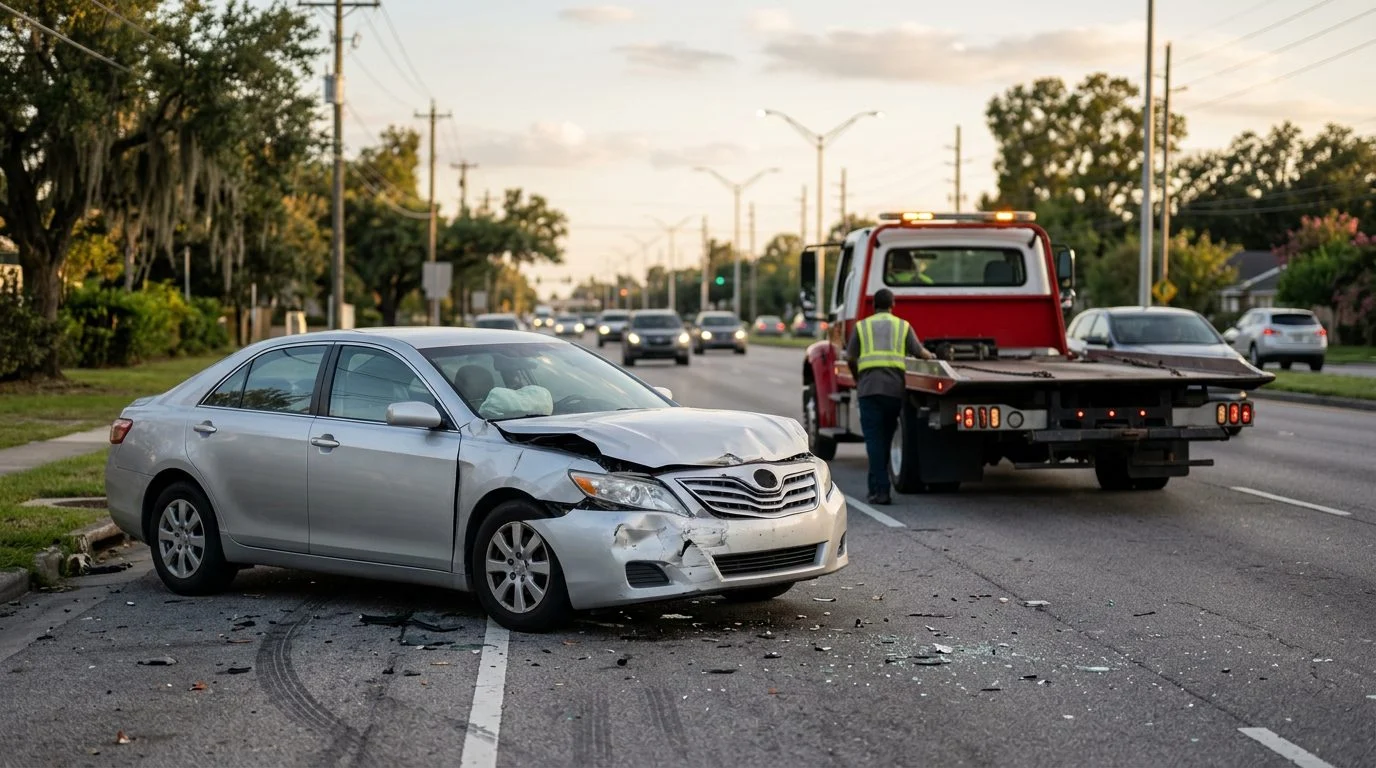
Truck Accidents | New Orleans, Louisiana
Understanding a Fatal Truck Crash in New Orleans
Losing someone in a truck crash brings grief, confusion and hard questions. This guide explains what families often face, led by trial lawyer Przemek Lubecki of our New Orleans office.
By Przemek Lubecki · Published November 8, 2026
New Orleans Truck Driver at Fault in Fatal Crash
If you lost a loved one in a crash you believe a truck driver caused, you don't have to sort out the questions alone. Request a free case evaluation with us. Talk it through with our team — the first consultation is free, confidential, and carries no obligation.
What It Means When a Truck Driver May Have Caused a Fatal Crash
A truck driver may have caused a fatal crash when careless driving contributed to the death. In Louisiana, that is a question of fault, and it is looked at separately from any police or criminal process.
Losing someone in a crash with a large truck is a shock. Families often face many questions at once. Who was at fault? What happened on the road? What records exist? How much time is there to act? This guide explains the general framework behind those questions.
Louisiana law makes a person responsible for harm caused by negligence, meaning careless or unreasonable conduct. La. Civ. Code art. 2316 describes this responsibility. A police report or traffic citation can be part of the picture. But a finding in one process does not automatically decide the other.
This page explains general concepts only. It does not predict how any particular case would be decided. For an overview of the framework, read our Louisiana wrongful death law guide.
How Fault Is Examined in a Fatal Truck Crash
The focus is on conduct, not on the result alone.
For the truck driver, the common questions are general ones. Was the speed right for the road and the weather? Was the following distance safe? Were lane changes made with care? Was the driver tired, distracted or impaired? Did the driver obey signals and signs?
A serious crash does not, by itself, show who did what. The analysis rests on the sequence of events. That sequence is built from physical evidence, witness accounts and vehicle data.
Louisiana also uses comparative fault, a rule that divides responsibility by percentage. Under La. Civ. Code art. 2323, the fault of everyone who contributed is determined. That includes people who are not parties to the suit. Under La. Civ. Code art. 2323(A)(2)(a), a person whose own negligence is equal to or greater than fifty-one percent is not entitled to recover damages. Under La. Civ. Code art. 2323(A)(2)(b), where the injured person’s own negligence is less than fifty-one percent, the amount of damages recoverable is reduced in proportion to that negligence. The amended version took effect January 1, 2026.
Which Parties May Be Responsible Besides the Driver
The trucking company may share responsibility, and other parties may too. Which parties fit depends on the facts.
Under La. Civ. Code art. 2320, employers answer for damage caused by their employees while those employees do the work they were hired to do. Responsibility attaches only when the employer might have prevented the act and did not.
A company’s own conduct can also be at issue. See Roberts v. Benoit, 605 So. 2d 1032 (La. 1991).
Other parties may include another motorist whose conduct contributed, a company that loaded or secured cargo, or a repair contractor whose work affected the truck.
Federal Trucking Rules and Why They Often Come Up
Federal rules for commercial truck drivers cover driving hours, driving logs, post-crash testing and driver files. These records often come up after a fatal crash.
Under 49 C.F.R. § 395.3(a)(3)(i), a driver may drive a total of 11 hours during the period specified in § 395.3(a)(2), which runs for 14 consecutive hours after the driver comes on duty following 10 consecutive hours off duty. Except for drivers who qualify for a short-haul exception, driving is not allowed after more than 8 hours of driving time without at least a 30-minute interruption. Weekly limits also apply, depending on how often the carrier runs trucks.
49 CFR 395.8 says no driver or carrier may make a false report about duty status. It also bars tampering with an electronic logging device so that it fails to record data accurately.
After certain crashes, 49 CFR 382.303 requires the employer to test surviving drivers for alcohol and controlled substances. Testing is required for a surviving driver who was performing safety-sensitive functions if the crash involved a death. In non-fatal crashes it is required when the driver receives a citation under State or local law for a moving traffic violation arising from the crash (within 8 hours of the crash for the alcohol test and within thirty-two hours for the controlled substances test), and someone, as a result of an injury, immediately received medical treatment away from the scene, or a vehicle had disabling damage and had to be towed away. If an alcohol test is not given within two hours, the employer must keep a record of the reasons.
A rule violation is not the same as automatic liability. It can be one piece of the picture. For how families approach suits after a semi crash on I-10, read our I-10 semi crash guide.
Why Records and Deadlines Are Time-Sensitive
Crash records can be lost, and the Louisiana filing deadline is the date families most need to track. Acting early helps keep records and options in view.
The rule does not excuse compliance with the lawful requirements of any other government body that sets longer periods for a category of records (49 C.F.R. § 379.3).
Electronic logging data, dispatch messages, GPS records and dashcam video can be overwritten or purged through routine practices. Vehicle event data recorders can preserve technical crash information and driver inputs, according to NHTSA on event data recorders. Evidence families often hear about includes the police crash report, photographs, scene measurements, witness contacts, nearby camera video and the truck itself.
Under La. Civ. Code art. 2315.2, a wrongful death suit prescribes one year from the death or two years from the day the injury was sustained, whichever is longer. Prescription is Louisiana’s term for a filing deadline. Medical malpractice wrongful death claims follow a one-year period from death under the same article. The exact period and any exceptions should be confirmed for the facts of the case.
Not sure what your next step is?
Talk it through with our team — the first consultation is free, confidential, and carries no obligation.
Who May Bring a Wrongful Death Claim in Louisiana
Louisiana law sets out, in order, which family members may bring a wrongful death suit. Eligibility turns on the family relationships involved.
Under La. Civ. Code art. 2315.2, a surviving spouse and child or children may sue. If there is no spouse or child, the surviving father and mother, or either of them, may sue under La. Civ. Code art. 2315.2. Brothers and sisters may sue if the deceased left no spouse, child or parent. Grandparents may sue only if none of those family members survive. Adoptive relationships count under the same article.
The deceased person’s own injuries are handled separately. Under La. Civ. Code art. 2315.1, the right to recover for those injuries survives in favor of the same family members, under the same time limits, and the deceased’s succession representative may also urge it in the absence of any class of beneficiary set out in Paragraph A.
Frequently Asked Questions
Who can file a wrongful death suit in Louisiana?
A surviving spouse and children come first under La. Civ. Code art. 2315.2. Parents, siblings and grandparents follow only in the order the article sets out, and a father or mother who has abandoned the deceased during his minority is deemed not to have survived him.
Under the same article, the time limit is one year from death or two years from the injury, whichever is longer, but for medical malpractice actions the time limit is one year from death. Confirm the exact period for your facts.
Can a trucking company be responsible?
Under La. Civ. Code art. 2320, the company may be answerable if the driver was doing the work the company hired them to do when the crash happened. The article’s text says this responsibility attaches only when the employer might have prevented the act that caused the damage and did not.
Talking With Przemek Lubecki About Your Family’s Situation
Przemek Lubecki is the responsible lawyer for this page. Our office is in New Orleans, Louisiana.
A family in this position often faces the driver, the company, the records and the deadline all at once. If you lost a family member in a crash you believe a truck driver caused, you don’t have to sort through these questions alone. Request a free case evaluation to talk through the crash, the records you already have and the parties involved. You can also call 855-LUBECKI.
The first consultation is free, confidential and without obligation to continue. The firm may associate or refer a case to other law firms.
How we approach these cases
Respect for your family
We understand that a family is dealing with a loss, not just a legal matter. We take the time to listen before discussing next steps.
Careful review of the record
Crash reports, trucking company records, driver logs and maintenance files can all matter. We work to understand what the records show.
Clear communication
We explain options in plain language so you can make informed decisions at your own pace.
Advocacy for fair compensation
We focus on holding responsible parties accountable and seeking fair compensation for the family's losses.
Act early to protect evidence
Trucking companies keep logs, electronic data, maintenance records and inspection files, and some of this information may be overwritten or discarded over time. If your family is facing a fatal truck crash, talking with a lawyer early can help with preserving what matters.
Common questions families raise
Immediate needs
Funeral arrangements, medical bills and lost income can arrive all at once. Our team can help you sort out what to address first.
Records and evidence
Police reports, photos, witness information and company records can be central to understanding how the crash happened.
Who may bring a claim
Louisiana law sets out who may bring a wrongful death claim. Our office can review your family's situation and explain how the law may apply.
Working with other firms
American Trial Lawyer, LLC may associate or refer a case to other law firms. We will tell you clearly if that happens.