
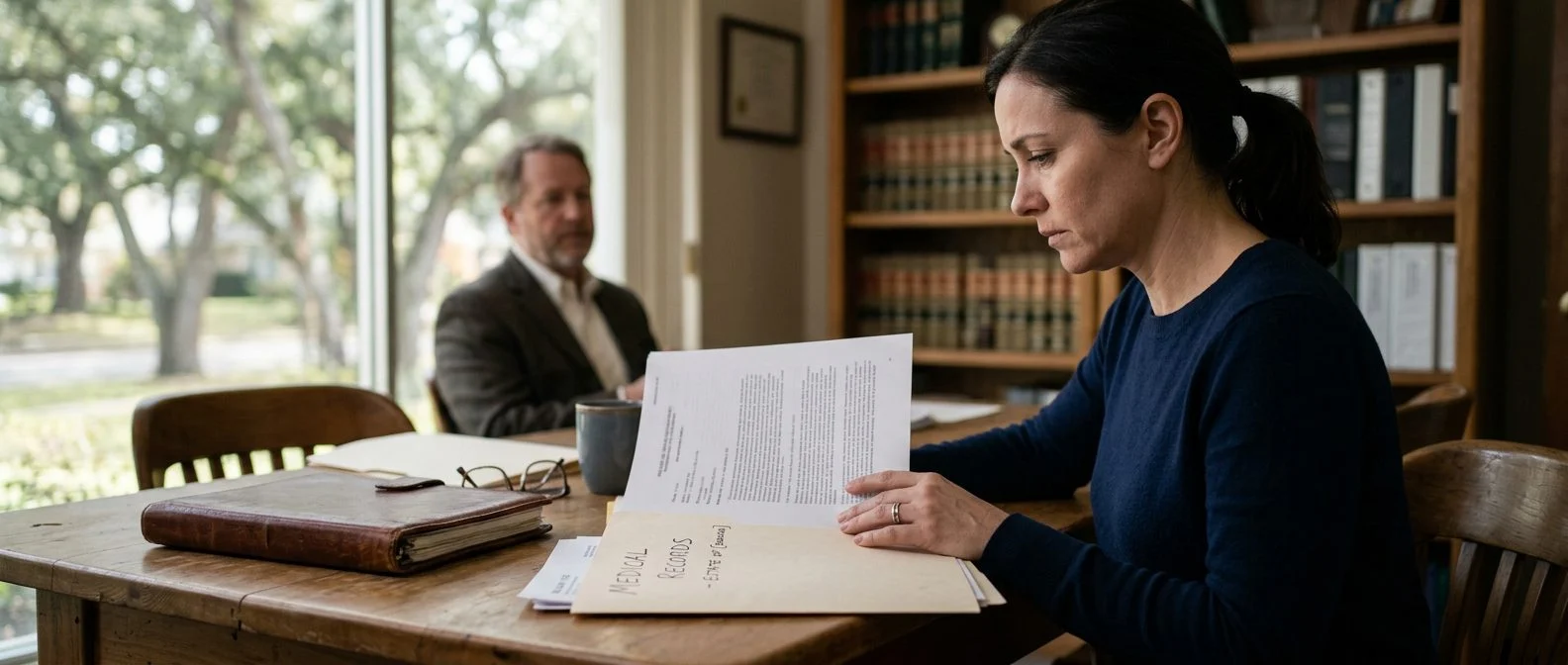
Family Medical Records After a Fatal Crash in Louisiana
The Short Answer: Families Can Often Request Records With Proof of Authority
If you’re asking whether a family can get medical records after a loved one dies in a crash in Louisiana, the answer is often yes. The request usually has to come from someone the provider accepts as authorized to act for the patient. Each hospital, clinic and ambulance service sets its own release process.
Most requests are made in writing. Expect to show identification, proof of how you are related to the person who died, and documents showing your authority to ask. Providers can take time to respond, so it helps to start early.
The paperwork can feel overwhelming in the first weeks after a death. This page walks through the general process. The details depend on the facts of the death and on whether an estate has been opened.
Who Can Usually Request the Records
The executor or administrator of the estate is the person providers most often recognize. A court can also appoint a representative to act for the estate. If no representative exists yet, the provider may ask for papers that show how the requester is related to the person who died. Examples include a marriage record for a spouse or a birth certificate for a child.
Relationship matters for a second reason. Louisiana law sets out who may bring a wrongful death suit, and the order is specific. The surviving spouse and child or children come first. If there is no spouse or child, the surviving father and mother, or either of them, may sue. Brothers, sisters and grandparents follow, each only if the closer group is absent (La. Civ. Code art. 2315.2). The person who requests records may not be the same person who can bring a claim.
Before you send anything, ask the hospital or clinic which documents it requires. Release forms and proof rules differ from provider to provider. A short phone call can prevent a rejected request and a second round of paperwork.
Proof of Death and Family Relationship Documents to Gather
Providers usually ask for an official copy of the death certificate, a photo ID for the person making the request, and documents that prove authority or family ties. Gather these before you call, so you can answer questions on the first try.
Most families collect these items:
- An official copy of the death certificate, not a plain photocopy
- A government-issued photo ID for the requester
- Letters of authority or a court order, if an estate has been opened
- Birth, marriage or other records that show how you are related
Organizations often want official copies rather than plain photocopies. Ask for more than one copy at the same time. Banks, insurers and providers often each want their own.
Keep a short checklist with the date of death, the name of the hospital or facility, and the patient’s full legal name and date of birth. Most release forms ask for these details. Having them ready speeds up the request.
How to Get an Official Louisiana Death Certificate
You can request an official Louisiana death certificate through the state’s official process. Ask the funeral home whether it can help order copies, and which request methods it uses. Ask what each method costs, too.
Processing time varies, so plan for a wait. Order several copies at once, so you won’t need to request more later.
A death certificate confirms the death. It does not contain the medical chart. Providers often ask for it before they release records, so it’s usually an early step in the process.
Medical, EMS, and Funeral Records That May Exist
Hospital records are the main medical file. They may include admission notes, imaging, lab results, discharge or transfer summaries, and billing statements. Ask for the complete chart, not only a summary.
Other records may sit elsewhere. An ambulance or fire-based crew that responded to the scene may keep an EMS run report. That report is kept apart from the hospital chart, so it needs its own request.
When the coroner investigates a death, an autopsy report or toxicology report may be held by the coroner’s office. Ask that office how copies are released. Its process may differ from the hospital’s.
The funeral home may also hold family information forms and the worksheet used for the death certificate. Keep copies of everything you receive, and write down who gave it to you and when.
Crash Records That Work Alongside the Medical File
Medical records show injuries and treatment. Crash records show how the collision happened. Families often need both to understand a fatal crash.
Louisiana limits who can see a crash report. Under La. R.S. 32:398, crash reports are confidential. They are available to the parties to the crash, parents or guardians of a minor who is a party to the crash, insurers, or an insurance support organization under contract to provide claims and underwriting, of any party which is the subject of the report, any healthcare provider, or their agent, that rendered healthcare services to any party which is the subject of the report, the succession representatives of those parties or the attorneys of the parties or succession representatives, or a news-gathering organization that requests documents related to a specific crash. Upon request, they must be made available within seven working days after the crash investigation is complete.
The same statute addresses crash reports and their availability. A copy of the crash report may cost up to $5 for a report of two pages or fewer, and up to $20 for a report over two pages, inclusive of all service fees and charges.
If you need insurance information on a vehicle, the state keeps a record of coverage declared after a crash. On written request and payment of a fifteen dollar fee, it forwards that information under La. R.S. 32:871.
If your loved one gave a written or recorded statement about the crash, Louisiana law sets a clear rule. The person who holds the statement must give a true and complete copy to the person who made it, or that person’s personal representative, within twenty days after written demand (La. R.S. 13:3732).
Commercial trucks add another layer. 49 C.F.R. § 395.20 provides: (a) Scope. This subpart applies to ELDs used to record a driver’s hours of service under § 395.8(a). (b) Applicability. An ELD used after December 18, 2017 must meet the requirements of this subpart. Driver logs and company records can matter in a truck or commercial vehicle crash. Families can also read about traffic camera and 911 recordings in a fatal crash.
How to Organize and Preserve the File, and Why Timing Matters
Start with a simple system. Make one folder, paper or digital, for each source: hospital, EMS, coroner, funeral home and crash records. Log every request with the date sent, the method used and the contact person’s name.
Keep original documents in a safe place. Scan them and store the scans in at least one other location. Some record holders keep files only for limited periods, so request what you need early.
Timing matters for the legal side, too. Under La. Civ. Code art. 2315.2(B), a wrongful death right of action prescribes, meaning it runs out, one year from the death or two years from the day the injury was sustained, whichever is longer, except that for medical malpractice actions the right of action prescribes one year from the death of the deceased (art. 2315.2(F)). The time limit applies to each case on its own facts, so don’t wait to start gathering records. The Orleans Parish wrongful death guide covers the time limit and the process in more detail.
Talk With Przemek Lubecki About Your Family’s Records
Many readers are requesting records for a parent, child, spouse or sibling. Some are also planning a funeral and trying to understand what happened on the road. Paperwork in that season can feel like one more weight to carry.
Przemek Lubecki is the responsible lawyer for this page. The office is in New Orleans. The firm handles wrongful death, car, truck, commercial vehicle, motorcycle, rideshare, brain injury and negligent security matters. If the firm takes a case, it may associate with or refer that case to other law firms.
Common Questions
Can a family get medical records after a loved one dies in a crash in Louisiana?
Often yes, if the requester has the authority the provider asks for. Each provider sets its own process.
Who can request a crash report in Louisiana?
Under La. R.S. 32:398, it is available to the parties to the crash, parents or guardians of a minor who is a party, the parties’ insurers or contracted insurance support organizations, healthcare providers who treated a party (or their agents), succession representatives, the attorneys of parties or succession representatives, and news-gathering organizations asking about a specific crash.
Who can bring a wrongful death claim?
Louisiana law lists the surviving spouse and children first, then parents, then siblings and grandparents, in that order.
Is a death certificate the same as the medical chart?
No. A death certificate confirms the death, but the medical chart is a separate set of records.
If you’re gathering records for someone you lost in a crash, you don’t have to face the paperwork alone. Call 855-LUBECKI (Office in New Orleans) or request a free case evaluation to talk with us.