
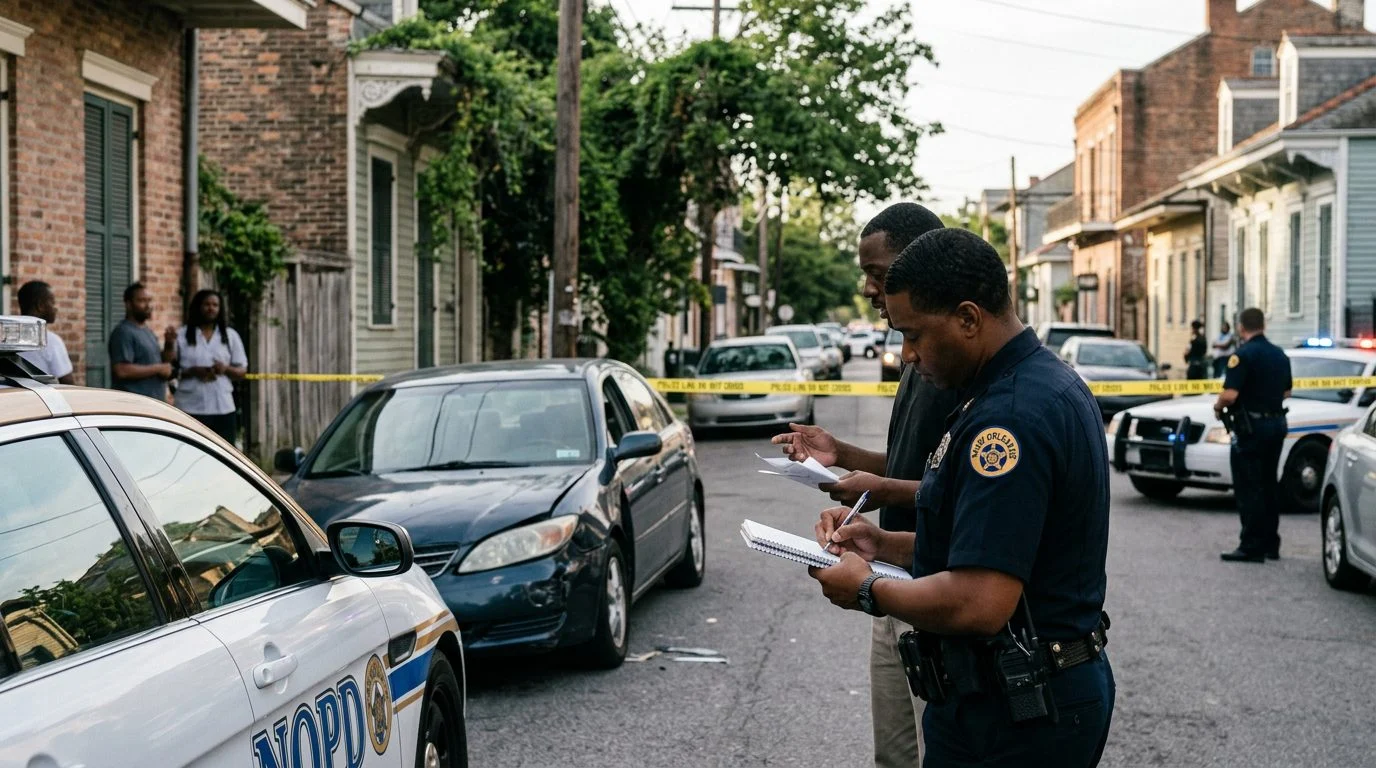
Wrongful Death & Crash Reports | New Orleans, Louisiana
Getting the Police Report After a Fatal Crash in New Orleans
Losing someone in a crash is hard enough without paperwork getting in the way. Here is how to request the report, what to have ready, and where to start.
By Przemek Lubecki · Published October 22, 2026
To get the police report after a fatal crash, first find out which agency investigated. Fatal crash files can take longer than other reports, so start early and keep a record of every request.
This guide answers the question many families ask: how do I get the police report after a fatal crash in New Orleans? It covers who holds the report, what to gather, how to ask, and what a report can and cannot show. American Trial Lawyer is a New Orleans firm that handles wrongful death cases.
What the Police Report Is and Why Families Ask for It
The police crash report is the investigating agency’s written record of a crash. It lists the date, time and location. It identifies the vehicles and people involved. It also records what the investigating officer documented at the scene.
Losing someone in a crash is hard. Many families ask for this report while they are still grieving. The request can feel like one more task on a long list. You don’t have to understand every page at once. Start with the basic facts and build from there.
Families often need the report for practical reasons. It gives a written starting point for what happened. It helps families sort out the facts before they make decisions about insurance, medical records or a possible lawsuit. Those decisions can wait while you gather information. The report is one piece of the picture, not the whole story.
If you are still waiting on a fatal crash report in New Orleans, you don't have to work out the next steps alone. Reach out to our team for a free, confidential first consultation. Talk it through with our team — the first consultation is free, confidential, and carries no obligation.
Which Agency Holds the Report
The agency that investigated the crash usually keeps the report. Under La. R.S. 32:398, the police department of a city or town investigates crashes inside its corporate limits. State police or a sheriff’s office investigate crashes outside those limits. In New Orleans, that is usually the New Orleans Police Department (NOPD).
Location decides the agency, so pin down exactly where the crash happened. A crash on a highway in Jefferson Parish or St. Bernard Parish may fall outside city limits. A different agency may hold that file than one in New Orleans. Crashes in Kenner, Metairie and Slidell also turn on the exact location.
Some clues can help. Look for a case, citation or item number on any paperwork you received. Ask relatives or friends who were at the scene for the street name and the agency that arrived. The Louisiana State Police traffic records unit explains who may request crash reports and where copies are available.
Information to Gather Before You Request the Report
Gather these details before you contact the agency:
- The date and approximate time of the crash.
- The exact place: street, intersection or highway, plus any nearby landmark.
- Any report, case, citation or incident number you received.
- The name of the person who died, the other drivers or parties, and vehicle details such as make, model and plate number if known.
- Proof of your relationship to the person who died, such as a death certificate or photo ID. The agency may ask who is making the request.
Louisiana law limits who may receive a crash report. Under La. R.S. 32:398, the reports and their information are confidential. They go to the parties to the crash, parents or guardians of a minor party, insurers or insurance support organizations under contract to provide claims and underwriting, healthcare providers who treated a party, succession representatives of those parties, the attorneys of those parties or representatives, and a news-gathering organization that requests documents related to a specific crash. Ask the agency which proof it needs to confirm your right to receive the report.
How to Request the Crash Report
Contact the investigating agency’s records division before you submit anything. Ask it to confirm the current request process, required forms, identification rules and any copy fees. Procedures can change, so check first.
Agencies must also provide copies of photographs, video and audio on request. They may charge a reasonable fee for those copies.
The City of New Orleans police reports page is linked here for reference. Under La. R.S. 32:398(I)(1)(a), crash reports are exempt from the public-records law, La. R.S. 44:1 et seq. Some copies may have details removed.
Keep a copy of every request, the date you sent it and any confirmation number. Fatal crash files can take longer to finish than other reports, so a written record helps you follow up.
Why a Fatal Crash Report Can Take Longer, and Related Records
Fatal crash investigations often involve more work. Investigators may need to interview witnesses, follow up on vehicle data or coordinate with other agencies. Because of that, the report may take longer than a report for a crash with no death.
The coroner’s investigation into the death is a separate record. Families may need to request it on its own path. Keep it apart from the crash report so the two files don’t get mixed up.
A crash report records what the investigating officer found. Under La. Civ. Code art. 2323, fault is determined for everyone who caused or contributed to an injury or death. Under La. Civ. Code art. 2323, if the degree or percentage of negligence attributable to the person suffering injury, death, or loss is equal to or greater than fifty-one percent, that person cannot recover damages.
Other records can add detail. Photos, video, witness statements and vehicle data sometimes help show how a crash happened. What is available depends on the agency and the facts of the case.
How the Crash Report Fits Into a Wrongful Death Claim
In Louisiana, certain family members may bring a wrongful death suit, in a set order. A surviving spouse and children come first. If there is no spouse or child, the surviving parents may sue, but a father or mother who has abandoned the deceased during his minority is deemed not to have survived him. Abandonment is presumed when the father or mother has left his child for a period of at least twelve months and the father or mother has failed to provide for the child’s care and support, without just cause, thus demonstrating an intention to permanently avoid parental responsibility. Next come siblings, then grandparents, depending on who survives. La. Civ. Code art. 2315.2 sets out that order.
Timing matters. Under the same article, the right to sue ends one year after the death or two years after the injury, whichever is longer, except for medical malpractice actions, which prescribe one year from the death of the deceased. A related survival action follows the same periods under La. Civ. Code art. 2315.1, except medical malpractice survival actions, whose prescriptive period is governed by R.S. 9:5628. Because these time limits matter, families should review their dates early.
Families often gather the crash report with medical records, coroner records and insurance information. Organizing these together early makes later decisions easier. For the broader process, see the Orleans Parish wrongful death guide on this site.
American Trial Lawyer handles wrongful death, truck, car, commercial vehicle, motorcycle, rideshare, brain injury and negligent security matters. The firm may associate or refer a case to other law firms. Przemek Lubecki is the responsible lawyer for this page, and the office is in New Orleans.
Not sure what your next step is?
Talk it through with our team — the first consultation is free, confidential, and carries no obligation.

Talk With Our Team About Your Family’s Situation
If you are still asking how do I get the police report after a fatal crash in New Orleans, you don’t have to work that out alone. Families at this stage are often planning a funeral, answering questions from relatives and trying to understand what happened on the road.
Call 855-LUBECKI or request a free case evaluation to talk through the crash and the report. The first consultation is free, confidential and without obligation to continue. Our office is in New Orleans, and Przemek Lubecki is the responsible lawyer.
Frequently asked questions
How do I get the police report after a fatal crash in New Orleans?
Ask the agency that investigated the crash. For crashes inside city limits, that is usually the New Orleans Police Department. Have the date, location and any case number ready.
Who can receive a Louisiana crash report?
Ask the agency which proof it needs from you.
How long does a fatal crash report take?
Upon request, crash reports must be made available to the persons the law lists, within seven working days following the completion of the crash investigation. Fatal crash investigations can take longer to finish.
Why families bring their questions to us
Focused on serious injury cases
Our work centers on truck, car, commercial vehicle and rideshare crashes, motorcycle accidents, brain injury, negligent security and wrongful death.
Built around families
We understand that a fatal crash affects everyone who loved the person who was lost, and we take the time to explain each step.
Plain-language answers
We explain the report, the process and your options in clear terms, so you can make decisions with less confusion.
Free, confidential consultation
Your first consultation is free, confidential and without obligation to continue.
Keep track of what you receive
Write down the investigating agency, the case or report number, and the names of the people you speak with. Keep copies of every request and every document you receive. If you are unsure which agency handled the crash, ask us.
How to request the report
1. Identify the investigating agency
For crashes inside New Orleans city limits, the New Orleans Police Department often handles the investigation. Crashes in other parts of the metro area may be investigated by a parish sheriff, the State Police or another agency.
2. Gather the details
Have the date, exact location, names of those involved and any case or incident number ready. The more precise the information, the easier it is for the agency to locate the file.
3. Submit your request
Ask the agency which request form it uses and what identification or proof of relationship it needs from you. Requirements differ from agency to agency, so confirm them before you submit.
4. Share the report with a lawyer
Once you have the report, bring it to a consultation. We can review what it contains and talk through what it may mean for your family's next steps.