
Wrongful Death | Truck Accidents | New Orleans
After a Fatal Truck Crash in New Orleans, Here Is What Comes Next
Losing someone in a truck crash brings grief and many urgent questions. Przemek Lubecki, trial lawyer, Office in New Orleans, helps families understand the steps ahead. An initial consultation is free, confidential and without obligation. You may be responsible for case costs and expenses in addition to the fee.
By Przemek Lubecki · Published October 14, 2026
If you are asking what happens next after a fatal truck crash in New Orleans, the answer starts with two investigations. The police crash investigation records what happened on the road. The trucking company runs its own internal review. This page explains both, what the police report does and does not decide, and what your family can do early. It is general information, not legal advice. Every crash has its own facts.
Where You Are Right Now
Losing someone in a truck crash is sudden and painful. You may be handling it on someone else’s behalf. You might be a spouse, a parent, an adult child, a sibling or a close friend. Many people read about legal steps while they are still planning a funeral or caring for other family members. That is a hard place to be, and you don’t have to understand everything at once.
This page covers the two investigations that follow a fatal truck or commercial vehicle crash. Knowing how each one works can help you ask better questions. It can also help you notice time-sensitive steps before they pass.
Przemek Lubecki is the responsible lawyer for this page. The office is in New Orleans, Louisiana. The firm handles truck accidents, commercial vehicle accidents and wrongful death cases. Nothing here is a promise about how any case will turn out. Keep one thing in mind as you read: the rules below are summaries of Louisiana and federal law, written in plain language. Your situation may include details that change the answer.
Not sure what your next step is?
Talk it through with our team — the first consultation is free, confidential, and carries no obligation.
The First Hours: Emergency Response and the Scene
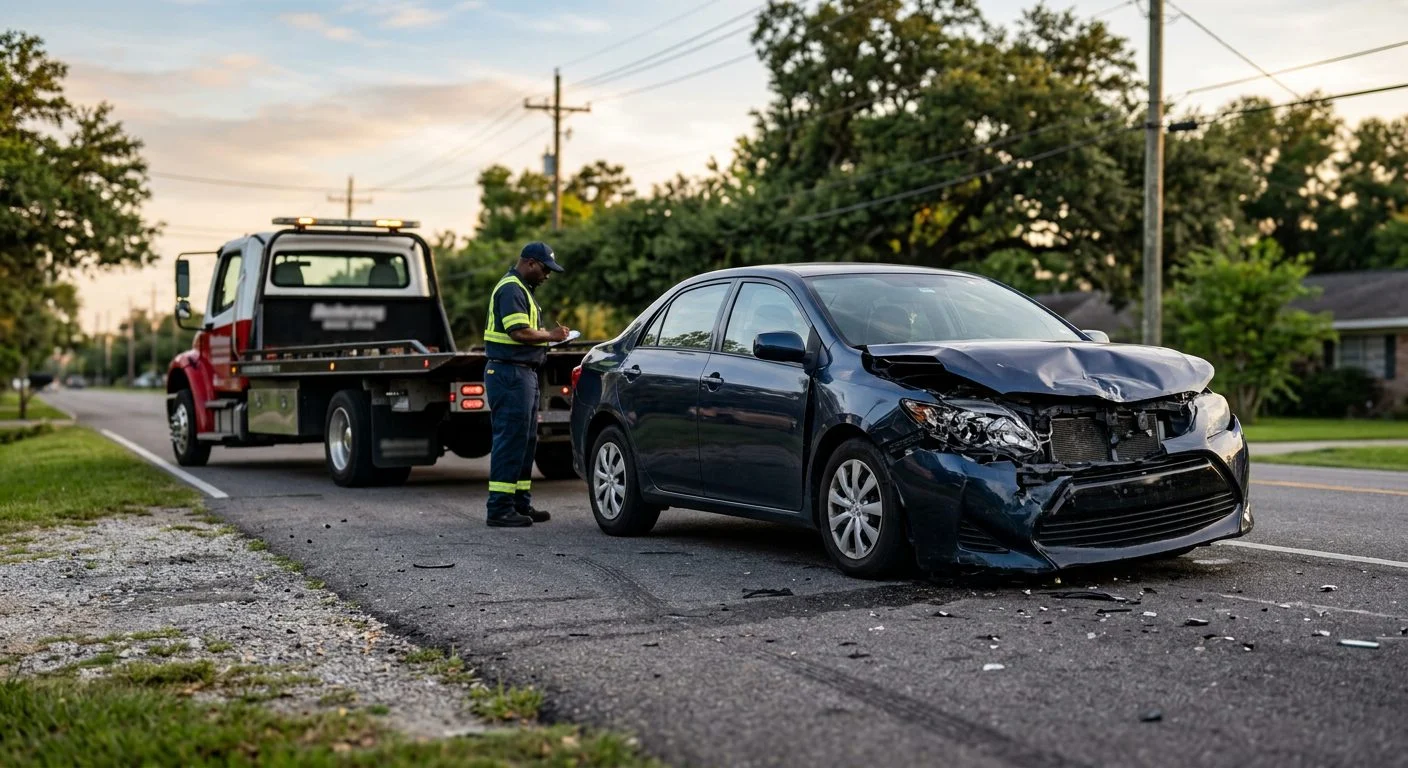
A fatal crash usually brings police, fire and emergency medical crews to the scene after a 911 call. Officers often hold the scene open while they document it.
Officers look at where the truck came to rest, where debris landed and whether there are skid marks. They also note the position of each vehicle. These details help show how the crash happened, so they matter to the investigation. Measurements taken at the scene can be hard to reproduce later.
Your family may not be allowed near the scene. You can still get key details. Ask the investigating agency for the officer’s name and the report or case number. Write them down the same day.
Confirm which agency responded. In New Orleans, that is often the New Orleans Police Department. The Louisiana State Police, a parish sheriff’s office or another local police department can also investigate, depending on where the crash happened. The responding agency is the one that creates the report.
What the Police Report Contains
A Louisiana crash report is the investigating officer’s written record of the crash. It usually lists the date, time and location, the vehicles and drivers, passengers and witnesses, a diagram, a narrative, any citations and contributing factors. The exact layout depends on the agency.
For a truck crash, the report may also show the carrier’s name, the USDOT number on the truck and details about the cargo. Those details help identify the company that operated the truck. Many families do not know the company’s name until they read the report, so check it carefully.
Reports can be supplemented. An officer may add later findings from a reconstruction team or toxicology results. Ask the agency whether a supplemental report exists.
A police report records what the officer saw, learned and concluded. It is not a court’s final ruling on fault, and it is not an insurer’s final decision. Insurers and courts can reach different conclusions from the same report. That is why the report is a starting point, not the end of the story.
How to Get a Copy of the Crash Report in Louisiana
You can request the crash report from the agency that investigated it. Have the report or case number, the crash date and the crash location ready. Louisiana law limits what agencies may charge. Under La. R.S. 32:398, an agency may charge no more than $5 for a report of two pages or less. For longer reports, the fee cannot exceed $20, including all service fees and charges.
The same statute says crash reports are confidential. They are available only to listed people. That list includes the parties to the crash, the parties’ attorneys, succession representatives and insurers. Upon request, the agency must make reports available within seven working days after the investigation is complete. Crash photos, video and audio can also be requested for a reasonable fee.
Access can be slower while a fatal crash is under investigation. Ask the agency for its own timeline. Keep a written log of each request, with the date you made it and the name of the person you spoke with.
Our office can help request records once you talk with us.
Criminal Investigation and Charges After a Fatal Crash
A criminal investigation is run by the state. It is separate from any civil claim for money damages. The district attorney or another prosecutor may review the crash on their own timeline. Citations or charges can change how the crash is described in public.
Your family does not control the criminal process. You cannot decide whether charges are filed, and you cannot speed up a prosecutor’s review. Send questions about the criminal side to the investigating agency or the prosecuting office.
Protect your family’s position by limiting public comments about fault. Avoid posting about the crash on social media. Do not give a recorded statement to the other driver’s insurer until you understand what you are agreeing to.
This section is general. Outcomes in criminal cases depend on facts and decisions made by others. No one can predict them from a crash report alone. Speculation about penalties rarely helps a grieving family.
The Trucking Company’s Investigation Begins
The motor carrier and its insurer often open their own review soon after a crash. The company runs that review, not the police or the family. It can start the same day, sometimes before the family has spoken with anyone.
A carrier may review dispatch and load records, driver logs, maintenance and inspection history, the driver’s qualification file, drug and alcohol testing records and its internal accident reports. Under federal rules, each driver must record duty status for each 24-hour period. Under the federal records-of-duty-status rule, except for a private motor carrier of passengers (nonbusiness), a motor carrier subject to these requirements must require each driver it uses to record the driver’s duty status for each 24-hour period using the prescribed method.
The carrier’s findings are created for the carrier. The family usually does not receive them unless the law requires it or a legal process brings them out. Louisiana law also makes employers answerable for damage their employees cause while doing their jobs. La. Civ. Code art. 2320 says masters and employers are answerable for damage caused by their servants in the functions in which they are employed.
Your family’s view of the facts may differ from what the company records. Write down what you know while your memory is fresh. Include details that seem small.
Have questions about what happened?
Ask our team directly. The first conversation is free, confidential, and there is no obligation to continue.
Federal Trucking Rules That Shape the Investigation
Federal rules for commercial drivers set testing deadlines and record-keeping duties. These rules can shape what a carrier must keep after a crash. They are minimums, and they do not decide fault on their own.
As soon as practicable following an occurrence involving a commercial motor vehicle operating on a public road in commerce, each employer shall test for alcohol each of its surviving drivers in the circumstances set out in the federal post-accident testing rule. If an alcohol test is not given within two hours, the employer must record why. If it is not given within eight hours, the employer must stop trying. For controlled substances, the cutoff is 32 hours.
Retention periods also matter. The federal drug and alcohol testing recordkeeping rule states that records of negative and canceled controlled substances test results, and of alcohol test results with a concentration of less than 0.02, shall be maintained for a minimum of one year. A motor carrier shall keep records of duty status and the supporting documents required for each of its drivers for not less than 6 months from the date of receipt, according to the federal duty-status recordkeeping regulation.
These are minimum periods. A company may keep records longer, but families should not assume it will. That is why early written requests matter.
How any rule applies depends on the facts of the crash.
Electronic Data, Dash Cameras and Other Evidence to Preserve
Electronic evidence from a truck can be overwritten or lost if no one asks for it to be kept. Many trucks store engine and event data. Many carriers also use electronic logs and GPS tracking. These systems do not always keep information indefinitely.
Other evidence can disappear too. Dash camera footage, telematics and GPS data, phone records and surveillance video from nearby businesses are common examples. Some systems record over older files on a set schedule. The damaged vehicles are evidence, too. Once they are repaired or sold, they cannot be examined the same way.
A written preservation request sent early puts the carrier and the investigating agency on notice. It asks them to keep specific items. Do not repair, sell or alter a vehicle involved in the crash without advice first.
Our firm can prepare and send preservation requests as part of its work on a case. The firm does not promise what evidence will be found. The other side may hold records your family cannot see.
Why Insurance Companies Look at the Reports Differently
Insurers review the police report and the carrier’s records. They are not neutral advisers to your family. Each side may read the same facts differently.
Louisiana uses comparative fault, which measures each person’s share of the fault. La. Civ. Code art. 2323 says the fault of all persons who contributed to the harm is determined. That applies whether or not those persons are parties to the case.
For crashes on or after January 1, 2026, Louisiana uses a modified rule. Under La. Civ. Code art. 2323, if the degree or percentage of negligence attributable to a person who suffers injury, death, or loss is equal to or greater than fifty-one percent, that person is not entitled to recover damages. Under La. Civ. Code art. 2323, when a person suffers injury, death, or loss partly as the result of his own negligence and partly as the result of the fault of another person or persons, the degree or percentage of fault attributable to all persons causing or contributing to the injury must be determined. Fault findings matter a great deal in these claims.
Be careful before you sign anything. Do not sign a release or settlement paper until you understand the claim and any deadlines. Early offers may not reflect the full value of a wrongful death claim. This page does not state any amount or range.
If someone gave a written or recorded statement after an injury, that person or a personal representative can ask for a copy. Under La. R.S. 13:3732, the person who took the statement must provide a true and complete copy within twenty days after written demand.
Common Questions Families Ask About the Investigation
Can the family get the trucking company’s internal report?
Access depends on the facts and the law. A lawyer can request records through the legal process.
What if the police report is wrong?
Ask the agency whether a supplemental report exists. You can also give the investigating officer written information about what you saw or know.
How long does the investigation take?
Timelines vary widely. Ask the investigating agency directly for its schedule.
Do we have to decide right away?
Not necessarily, but do not wait to ask questions. Deadlines for wrongful death claims are short and depend on the facts of each case, so families should contact a lawyer promptly. Exceptions can apply, so confirm your deadline with a lawyer promptly. A survival action for the injured person’s own damages follows a similar period under La. Civ. Code art. 2315.1.

Want to know where you stand?
Tell us what happened and our team will walk you through the options available to you, at no cost.
Talk With Przemek Lubecki About Your Family’s Next Steps
Przemek Lubecki is the responsible lawyer for this page. He is a trial lawyer, and the office is in New Orleans. If you are waiting on a crash report, unsure how to respond to the carrier, or worried that records may disappear while your family grieves, you don’t have to face it alone.
You can contact the firm for a free, confidential initial consultation with no obligation to continue. You may owe case costs and expenses in addition to any fee. Call 855-LUBECKI or request a free case evaluation.
Spanish: consulta inicial gratuita, confidencial y sin compromiso. Puede que usted deba pagar costos y gastos del caso además de cualquier honorario.
The firm may associate or refer a case to other law firms where that is likely.
How the Firm Can Help Families Through the First Steps
Preserving Evidence
Trucking companies keep logs, maintenance records, driver files and electronic data.
Reviewing the Police Report
Police reports can contain errors or leave out key details. We help families review what the report says and identify what may need to be added or corrected.
Supporting the Family
Wrongful death cases involve loved ones who may need answers, guidance and time to grieve. We keep communication clear and respectful at every stage.
Planning the Case
Every case depends on its own facts. We explain the possible paths available and what each would involve, so families can make informed decisions.
Important: Do Not Rely on Early Assumptions
Insurance adjusters and trucking company representatives may contact your family quickly. Be cautious about giving recorded statements or signing documents before you understand what they mean. The Firm may associate or refer a case to other law firms. Any such arrangement will be disclosed to you.
Questions Families Often Ask
Can we get the trucking company's internal report?
Access depends on the facts and the law. A lawyer can request records through the legal process.
What if the police report is wrong?
You can also give the investigating officer written information about what you saw or know.
Who may be responsible?
Truck crashes can involve drivers, carriers, maintenance providers, cargo loaders and others. Identifying the right parties takes a careful review of the facts.
Will we need to go to court?
Many cases resolve without a trial, but every case is different. We explain what to expect at each step, including the possibility of trial.
Talk With Przemek Lubecki About Your Family's Situation. You may be responsible for case costs and expenses in addition to the fee.
Related practice areas
- How to File a Wrongful Death Lawsuit in Orleans Parish: A Family’s Step-by-Step Guide
- Wrongful Death Lawsuit Deadline in Louisiana | New Orleans