
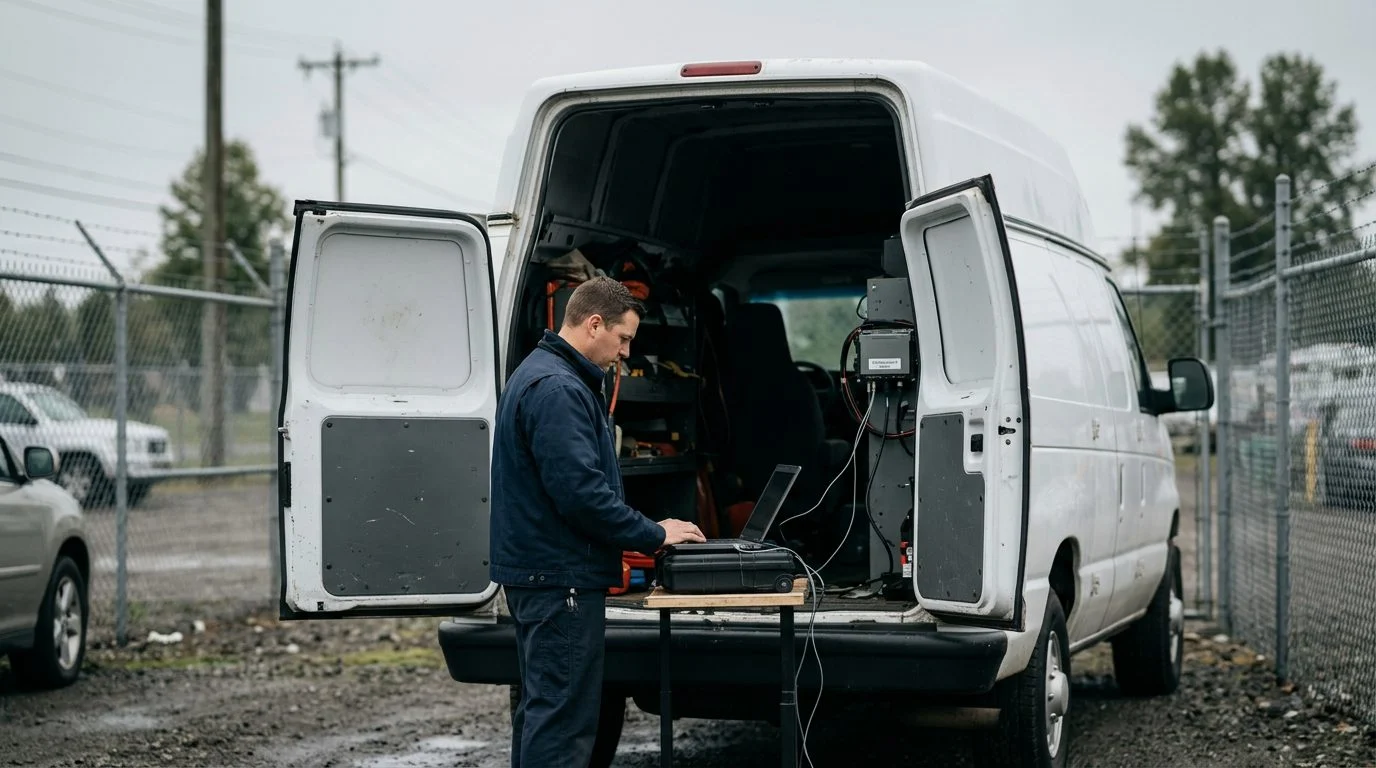
Wrongful Death | New Orleans, Louisiana
When an Impaired Truck Driver Takes a Loved One, Families Deserve Answers
Przemek Lubecki and the team at American Trial Lawyer, LLC represent Louisiana families in wrongful death cases arising from truck crashes caused by impaired drivers. Our office is in New Orleans.
By Przemek Lubecki · Published October 26, 2026
A crash with a commercial truck can change a family’s life in seconds. If the driver was impaired, Louisiana law may allow the family to bring a wrongful death claim. This page explains what that claim is, who can file it, who else may share responsibility, and how impairment is documented. It is written for families who are still dealing with grief and funeral plans, so it stays plain and to the point. This page covers the questions families ask when they look for an impaired truck driver wrongful death lawyer Louisiana.
What a Wrongful Death Claim After an Impaired Commercial Driver Crash Is
A wrongful death claim is a civil lawsuit that eligible family members bring when another person’s fault causes a death. It is separate from any criminal case against the driver, so the two can move on different timelines.
A commercial vehicle is a heavy vehicle used for business, such as a tractor-trailer, a box truck, or a bus. Impairment means the driver was under the influence of alcohol, illegal drugs, or misused prescription or over-the-counter medicine.
Under Louisiana Civil Code art. 2315.2, family members who can sue are listed in order. The surviving spouse and children come first. The surviving parents may sue if the deceased left no spouse or child, but a father or mother who has abandoned the deceased during his minority is deemed not to have survived him. Siblings and grandparents may sue only if the closer groups are absent. Each family’s situation is different, so the facts need a careful look.
This page is for families who lost someone and want to understand their options. You don’t need to know the legal terms yet.
If a crash with a commercial driver who may have been impaired took someone you love, you don't have to face the questions alone. Our team can talk it through with you at no cost. Talk it through with our team — the first consultation is free, confidential, and carries no obligation.

Can You Sue a Truck Driver, and Who Else Can Be Responsible?
Yes, the impaired driver can be named as a defendant in a civil wrongful death lawsuit. Other parties may share responsibility too, depending on the facts.
Possible parties include:
- The motor carrier, meaning the trucking company
- The employer that dispatched or assigned the driver
- A company that leased the truck or trailer
- A maintenance contractor that serviced the vehicle
Louisiana makes employers answerable for damage caused by workers while they do the job they were hired to do. The rule has a limit. Louisiana Civil Code art. 2320 says responsibility applies only when the employer might have prevented the act and did not.
Claims about hiring and supervision look at what a company knew, or should have known, about a driver’s record, training, and testing history. Those questions usually depend on company records, which is why they matter early.
Each defendant may carry its own insurance. Under Louisiana Civil Code art. 2324, a joint tortfeasor (one of several at-fault parties) generally is not liable for more than its own degree of fault, unless it conspired with another person to commit an intentional or willful act, in which case it is answerable in solido with that person. That makes it important to identify every possible party.
How Impairment Is Documented After a Fatal Truck Crash
Impairment is shown through testing, records, and crash evidence, and timing matters. The federal post-accident testing rules require an employer, following an occurrence involving a commercial motor vehicle operating on a public road in commerce, to test for alcohol, as soon as practicable, each of its surviving drivers who was performing safety-sensitive functions with respect to the vehicle, if the accident involved the loss of human life. The same rule also covers controlled substances.
The rule sets clocks. If an alcohol test is not given within two hours, the employer must keep a written record of why. After eight hours, the employer must stop trying to give it. For controlled substances, the employer must stop after 32 hours and keep a record of the reasons. The driver must also stay readily available for testing, though the rule does not require delaying necessary medical attention for injured people or prohibit leaving the scene for the period necessary to obtain assistance or necessary emergency medical care.
Records matter too. The federal record-keeping rules set minimum keeping periods. Collection-process records must be kept at least two years, and negative test results at least one year. Because these periods exist, written requests to keep records should go out early.
Other evidence that can be reviewed includes:
- Police crash reports and citations
- Toxicology results and witness statements
- Dash camera and vehicle data
- Electronic logging device records and dispatch records
- Driver qualification files
Federal rules also list causing a fatality through negligent operation of a commercial motor vehicle as an offense that can disqualify a driver (49 CFR 383.51); 49 CFR 382.401 instead requires that each employer maintain records of its alcohol misuse and controlled substances use prevention programs. See 49 CFR 383.51. A criminal case and a civil wrongful death claim are separate proceedings, with different goals and timelines.
What Damages Are Generally Discussed in a Louisiana Wrongful Death Claim
Damages are the losses a family may seek from the responsible parties. Family members may also seek damages for losses tied to the relationship itself.
If the person who died was hurt before death, Louisiana also allows a survival claim for that person’s own damages. Louisiana Civil Code art. 2315.1 uses the same one-year or two-year period, and the succession representative may bring it when no family class applies.
When an impaired driver’s intoxication was a cause of the injuries, Louisiana Civil Code art. 2315.4 allows exemplary damages. These are added to general and special damages, but only on proof that the defendant acted with wanton or reckless disregard for others’ safety. They are not automatic.
Louisiana’s comparative fault rule looks at each party’s share of fault, including the person who died. La. Civ. Code art. 2323 addresses how fault is divided when an injured person’s own negligence contributes to the harm, and it sets out different consequences depending on the percentage of that negligence. Under La. Civ. Code art. 2323, if the degree or percentage of negligence attributable to the person suffering injury, death, or loss is less than fifty-one percent, the amount of damages recoverable is reduced in proportion to that percentage, but the claim is not reduced when the harm was caused partly by the fault of an intentional tortfeasor. Under the same article, if that degree or percentage of negligence is equal to or greater than fifty-one percent, the person suffering injury, death, or loss is not entitled to recover damages, unless the harm was caused partly by the fault of an intentional tortfeasor, in which case the claim is not reduced.
How a claim is valued depends on the facts. Those include the deceased person’s age, earnings history, family relationships, the evidence of impairment and fault, and the number of responsible parties.
What to Expect: The Process and a Typical Timeline
A typical claim starts with a free consultation, then moves through records, investigation, and claims before any lawsuit. Each step depends on the case.
- Free consultation. The first consultation is free, confidential, and without obligation. Bring the crash report, names of the parties, and any records you already have.
- Preservation requests. A lawyer can ask companies in writing to keep logs, vehicle data, testing records, and maintenance files.
- Investigation. Review covers crash reports, toxicology results, citations, witness accounts, and company records.
- Claims. Claims are presented to insurers and responsible parties.
- Lawsuit if needed. If a fair resolution is not reached, a suit may be filed in a Louisiana court. Under art. 2315.2, the wrongful death deadline is one year from the death or two years from the injury, whichever is longer, except that for medical malpractice actions the deadline is one year from the death.
Timelines vary with the scope of the investigation, the number of defendants, and court schedules.
Why Families Work With Przemek Lubecki and the New Orleans Office
Families who want an impaired truck driver wrongful death lawyer in Louisiana can contact the firm’s office in New Orleans. Przemek Lubecki is the responsible lawyer for this page.
- Przemek Lubecki is a trial lawyer and the responsible lawyer for this content.
- The office is in New Orleans, Louisiana, serving Orleans Parish and the New Orleans metro area, including Metairie, Kenner, Jefferson Parish, St. Bernard Parish, and Slidell.
- The firm handles wrongful death, truck, commercial vehicle, car, motorcycle, rideshare, brain injury, and negligent security matters.
- Support staff help with records requests, scheduling, and communication, so families can focus on decisions.
- The firm may associate with or refer a case to other law firms. If that is likely for your case, the firm will tell you.
Not sure what your next step is?
Talk it through with our team — the first consultation is free, confidential, and carries no obligation.
Common Questions About Impaired Commercial Driver Wrongful Death Claims
Most questions come down to who can sue, how much time there is, and what it costs to start.
How long do families have to file?
Louisiana sets a deadline of one year from death or two years from injury, whichever is longer. Contact a lawyer promptly so the deadline is not missed.
Can a trucking company be responsible for a driver’s impairment?
It may be, depending on the facts, through hiring, supervision, or employer responsibility rules.
Will we have to go to court?
Some claims resolve without a trial. Preparing for trial is still part of how a case is evaluated.
Are there costs?
The first consultation is free, confidential, and without obligation. Case costs and expenses may apply in addition to any fee, and the fee arrangement is explained before you decide.
If your family lost someone in a crash with a commercial driver who may have been impaired, you don’t have to work out the next steps alone. Call 855-LUBECKI for a free consultation, or request a free case evaluation at a time that fits your family.
How We Approach These Cases
Focused on Accountability
We look beyond the driver to the trucking company, shipper, or other parties whose decisions may have contributed to the crash.
Careful Evidence Review
Driver logs, toxicology records, dashcam footage, and maintenance files can be critical. We work to identify and preserve what matters.
Support for Families
Losing someone in a crash is painful. We explain each step in plain language so families can make informed decisions.
Clear Communication
You will know what is happening in your case and why, with straightforward answers to your questions.
What Families Often Ask Us
What happens after a fatal truck crash?
Families often face police reports, insurance calls, and medical and funeral decisions all at once. Speaking with a lawyer early can help you understand the process and organize what you need.
Can the trucking company be involved?
In some cases, a trucking company or other business may share responsibility for a driver's impairment, depending on the facts. Every case is different, and we review the details with you.
Who is responsible for the case?
Przemek Lubecki is the responsible lawyer for this page. Our office is located in New Orleans and we handle matters across Orleans Parish, the New Orleans metro, and Louisiana.
What does a consultation cost?
Your first consultation is free, confidential, and without obligation to continue.
Important: Evidence Can Change Quickly
Records from a crash, including driver logs and testing results, may not stay available for long. If you are a family member facing a wrongful death, contacting a lawyer early can help protect important information.