
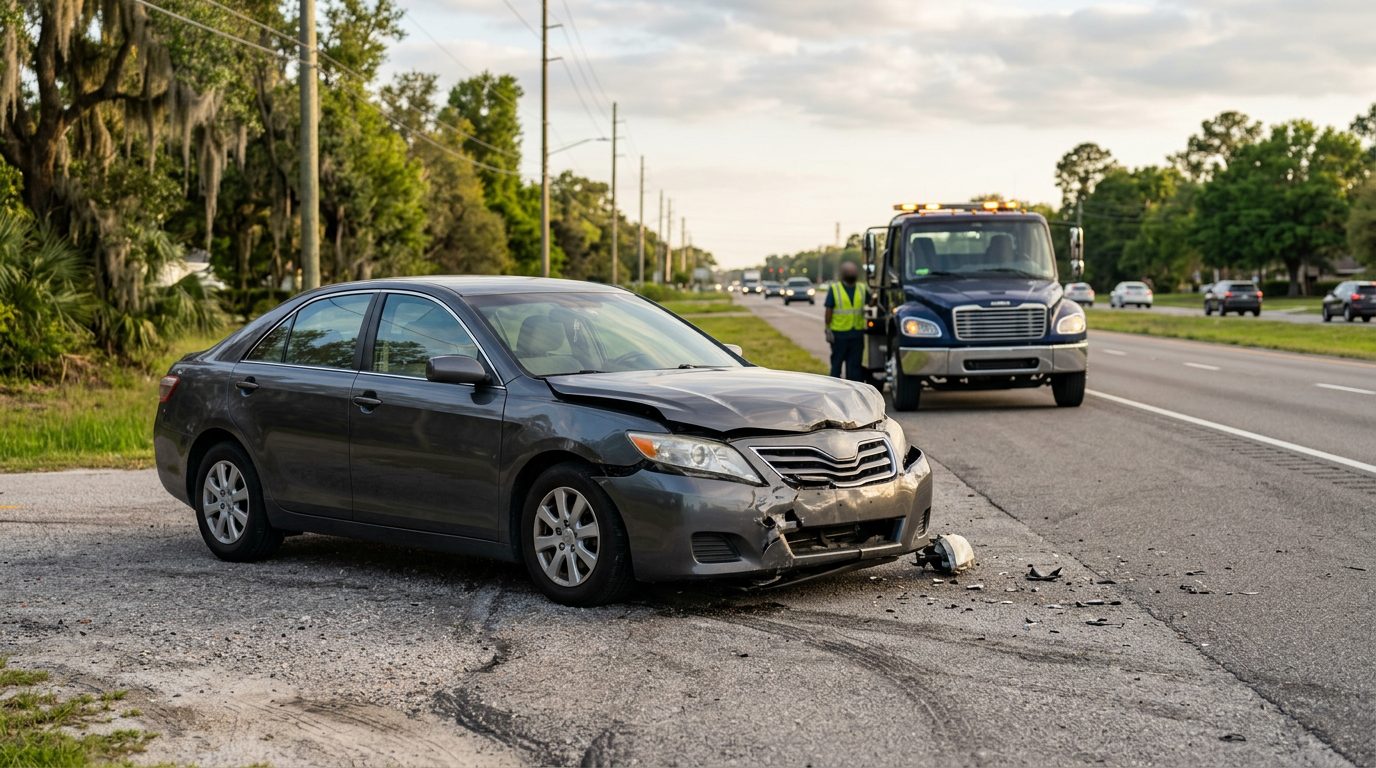
Truck Accidents | New Orleans, Louisiana
What to Do If a Semi Truck Hits You in Louisiana
Crashes with big rigs are frightening and confusing. Here is how to protect your health, your evidence and your options, and how Przemek Lubecki can help you make sense of what comes next.
By Przemek Lubecki · Published November 10, 2026
If a semi truck just hit you, you may feel shaken, sore, and unsure what comes next. Knowing what to do if a semi truck hits you can help protect your health and any later claim.
In short, get to safety, call 911, get medical care, and write down what you can about the scene. Then be careful with insurance calls until you know what you’re agreeing to. This guide walks through those steps in order.
Start with safety in the first minutes after a semi truck crash
Safety comes first, for you and for everyone else involved. Check yourself and any passengers for injuries. If you can, move to a safe spot, turn on your hazard lights, and stay at the scene.
Call 911 right away. Police and medical responders can come to the scene, and the responding agency can prepare a crash report. La. R.S. 32:398 requires a driver in a crash involving injury or damage over five hundred dollars to give his or her name, address, and the vehicle’s registration number.
If you’re too hurt or shaken to handle these steps, ask a passenger, a bystander, or a family member to help. Anyone who can help should do so.
If a semi truck hit you or someone in your family, you don't have to sort out the next steps alone. We're glad to talk through what happened in a free, confidential first consultation with no obligation to continue. Talk it through with our team — the first consultation is free, confidential, and carries no obligation.
Get a medical evaluation even if you feel fine
See a doctor or go to an emergency department soon after the crash, even if you feel okay. Some symptoms can show up hours or days later. An early check creates a record of your condition at the time.
Follow the treatment plan you’re given. Keep your appointments, and tell every provider about each symptom. That includes headaches, dizziness, neck or back pain, and trouble thinking clearly. Ask for written work restrictions if your job is affected.
Keep a file of your medical records. Note dates, providers, diagnoses, and prescriptions. Save bills, pharmacy receipts, and out-of-pocket costs. Write down mileage to appointments, too. These details show how the crash has affected your health, work, and daily life.
Document the scene, the truck, and the driver
Photograph the scene before anything is moved, if it’s safe. Take wide shots and close-ups. Capture vehicle damage, the truck’s company name, its DOT number and unit number, trailer markings, road conditions, skid marks, traffic signals, and the surrounding area.
Write down the truck driver’s name and license details. Get the carrier’s name and any insurance details shared at the scene. Note the time and place of the crash.
Collect names and phone numbers for witnesses. Ask what they saw, and write down their words as they say them.
Finally, write a short private account of the crash while your memory is fresh. Keep it for your own records, and share it only with people helping you with the claim.
Why a semi truck case often involves more records than a car crash
Trucking companies and their insurers often start gathering records early. These can include driver logs, maintenance files, dispatch messages, and data from the truck itself.
Federal rules require motor carriers to make each driver record duty status for each 24-hour period. Under 49 C.F.R. § 395.8, except for a private motor carrier of passengers (nonbusiness) as defined in § 390.5, each change of duty status, such as where the driver reports for work, starts to drive, goes on duty not driving, or is released from work, must be recorded with the name of the city, town, or village and State abbreviation. If the change occurs at a location other than a city, town, or village, record the highway number and nearest milepost, the highway number and service plaza, or the highway numbers of the nearest two intersecting roadways, followed by the nearest city, town, or village and State abbreviation. Federal rules also set minimum retention periods for company records. Under 49 C.F.R. § 379.3, companies must retain records for at least the minimum retention periods in appendix A to that part; after those periods, records may be destroyed at the discretion of each company’s management, but the part does not excuse compliance with the lawful requirements of any other governmental body that prescribes longer retention periods for any category of records.
Many large trucks also have an event data recorder. The National Highway Traffic Safety Administration says these devices can preserve technical crash information and driver inputs. That information may help show how a collision happened.
Save your own evidence, too. Keep phone photos, texts, and any dashcam or cell video in its original form. Don’t edit, crop, or delete those files. Whether any record helps your claim is a question about the details of your crash.
Be careful with insurance calls and recorded statements
An adjuster for the trucking company or its insurer may call you soon after the crash. The adjuster may ask for a recorded statement. That call may come before you’ve seen a doctor or thought through what happened.
You can take time before you agree to talk. Ask what the call is for, and ask for time to think. Don’t guess about your injuries, your speed, or who was at fault. Say what you know, and say when you don’t know.
Louisiana law covers statements taken from injured people. A person who takes a written, recorded, or transcribed statement must give the injured person a true and complete copy. After a written demand, that copy is due within twenty days (La. R.S. 13:3732).
Stick to facts you can document. A calm, factual tone helps you keep track of what was said and when.
Track your timeline and know the filing deadlines
Start a simple folder or journal today. Note the crash date, each appointment, missed work, help you needed at home, and how the injury affects daily life. A dated record is easier to use later than memory alone.
Louisiana generally gives two years from the day an injury is sustained to file a delictual (fault-based) action (La. Civ. Code art. 3493.1). That article has exceptions: it does not run against minors or interdicts in actions involving permanent disability brought under the Louisiana Products Liability Act or state product liability law (La. Civ. Code art. 3493.1).
Fault can also affect recovery.
If a loved one died in a truck crash, a wrongful death claim has its own timing. The right of action prescribes one year from the death or two years from the day that injury or damage is sustained, whichever is longer. For medical malpractice actions, it prescribes one year from the death (La. Civ. Code art. 2315.2). The exact deadline depends on the facts of your case, so ask about it early.
Not sure what your next step is?
Talk it through with our team — the first consultation is free, confidential, and carries no obligation.

Talk with a New Orleans trial lawyer about your options
You may be hurt, worried about bills, or handling a loss in your family. You may not know yet whether a claim makes sense. You don’t have to decide everything today.
Przemek Lubecki is the responsible lawyer for this page. The firm’s office is in New Orleans. American Trial Lawyer, LLC handles truck, commercial vehicle, and car crash cases, and wrongful death cases for families.
American Trial Lawyer, LLC may associate or refer a case to other law firms.
Should I call 911 after a crash with an 18-wheeler?
Yes. Calling 911 brings police and medical responders to the scene and starts a crash report.
Can I get a copy of the police crash report in Louisiana?
Crash reports are confidential and are made available only to the parties, parents or guardians of a minor who is a party to the crash, insurers or insurance support organizations under contract to provide claims and underwriting for a party, healthcare providers who rendered healthcare services to a party, succession representatives, attorneys of the parties or succession representatives, and news-gathering organizations requesting documents related to a specific crash, upon request. Under Louisiana law, upon request, crash reports must be made available to the parties, their insurers, and their attorneys within seven working days after the investigation is complete (La. R.S. 32:398).
Do I have to give a recorded statement to the trucking company’s insurer?
You can take time before you talk. If you give a recorded statement, you can request a copy in writing.
If a semi truck hit you or someone you love, you don’t have to work out the next steps alone. Call 855-LUBECKI or request a free case evaluation. The first consultation is free, confidential, and without obligation to continue.
Five steps to take after a semi truck crash
1. Call 911
Call 911 so police and medical responders reach the scene and a crash report is started. If you can, stay where you are until help arrives.
2. Get medical care right away
Some serious injuries, including brain injuries, may not show symptoms until hours or days later. Get checked by a doctor even if you feel you are only shaken up.
3. Document the scene
If it is safe, photograph vehicle positions, damage, skid marks, road conditions and the truck's company name and unit number. Write down what you remember while it is fresh.
4. Be careful with insurers
Trucking companies and their insurers may contact you quickly. Consider speaking with a lawyer before giving a recorded statement or signing any release.
A key warning
Commercial trucking cases can involve several parties, including the driver, the trucking company, the cargo owner and insurers. Evidence such as electronic logs and maintenance records can disappear over time, so it is important to act early.
How our firm can help
Free, confidential first consultation
Your first consultation is free, confidential and without obligation to continue.
Responsible lawyer: Przemek Lubecki
Przemek Lubecki is the responsible lawyer for the content of this page and focuses on representing people seriously hurt in truck, commercial vehicle and car crashes, and families in wrongful death cases.
Office in New Orleans
We serve people throughout Orleans Parish, the New Orleans metro area and Louisiana, including Metairie, Jefferson Parish, Kenner, St. Bernard Parish and Slidell.
Organized case preparation
We work to gather crash reports, photographs, medical records and other information that can help explain what happened.