
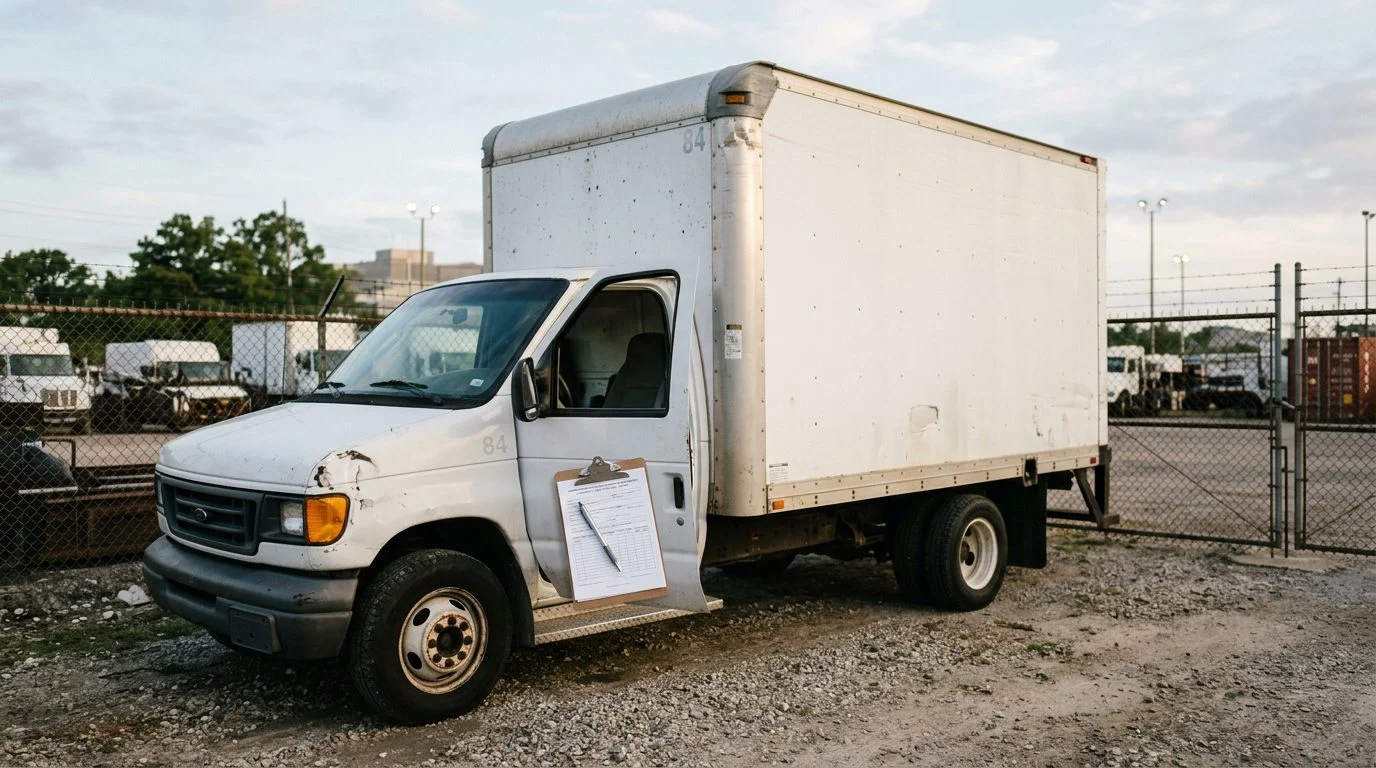
Commercial Vehicle Accidents | Jefferson Parish
Hurt in a Tractor-Trailer, Dump Truck or Work Van Crash? Start With a Clear Conversation.
Przemek Lubecki, responsible lawyer, Office in New Orleans, represents people seriously injured in commercial vehicle crashes and families in wrongful death cases across Jefferson Parish and Louisiana. You may be responsible for case costs and expenses in addition to the fee.
By Przemek Lubecki · Published October 19, 2026
Commercial vehicle accidents in Jefferson Parish often involve more parties, more records and more rules than a typical car crash. If you were hurt by a tractor-trailer, dump truck or work van, Louisiana’s fault and deadline rules still apply, and federal trucking rules can add evidence and possible defendants. This guide explains the basics in plain language for injured residents and for families who have lost a loved one.
What Counts as a Commercial Vehicle Crash in Jefferson Parish
A commercial vehicle crash involves a vehicle used for business, not just a personal car. Common examples include tractor-trailers and 18-wheelers, dump trucks, box trucks, delivery and cargo vans, buses, tow trucks, and heavy equipment or work trucks used in a company’s operations.
The company that owns, leases or dispatches the vehicle matters as much as the driver. Its decisions about hiring, training, maintenance and schedules can become part of the story. That is why these cases often ask who the driver worked for, not only who was behind the wheel.
Jefferson Parish has busy highways and commercial streets. Interstate 10, the Westbank Expressway, the approaches to the Huey P. Long Bridge, and commercial corridors in Metairie, Kenner, Harvey and Westwego all carry heavy traffic. Trucks from out of state also pass through the region, so the carrier may be based far from Louisiana.
A commercial vehicle crash can involve just one other car. It can also involve a motorcycle, a pedestrian or a rideshare vehicle. Each setting raises different questions about who was responsible.
Not sure what your next step is?
Talk it through with our team — the first consultation is free, confidential, and carries no obligation.
Louisiana and Federal Commercial Vehicle Rules
Federal safety rules govern many commercial carriers. Louisiana also has its own rules for commercial vehicles. Knowing the basic federal limits helps you understand which records matter.
Hours of service limit how long a driver may work. For drivers of property-carrying commercial vehicles, such as trucks hauling cargo, § 395.3 provides that a driver may not drive without first taking 10 consecutive hours off duty, except as otherwise provided in § 395.1. A driver also may not drive after 14 consecutive hours following that break, and may drive no more than 11 hours in that window. Driving is also not permitted once more than 8 hours of driving time pass without a 30-minute interruption, subject to exceptions for certain short-haul drivers.
Maintenance is another federal focus. § 396.3 provides that every motor carrier and intermodal equipment provider must systematically inspect, repair, and maintain, or cause to be systematically inspected, repaired, and maintained, all motor vehicles and intermodal equipment subject to its control. Parts that affect safe operation must stay in safe and proper condition.
§ 391.11 provides that a person shall not drive a commercial motor vehicle unless he/she is qualified to drive a commercial motor vehicle. That rule requires a commercial driver to be at least 21 years old and to hold a valid commercial operator’s license. After a serious crash involving a commercial truck, whether the trucking company tested its driver for alcohol and drug use afterward, and how that step was documented, can be an important question in a case.
When a rule was broken, that fact can become part of a claim. How it is weighed turns on the evidence in each case.
Why More Than One Party May Be Responsible
More than one party can share responsibility in a commercial vehicle crash. The driver, the employer and other companies tied to the vehicle may all be part of the picture.
Louisiana law makes employers answerable for harm their workers cause while doing their jobs. La. Civ. Code art. 2320 states this rule. It adds that the employer’s responsibility attaches only when the employer might have prevented the act that caused the damage and did not.
Other possible parties include the vehicle owner, a maintenance or repair contractor, a company that loaded the cargo, or another motorist. Each party’s role is a question of fact.
When several people are at fault, La. Civ. Code art. 2324 says that if liability is not solidary, a joint tortfeasor is not liable for more than its own degree of fault; a person who conspires with another to commit an intentional or willful act is answerable in solido with that person for the resulting damage.
Louisiana also uses comparative fault. La. Civ. Code art. 2323 provides that if the degree or percentage of negligence attributable to the person suffering injury, death, or loss is equal to or greater than fifty-one percent, that person shall not be entitled to recover damages, unless the injury resulted partly from an intentional tortfeasor’s fault, in which case the claim shall not be reduced. La. Civ. Code art. 2323 provides that if the degree or percentage of negligence attributable to the person suffering injury, death, or loss is less than fifty-one percent, the amount of damages recoverable shall be reduced in proportion to that degree or percentage of negligence, except that if the injury resulted partly from an intentional tortfeasor’s fault, the claim shall not be reduced.
Commercial insurance can be structured differently from a personal auto policy. Early questions about coverage matter.
Records That Can Be Lost After a Crash
Trucking records do not have to be kept forever, so early action matters. Some of the most useful evidence sits with the company, not at the scene.
Federal rules set minimum keeping periods. § 396.3 provides that motor carriers, except for a private motor carrier of passengers (nonbusiness), must retain the records required by this section where the vehicle is either housed or maintained for a period of 1 year and for 6 months after the motor vehicle leaves the motor carrier’s control. § 379.3 provides that companies subject to this part shall retain records for the minimum retention periods provided in appendix A to this part. After those periods, the records may be destroyed at the company’s discretion, but this does not excuse compliance with the lawful requirements of any other governmental body prescribing longer retention periods.
Records that often matter include:
- electronic logging device data and driver logs
- dash camera and onboard video
- inspection, repair and maintenance files
- driver qualification files
- drug and alcohol test records
- dispatch messages and bills of lading
- police and crash reports
You can also protect your own evidence. Take photos of the scene and the vehicles. Write down witness names and contact information. Keep medical records, bills and receipts, and a simple journal of pain and missed work.
Jefferson Parish Roads and Common Crash Settings
Crashes involving large trucks often happen where traffic merges, turns or slows suddenly. Commercial vehicle accidents in Jefferson Parish can happen on interstates and on local streets alike.
Speed is one common factor. The Insurance Institute for Highway Safety states that excessive speed increases the likelihood and severity of crashes and injuries, including in 18-wheeler collisions.
Industrial, port-related and construction areas bring heavy trucks onto roads that families and commuters also use. Trucks often need more distance to stop. Turning and backing can put them in close quarters with cars, bikes and pedestrians.
Weather matters too. Heavy rain, standing water and flooding can change braking distance and reduce visibility for every driver, including commercial drivers. These conditions make scene photos and written notes even more important.
Injury Claims, Wrongful Death and the Filing Deadline
Fault-based injury claims in Louisiana generally must be filed within two years of the day the injury happened. That two-year time limit, called prescription, is set by La. Civ. Code art. 3493.1.
Wrongful death claims follow La. Civ. Code art. 2315.2. That time limit is one year from the death or two years from the day the injury happened, whichever is longer, except that for medical malpractice actions the right of action prescribes one year from the death of the deceased.
The same article lists who may sue. The surviving spouse and children come first. Parents may sue if there is no surviving spouse or child, but a father or mother who has abandoned the deceased during his minority is deemed not to have survived him. Siblings may sue if there is no spouse, child or parent. Grandparents may sue if none of those people survived.
Louisiana law also allows those family members to recover for loss of consortium, service and society.
The exact deadline and any exceptions depend on the facts of each case, so don’t wait to find out. Seek medical care promptly. Think carefully before giving a recorded statement to an insurance company.
Have questions about what happened?
Ask our team directly. The first conversation is free, confidential, and there is no obligation to continue.
About Przemek Lubecki and the New Orleans Office
Przemek Lubecki is the responsible lawyer for this page. The office is in New Orleans, Louisiana. Przemek Lubecki is a trial lawyer who handles truck accidents, car accidents, commercial vehicle accidents, rideshare accidents, motorcycle accidents, wrongful death, brain injury and negligent security matters.
Przemek Lubecki is licensed to practice law in Louisiana. Our team includes assistants and office staff who support the work of this office.
The New Orleans office serves people injured across Orleans Parish, Jefferson Parish, the New Orleans metro area and Louisiana. That includes residents of Metairie, Kenner, St. Bernard Parish and Slidell.
Our firm may associate with or refer a commercial vehicle case to other law firms. Lawyers at other firms who work on a referred case are not part of American Trial Lawyer, LLC.
Next Steps: Your Consultation and Costs
If a commercial vehicle hurt you or someone in your family, the first steps are protecting records and learning the deadlines.
How long do I have to file an injury claim in Louisiana?
Generally, Louisiana gives two years from the day of injury for fault-based injury claims (La. Civ. Code art. 3493.1). Wrongful death claims follow a different time limit.
Can more than one party be responsible in a truck crash?
Yes. More than one party can share fault. An employer may be answerable for harm its worker causes on the job, under the conditions in Louisiana Civil Code article 2320.
How long does a family have to file a wrongful death claim in Louisiana?
The time limit is one year from the death or two years from the injury, whichever is longer; for medical malpractice actions, the time limit is one year from the death.
If a tractor-trailer, dump truck or work van was involved in a crash that hurt you or someone you love, request a free case evaluation or call 855-LUBECKI, the number for our Office in New Orleans, to speak with Przemek Lubecki. Your first consultation is free, confidential and carries no obligation to continue. You may be responsible for case costs and expenses in addition to the fee.
How We Approach Commercial Vehicle Cases
Early Records Review
Commercial crashes often generate more paperwork, including crash reports, driver logs and vehicle records. We look at what is available early so nothing important is lost.
Every Possible Party Considered
A commercial crash can involve a driver, a carrier, a vehicle owner, a contractor or others. We look at each party that may be connected to the crash.
Support for Families
When a loved one has died, we explain each step of a wrongful death case in plain language and keep families informed.
Plain-Language Updates
Our team keeps you informed about your case and answers your questions without legal jargon.
Protect Your Information After a Crash
Commercial carriers and their insurers may contact you quickly. Keep your medical records, photos and any paperwork from the scene, and talk with a lawyer before giving a recorded statement.
Commercial Vehicle Crashes We Discuss
Tractor-Trailers and Semi-Trucks
Large truck crashes on Jefferson Parish roads and highways can cause serious injuries. We review how the crash happened and who may be involved.
Dump Trucks and Work Vehicles
Construction and work-site vehicles can be involved in crashes on busy corridors. We look at the vehicle, its operator and the work setting.
Delivery and Work Vans
Crashes involving commercial vans and fleet vehicles often involve company policies and records. We help families and injured people understand their options.
Case Association With Other Firms
We may associate or refer a case to other law firms when that is appropriate. If that happens, we will tell you and explain what it means for your case.
Talk With Przemek Lubecki About Your Commercial Vehicle Crash. You may be responsible for case costs and expenses in addition to the fee.
Want to know where you stand?
Tell us what happened and our team will walk you through the options available to you, at no cost.
Related practice areas
- Commercial Vehicle Accidents in New Orleans: What Injured People Need to Know After a Crash
- Commercial Vehicle Accidents Kenner: What to Know Now