
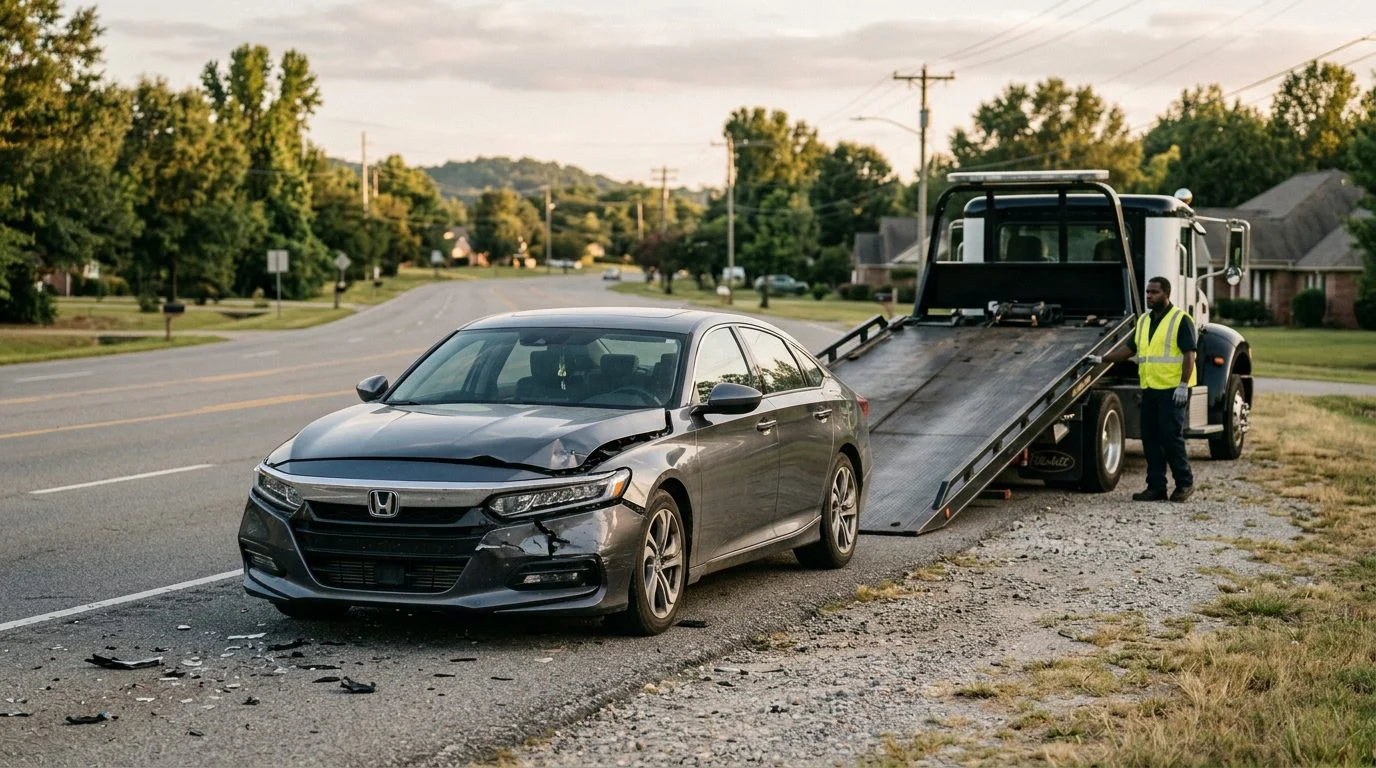
Car Accidents | New Orleans, Louisiana
Hit by a Driver? Here's What to Know About Paying Your Deductible
Your car insurance deductible and your injury claim are separate questions. Przemek Lubecki and our team at our New Orleans office can help you understand where you stand.
By Przemek Lubecki · Published November 3, 2026
Do I have to pay my deductible after a car accident in Louisiana? Often, the answer turns on which insurance coverage pays for the repairs. If your own collision coverage pays, you usually pay your deductible first. If another driver’s insurance pays for the damage, you may be able to seek that deductible back. This page explains how Louisiana handles the deductible, how fault changes the picture, and why time limits matter. It’s written for drivers and families in New Orleans and across Louisiana who are dealing with a repair bill after a crash they did not choose.
The Short Answer: Which Coverage Is Paying for Your Car
Your deductible usually applies when your own collision or comprehensive coverage pays for repairs. Collision coverage pays for damage to your car in a crash. Comprehensive coverage handles many non-crash losses, such as theft or hail. In both cases, you pay the deductible first, and the insurer pays the rest.
Your declarations page shows your deductible amount. It is the summary page of your policy.
If another driver’s liability insurance pays for your car’s damage, that claim goes to their insurer. In that case, your own deductible may not be the first charge to you. Whether you pay up front depends on the facts of your crash, your coverages and your policy terms.
If a crash left you with a deductible bill and questions about who pays, our team is ready to talk through your situation with you. Talk it through with our team — the first consultation is free, confidential, and carries no obligation.
How Auto Insurance Deductibles and Coverages Work in Louisiana
A deductible is part of your own policy. It is separate from who caused the crash.
Collision coverage pays for damage to your vehicle in a crash, usually after you pay the deductible. Comprehensive coverage works the same way for non-crash losses.
Liability coverage works differently. It protects other people when you cause a crash. Bodily injury liability pays for injuries to others. Property damage liability pays for damage to other vehicles and property.
Louisiana law also sets one specific deductible you may see. Under La. R.S. 22:1295, uninsured motorist property damage coverage, when the named insured has not rejected it and requests it in writing for a policy that does not afford collision coverage, is subject to a deductible of two hundred fifty dollars for any one accident. La. R.S. 22:1295 reads: “Unless the named insured has rejected uninsured motorist coverage, the insurer issuing an automobile liability policy that does not afford collision coverage for a vehicle insured thereunder shall, at the written request of a named insured, provide coverage in the amount of the actual cash value of such motor vehicle described in the policy or the minimum amount of property damage liability insurance required by the Motor Vehicle Safety Responsibility Law, R.S. 32:851 et seq., whichever is less, for the protection of persons insured thereunder who are legally entitled to recover damages from the owner or operator of an uninsured motor vehicle because of property damage to the motor vehicle described in the policy arising out of the operation, maintenance, or use of the uninsured motor vehicle.” That figure applies to that coverage only. It is not a rule for every collision claim.
How Fault Shapes Who Pays in a Louisiana Car Accident
Under Louisiana law, the person whose fault caused the damage is generally responsible for repairing it. The Civil Code says every act of man that causes damage obliges the person by whose fault it happened to repair it (La. Civ. Code art. 2315). Negligence, imprudence or want of skill can also make a person responsible (La. Civ. Code art. 2316).
Fault also matters when both drivers share blame. Louisiana’s comparative fault rule in La. Civ. Code art. 2323 provides that when the degree or percentage of negligence attributable to the person suffering injury, death, or loss is equal to or greater than fifty-one percent, that person shall not be entitled to recover damages. If your share of fault is fifty-one percent or more, you are not entitled to recover damages (La. Civ. Code art. 2323). If it’s less than fifty-one percent, the amount of your recoverable damages is reduced in proportion to your share of fault (La. Civ. Code art. 2323).
Fault decides whose insurance is the main source for repairs and medical care. Don’t assume your deductible is lost just because you were not the one at fault.
Getting Your Deductible Back After a Crash That Was Not Your Fault
Here is how it often works. Your own insurer may pay the repair first. Then it seeks reimbursement from the at-fault insurer. This is called subrogation. If you share some fault, that reimbursement can shrink too, in the same proportion as your own recovery (La. Civ. Code art. 2324.2). Property damage can also include sales taxes you paid on the repair or replacement (La. Civ. Code art. 2315).
Good records help. Keep these items:
- The crash report and any citation details
- Photos of the scene and both vehicles
- Repair estimates and final invoices
- Rental receipts, your deductible receipt and your insurer’s claim numbers
Louisiana’s crash report law helps here. The investigating officer must tell drivers to share liability carrier and agent details with anyone hurt or damaged. Upon request, crash reports are made available to the parties, their attorneys and insurers, and others the statute lists, within seven working days after the investigation is complete (La. R.S. 32:398).
If your own auto policy had lapsed, Louisiana’s no-pay-no-play rule can affect recovery.
Safety comes first. If the crash happens in an area under an evacuation order or a declared state of emergency, the law allows seventy-two hours after the crash. If the crash happens in an area under an evacuation order or a declared state of emergency, the law allows seventy-two hours after the crash.
Medical Bills, MedPay and Your Injury Claim
Medical bills can come from several sources, and MedPay is one of them. MedPay (medical payments coverage) is an optional part of some auto policies. Your declarations page shows whether MedPay is included.
Louisiana’s billing rule also matters. When a health insurer or Medicare paid a contracted provider, your recovery of those medical expenses is limited to the amount actually paid, plus cost sharing. It is not the full billed amount (La. R.S. 9:2800.27). That limit does not apply to benefits received through auto medical payments coverage, under the same statute.
Get checked after a crash, even if you feel fine. Tell your doctor about every symptom, including ones that seem minor, and keep the records.
No one can predict a settlement from a deductible question. Injuries, documented treatment, fault and available insurance limits all play a part. Our page on pain and suffering in a Louisiana car accident claim covers that side of the case.
How Long You Have to File a Claim in Louisiana
Louisiana’s general deadline for delictual (tort) claims is two years. Lawyers call that deadline prescription. The statute says delictual actions are subject to a liberative prescription of two years, running from the day the injury or damage is sustained (La. Civ. Code art. 3493.1).
Two years is the general rule. The article’s stated exception is narrow: the two years does not run against minors or interdicts in permanent-disability claims brought under Louisiana product liability law, so review the deadline in your case promptly.
Your deductible and injury questions come from the same crash, so keep the crash date in your records. The clock starts on the day of injury or damage. Related pages cover whether a car accident claim goes to trial and what happens if you’re sued after causing a crash.
Not sure what your next step is?
Talk it through with our team — the first consultation is free, confidential, and carries no obligation.

Talk With Przemek Lubecki About Your Deductible and Your Claim
A deductible bill after a crash can feel unfair, especially if you were not at fault. You may also be handling a damaged car, an injury and a relative’s questions at the same time.
Do I have to pay my deductible after a car accident in Louisiana if I was hit?
Not always.
Does Louisiana use comparative fault for car accidents?
Yes. Under La. Civ. Code art. 2323, a person suffering injury, death, or loss is not entitled to recover damages when the degree or percentage of his own negligence is equal to or greater than fifty-one percent, except where the other person’s fault is that of an intentional tortfeasor, in which case his claim for recovery of damages is not reduced.
How long do I have to file a claim in Louisiana?
The general rule is two years from the day of injury or damage, with limited exceptions (La. Civ. Code art. 3493.1).
Przemek Lubecki is the responsible lawyer for this page, and the office is in New Orleans. If a deductible bill and an injury have you weighing your options, you can talk through your facts with him. The first consultation is free, confidential and without obligation. Call 855-LUBECKI or request a free case evaluation. The firm may associate or refer a case to other law firms. For more on car accident claims in Orleans Parish, see our Orleans Parish car accident claim guide.
Steps That Can Help You Sort It Out
Review your own policy
Look at your declarations page and coverage terms to see how your policy describes collision coverage and deductibles.
Keep your records
Save the police report, photos, repair estimates, rental receipts and medical bills. Organized records make every question easier to answer.
Keep your insurer's claim notes
Write down the names of adjusters you speak with, the dates of calls, and what was said, so you have a clear timeline.
Ask before you sign
Before accepting a settlement or signing any release, talk through the paperwork with a lawyer who can explain what it covers.
Why Talk With American Trial Lawyer
A free first consultation
Your first consultation is free, confidential and without obligation to continue.
Przemek Lubecki is the responsible lawyer
Przemek Lubecki is the trial lawyer responsible for this page's content. He and our team focus on people seriously hurt in crashes and families in wrongful death cases.
Office in New Orleans
We serve people across Orleans Parish, the New Orleans metro area and Louisiana from our New Orleans office.
Plain-language answers
We explain your options in clear terms, at a pace that works for you.
Good to Know
Your deductible is a question about your own insurance policy. Whether an injury claim applies to you depends on the facts of your crash. American Trial Lawyer may associate with or refer your case to other law firms where that makes sense for you.