
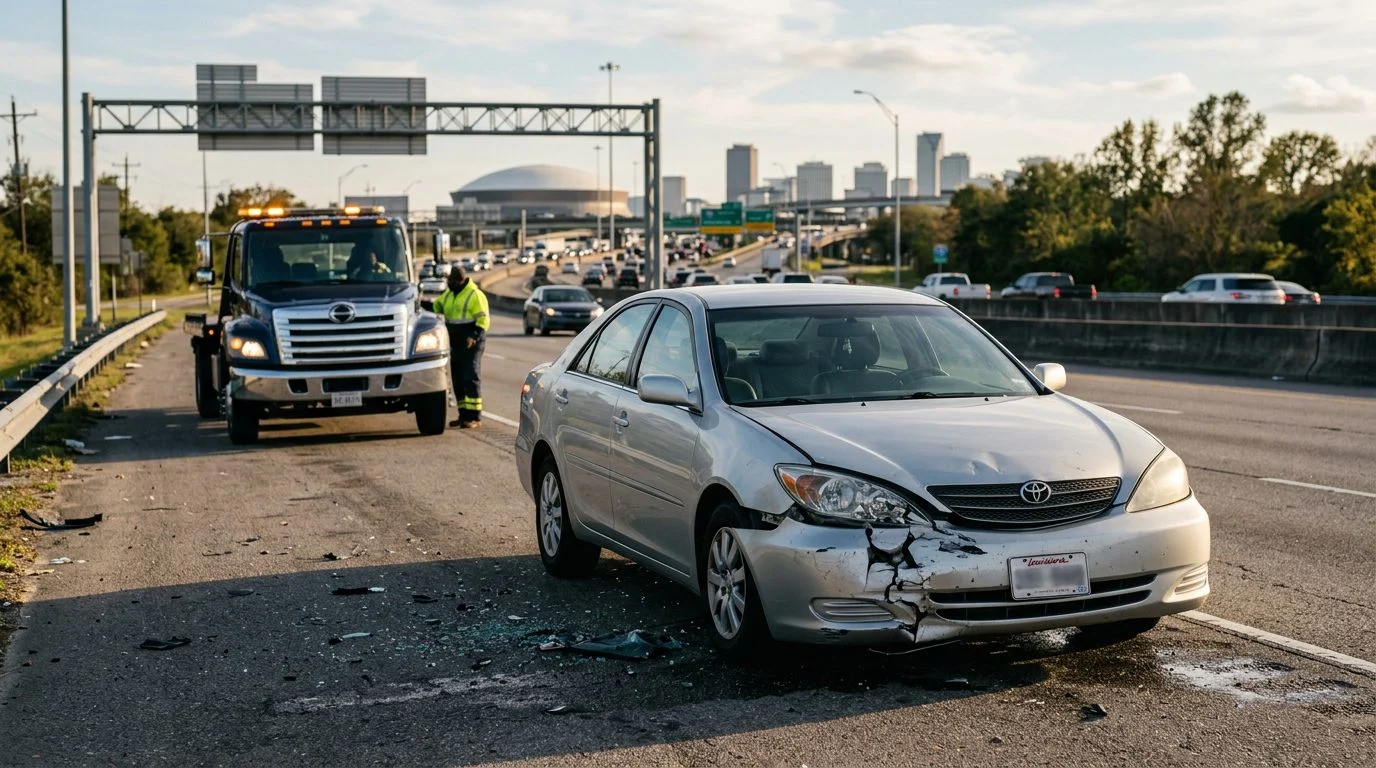
Car Accidents | New Orleans and the I-10 Corridor
Hurt in a Car Accident on I-10? Talk With a New Orleans Trial Lawyer
Przemek Lubecki and our team represent people injured in car crashes on I-10 and across Orleans Parish, Jefferson Parish and Louisiana. Your first consultation is free, confidential and without obligation. You can also call 855-LUBECKI.
By Przemek Lubecki · Published October 25, 2026
Car Accident Lawyer for I-10 and I-610 Crashes in New Orleans
Looking for a car accident on I-10 lawyer in New Orleans? If another driver’s fault hurt you on I-10 or I-610, you may have a claim against that driver. American Trial Lawyer is a New Orleans firm led by trial lawyer Przemek Lubecki. The first consultation is free, confidential and without obligation.
If a crash on I-10 or I-610 left you hurt and you're weighing your options, our team can talk it through in a free, confidential consultation. Talk it through with our team — the first consultation is free, confidential, and carries no obligation.
Who this page is for and what the service covers
This page is for drivers and passengers hurt in passenger-car crashes on I-10 or I-610 in Orleans Parish. It also helps families who lost a loved one in a crash.
American Trial Lawyer represents people seriously hurt in car, truck, commercial vehicle and other crashes. The firm also represents families in wrongful death cases. It handles rideshare and motorcycle crashes, brain injury matters and negligent security claims too.
Przemek Lubecki is the lawyer responsible for the content of this page. The firm’s office is in New Orleans, and the firm’s lawyers and support staff serve clients from that office.
The firm may associate or refer a case to other law firms.
What a claim after an I-10 or I-610 crash can cover
A claim can seek compensation for the losses a crash causes. Those losses often include medical care, lost income and damage to property. Every crash is different, so the losses differ too.
- Medical care: treatment from the scene and emergency room through follow-up care and rehabilitation.
- Lost income: wages missed during recovery, and lost ability to earn if injuries limit future work.
- Vehicle and property: repair or replacement of the vehicle and damaged personal items.
- Pain and daily life: pain, suffering and loss of enjoyment of life.
- Family losses: Louisiana law allows damages for loss of consortium, service and society, recoverable by the same people who could bring a wrongful death action (La. Civ. Code art. 2315).
Medical bills follow a special rule. For medical bills paid by a health insurer or Medicare to a contracted provider, recovery is limited to the amount actually paid plus any cost sharing the claimant paid or owes, and not the amount billed (La. R.S. 9:2800.27).
Brain injury claims often need detailed medical records over time. Keep every appointment note and test result.
Evidence to keep after a crash on I-10 or I-610
Keep records from the day of the crash. They support every part of a claim.
- Photos: the scene, lanes, traffic, lighting, debris and road signs. Photograph all vehicle damage before repairs.
- Crash report details: the report number and the investigating agency. Louisiana crash reports are confidential. They are available only to the parties, parents or guardians of a minor party, insurers (or insurance support organizations under contract for claims and underwriting), healthcare providers, succession representatives and attorneys, and news-gathering organizations requesting documents for a specific crash, on request within seven working days after the investigation is complete (La. R.S. 32:398).
- Witnesses: names and contact details for witnesses, drivers and passengers.
- Insurance: policy details and claim numbers from every party.
- Medical records and bills: starting with the first visit.
- A simple daily journal: symptoms, missed work and tasks you can’t do.
If a large truck is involved, driver hours matter. Federal rules set limits and required rest breaks for property-carrying truck drivers (FMCSA hours-of-service summary).
A common mistake is waiting to get checked out. Gaps in treatment can make it harder to tie injuries to the crash.
Louisiana deadlines and fault rules that shape a claim
Most injury claims in Louisiana have a two-year deadline that starts on the day of injury (La. Civ. Code art. 3493.1).
- Filing deadline: delictual (tort) actions are subject to a two-year liberative prescription (a legal time limit). It starts on the day injury or damage is sustained (La. Civ. Code art. 3493.1).
- Wrongful death: the right of action prescribes one year from the death or two years from the injury, whichever is longer (La. Civ. Code art. 2315.2).
- Shared fault: if the degree or percentage of negligence attributable to the person suffering injury, death, or loss is equal to or greater than fifty-one percent, that person shall not be entitled to recover damages, unless the injury was partly the result of an intentional tortfeasor’s fault, in which case the claim is not reduced (La. Civ. Code art. 2323). Under La. Civ. Code art. 2323, a person whose own negligence is equal to or greater than fifty-one percent may not recover damages; when that percentage is less than fifty-one percent, the amount of damages recoverable shall be reduced in proportion to it, and a claim that is partly the result of an intentional tortfeasor’s fault shall not be reduced.
- Effective date: the amendment took effect on January 1, 2026 (Acts 2025, No. 15).
- More than one at-fault driver: where liability is not solidary, each person is generally liable only for their own degree of fault, but a person who conspires with another to commit an intentional or willful act is answerable in solido with that person (La. Civ. Code art. 2324).
Note the exact crash date.
How the process works, step by step
The process usually moves through five stages, from a first talk to a final resolution.
- Free first consultation. The firm reviews your crash, injuries and insurance details. It is free, confidential and carries no obligation to continue.
- Investigation. The firm gathers the crash report, medical records, bills and vehicle documentation.
- Claim presentation. The claim goes to the insurers with documented injuries and losses.
- Negotiation or lawsuit. If a fair resolution isn’t reached, a lawsuit may be filed. Cases that don’t resolve may go to trial.
- Resolution. The claim closes once it is settled or decided by the court.
How long each stage takes depends on the facts. Injury severity, insurer response and court schedules all play a part.
Not sure what your next step is?
Talk it through with our team — the first consultation is free, confidential, and carries no obligation.
Why reach out to American Trial Lawyer
The firm is led by trial lawyer Przemek Lubecki, who is responsible for this page’s content. The firm’s lawyers and support staff work from the New Orleans office.
- Plain explanations: you hear each option in plain language before you decide anything.
- Trial readiness: cases that don’t resolve may proceed to trial.
- Clear next step: the first consultation is free, confidential and without obligation.
- No promises: every case is different, and no result can be promised.

Questions people ask before calling a lawyer
Is the first consultation free?
Yes. The first consultation is free, confidential and without obligation to continue.
Can a passenger make a claim after a car accident?
Under La. Civ. Code art. 2315, every act of man that causes damage to another obliges him by whose fault it happened to repair it. Louisiana law says a person whose fault causes damage must repair it (La. Civ. Code art. 2315).
How long do I have to file?
For most injury claims, the two-year deadline starts on the day of injury (La. Civ. Code art. 3493.1). Wrongful death claims follow their own timing.
What if I was partly at fault?
Under La. Civ. Code art. 2323, if the degree or percentage of your negligence is equal to or greater than fifty-one percent, you are not entitled to recover damages. This bar does not apply where your injury is partly the result of an intentional tortfeasor’s fault; in that case your claim is not reduced. A person whose own negligence is equal to or greater than fifty-one percent of the fault cannot recover damages under La. Civ. Code art. 2323, while a person whose negligence falls below that level has the amount recoverable reduced in proportion to that share, and a claim partly caused by an intentional tortfeasor is not reduced.
Will my case go to trial?
Some cases settle, and some go to trial. Either path is possible.
Do I have to decide right away?
No. The consultation carries no obligation to continue.
If a car accident on I-10 left you hurt, and you’re deciding whether to talk with a lawyer, request a free case evaluation or call 855-LUBECKI for a free consultation. The New Orleans office is ready to answer your questions.
Why Clients Contact American Trial Lawyer
A Responsible Lawyer You Can Reach
Przemek Lubecki is the responsible lawyer for this page and for car accident matters handled from our New Orleans office.
Local to the I-10 Corridor
We understand the roads, parishes and courts where many I-10 crashes occur, from New Orleans to the surrounding metro area.
Focus on Your Recovery
We listen to what you have been through and help you think through the next steps while you focus on your health.
A Free, Confidential Consultation
Your first consultation is free, confidential and without obligation to continue.
Before You Speak With an Insurance Company
Insurance adjusters work for the insurance company. Talk with a lawyer before giving a recorded statement or signing any release or settlement paperwork.
After a Crash on I-10: Steps That Can Help
Get Medical Care
See a doctor or go to an emergency room, even if your injuries seem minor. Some injuries appear hours or days later.
Document the Scene
If it is safe, take photos of the vehicles, the roadway, traffic signs and any visible injuries. Write down the other driver's details and names of witnesses.
Keep Your Records
Save the police report number, medical bills, receipts for expenses and notes about missed work or daily activities.
Contact Our Office
Call 855-LUBECKI or request a free case evaluation so we can review what happened and talk through your options.