
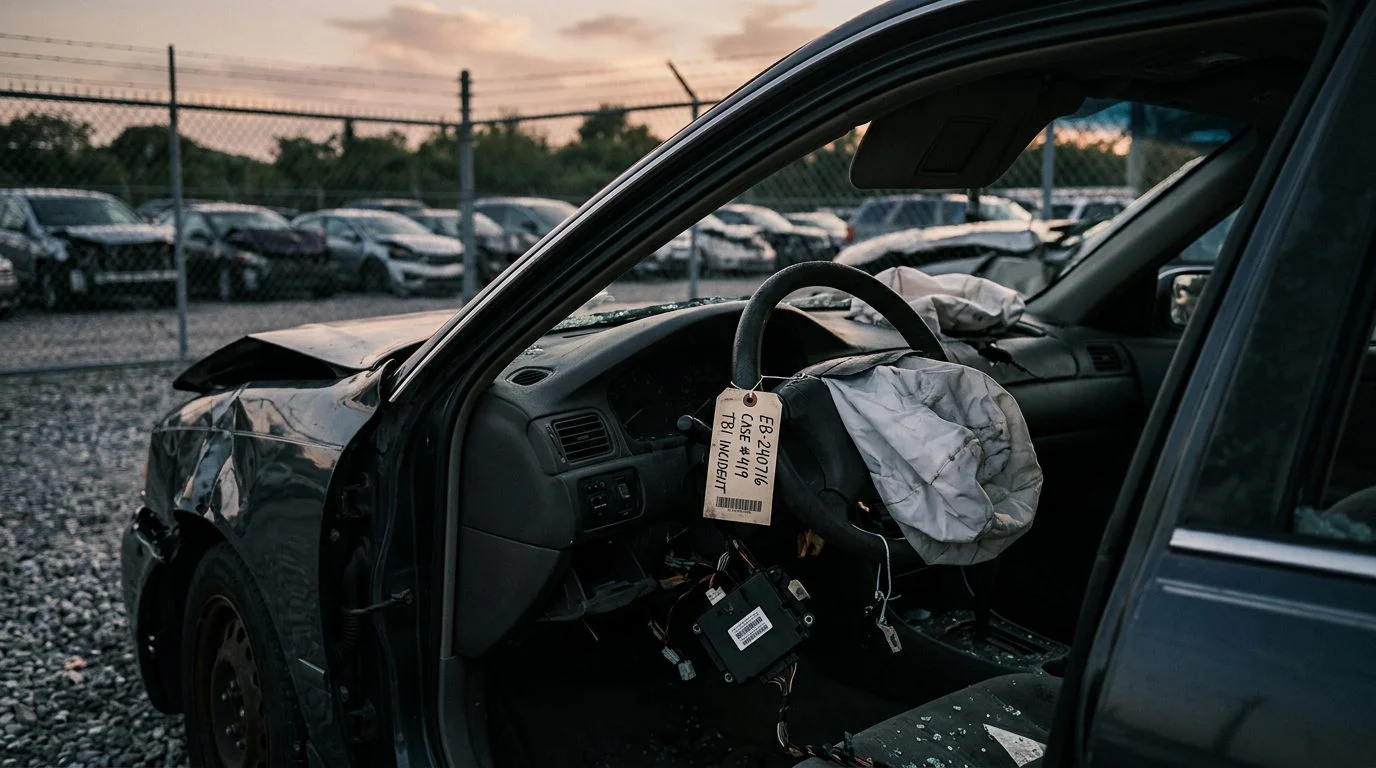
Traumatic Brain Injury Truck Accident Claim New Orleans
By Przemek Lubecki · Published October 21, 2026
A traumatic brain injury truck accident claim in New Orleans is a civil case. It seeks compensation for harm a crash caused, including harm to your brain, your health and your daily life. Louisiana law says a person whose fault causes damage must repair it. This page explains how these claims work, what makes trucking cases different and what to expect next.
What a traumatic brain injury truck accident claim covers
A claim asks the people responsible for a truck crash to pay for losses caused by a head injury. It is a civil matter, not a criminal one.
Traumatic brain injury (TBI) is an injury to the brain caused by an outside force, such as a blow or jolt to the head. The Administration for Community Living names automobile accidents as a common cause. Injuries range from mild concussion to severe injury. The American Association of Neurological Surgeons notes that concussion is one type of TBI.
Under La. Civ. Code art. 2315, a person whose fault causes damage must repair it. Every case is different, and the losses involved depend on the facts of each situation.
The injured person usually brings the claim. If a crash is fatal, certain family members may have their own claim, covered below.
Our team handles truck accidents, car accidents, commercial vehicle accidents, rideshare accidents, motorcycle accidents, wrongful death, brain injury and negligent security matters. We serve people in Orleans Parish, the New Orleans metro area and across Louisiana. The firm may associate or refer a case to other law firms.
Some head injuries are not obvious at the scene. Getting checked promptly helps your health and your records.

Not sure what your next step is?
Talk it through with our team — the first consultation is free, confidential, and carries no obligation.
Why truck crash brain injury cases differ from other crashes
Truck cases often involve more than one party and more records. Commercial trucks follow federal safety rules that other vehicles do not.
Several parties may share responsibility. These can include the driver, the trucking company, a company that leases the truck, a freight broker, a maintenance contractor or a cargo loader. Under La. Civ. Code art. 2320, employers answer for damage caused by their workers while doing the work they were hired to do, but responsibility only attaches when the employer might have prevented the act which caused the damage and has not done it.
Louisiana also divides fault among parties. Under La. Civ. Code art. 2324, where liability is not solidary, a joint tortfeasor is not liable for more than its own degree of fault; a person who conspires with another to commit an intentional or willful act is answerable in solido with that person for the damage caused by that act. That is why finding every party with a role matters.
Federal rules add records. 49 CFR 395.8 requires motor carriers to have drivers record their duty status for each 24-hour period. It also bars false reports and tampering with an electronic logging device.
Other records often sit with the company, not the injured person. These include driver files, dispatch messages and maintenance and inspection records.
Symptoms, recovery and the medical record that supports a claim
Brain injury symptoms can include headaches, memory and attention problems, slowed thinking, mood changes, sleep trouble, fatigue and sensitivity to light or noise.
A clinician should assess symptoms and how long they last after head trauma. The American Association of Neurological Surgeons supports that step. A postconcussion symptom research study reports that persistent symptoms can follow mild TBI.
Recovery varies. Severity, age, prior health and treatment all play a role. Some people improve over time, and others have lasting effects. That is why long-term medical assessment matters.
Evidence that connects the crash to the injury can include imaging, neurological exams, neuropsychological testing and treatment notes. Statements from family, employers and providers about changes in daily life also help. Keep a written log of symptoms, missed work and daily limits.
Evidence that can disappear fast and why early action matters
Trucking records belong to the company, and some can be lost. An early written request asks the company to keep them.
Federal post-accident testing has short windows. After a qualifying crash, the employer must test surviving drivers for alcohol and controlled substances as soon as practicable. 49 CFR 382.303 sets the time limits. An alcohol test not given within two hours requires a written reason. Alcohol testing stops after eight hours. Controlled substance testing stops after 32 hours.
49 CFR 379.7 says records may be preserved by any technology that accurately reflects all of the information in the record and remains accessible in a form that can be accurately reproduced later for reference.
Louisiana crash reports are confidential. Under La. R.S. 32:398, they are available only to the parties, parents or guardians of a minor party, their attorneys, insurers or an insurance support organization under contract to provide claims and underwriting of any party which is the subject of the report, healthcare providers or their agents that rendered healthcare services to any party which is the subject of the report, succession representatives, and news-gathering organizations that request documents related to a specific crash. On request, they are released within seven working days after the investigation is completed.
At the scene, photos, vehicle positions, debris, witness names and the company name and unit number on the truck all help. Nearby business video can also matter.
How a truck brain injury claim moves forward, step by step
A claim usually moves from intake to investigation, medical documentation, a demand to the insurer and, if needed, a lawsuit.
- Intake. You describe the crash, your injuries, your treatment and any insurance contact so far. The conversation is confidential.
- Investigation. The team identifies every party that may share fault and reviews the federal and state rules for the truck and driver.
- Medical documentation. Treating providers describe the brain injury and its effects in the medical record.
- Claim presentation. A demand goes to the insurer. Negotiation follows if the insurer engages.
- Filing, if needed. Under La. Civ. Code art. 3493.1, most personal injury lawsuits in Louisiana generally must be filed within two years of the date the injury is sustained. Exceptions exist, including for minors and interdicts in permanent-disability actions brought under the Louisiana Products Liability Act or state product liability law. La. Civ. Code art. 3493.1 sets that rule. Exceptions may apply, so timing should be reviewed early.
Insurance companies, damages and legal options for family members
Your case is judged on its own facts, so the losses that apply to you are best reviewed with a lawyer. Future medical costs are recoverable only when they are directly related to a manifest physical or mental injury or disease, under La. Civ. Code art. 2315.
An insurer may make an offer before the full effects of a brain injury are known. Read any offer carefully before you sign a release.
Under La. Civ. Code art. 2323, if the degree or percentage of negligence attributable to the person suffering injury, death, or loss is equal to or greater than fifty-one percent, that person shall not be entitled to recover damages. Under La. Civ. Code art. 2323, if the degree or percentage of negligence attributable to the person suffering injury, death, or loss is less than fifty-one percent, the amount of damages recoverable shall be reduced in proportion to that negligence.
After a fatal crash, La. Civ. Code art. 2315.2 lists who may sue. The surviving spouse and child or children come first. If the deceased left no spouse or child surviving, the father and mother, or either of them, may sue, but a father or mother who abandoned the deceased during his minority is deemed not to have survived him. Then siblings, then grandparents, each only if the group before them is absent. The right generally prescribes one year from the death or two years from the injury, whichever is longer.
Value depends on the injury, the medical evidence, fault and available insurance. No dollar amount can be promised.
Have questions about what happened?
Ask our team directly. The first conversation is free, confidential, and there is no obligation to continue.
Why American Trial Lawyer and what to expect from a consultation
American Trial Lawyer, LLC is led by trial lawyer Przemek Lubecki, the responsible lawyer for this page. Our New Orleans office handles Louisiana matters.
The first conversation covers the crash, your injuries, your medical records and your questions about deadlines. You can call 855-LUBECKI to speak with Przemek Lubecki.
Our team works on serious injury and wrongful death matters. Each case is reviewed on its own facts, and no outcome is predicted.

Frequently asked questions
Can you recover from severe brain damage?
Recovery varies with severity, age, health and treatment. Some people improve over time, and others have lasting effects.
What are the long-term symptoms of traumatic brain injury?
Symptoms can include memory and attention problems, mood changes, sleep trouble, fatigue and headaches. Long-term effects differ from person to person.
How much are most truck accident settlements?
No amount can be predicted or promised. Value depends on the injury, medical evidence, fault and insurance.
What is the deadline to file?
For most injury claims after July 1, 2024, Louisiana generally allows two years from the day of injury (La. Civ. Code art. 3493.1). Exceptions may apply.
Will the firm handle my case itself?
The firm may associate or refer a case to other law firms.
See the family section above.
If you’re weighing a traumatic brain injury truck accident claim in New Orleans, you can request a free case evaluation. The first consultation is free, confidential and comes with no obligation to continue. You may be responsible for case costs and expenses in addition to any fee.