
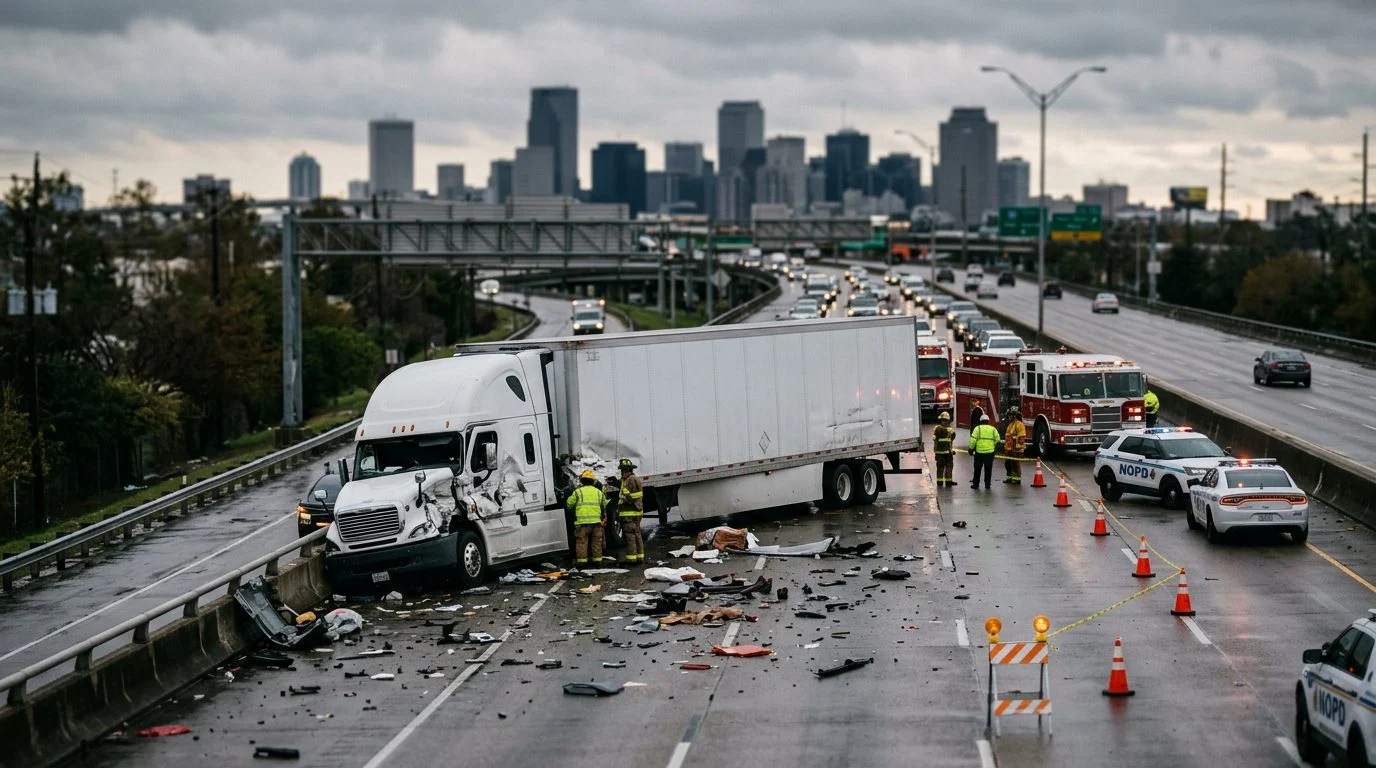
Big Rig Crash Claims in Orleans Parish: How Truck Accident Cases Work
A big rig crash claim asks the people or companies responsible for a truck crash to pay for the harm it caused. In Orleans Parish, these claims follow Louisiana civil law and federal trucking rules. They usually move from the crash scene to insurance talks, and sometimes to a lawsuit and trial.
This guide explains each step in plain language. It is general information, not advice about your case, and every case turns on its own facts.
Przemek Lubecki is the responsible lawyer for this page. The New Orleans office serves Orleans Parish. The firm also serves the New Orleans metro and Louisiana.
What a Big Rig Crash Claim Covers and Who Can Be Named
A big rig crash claim seeks payment for harm a truck crash caused. That harm can include medical bills, lost pay, and other losses Louisiana law allows.
A big rig is a tractor-trailer, 18-wheeler, or other heavy commercial truck. These claims differ from ordinary car-versus-car claims. Trucks weigh far more than passenger cars. The companies that run them follow federal trucking rules, and their paperwork is often larger and more detailed.
Injured people can include truck drivers, passengers, people in other vehicles, motorcyclists, and pedestrians. Each may have a claim, depending on how the crash happened.
Several parties may share responsibility. These can include the driver, the motor carrier that runs the truck, the owner, a lessor that leases the equipment, a company that loaded the cargo, a maintenance contractor, or a freight broker. Identifying each party early matters, because each may carry its own insurance.
Not sure what your next step is?
Talk it through with our team — the first consultation is free, confidential, and carries no obligation.
The First Hours After an 18-Wheeler Crash
Safety and medical care come first. Call for emergency help if anyone is hurt, and get checked even if you feel fine. Adrenaline can mask pain, and some injuries show up later.
Louisiana law requires a crash report when a crash causes injury, death, or property damage over five hundred dollars. The driver must make that report under La. R.S. 32:398. Inside city limits, the local police department investigates. Outside city limits, state police or the sheriff’s office investigates. Crash reports are available to the parties, their insurers, and their attorneys. Under the same statute, they are generally provided within seven working days after the investigation is complete.
At the scene, take practical steps when you can. Photograph the vehicles, the damage, the license plates, and the roadway. Write down witness names and phone numbers, along with the time and location. Note the truck’s company name and DOT number, which are usually on the cab door or trailer.
Expect the trucking company’s insurer or a company representative to call early. You can be polite and still say you need time before discussing the crash. A common mistake is calling injuries minor before a doctor has checked them.
Evidence That Usually Decides Truck Crash Cases
The truck’s own records often carry the most weight. Some of them can be overwritten or lost, so timing matters.
Electronic logging device data and duty-status records show when the driver was working and driving. Under section 395.8 of the federal motor carrier regulations, a motor carrier subject to the requirements of this part must require each driver it uses to record the driver’s duty status for each 24-hour period. That rule also bars false reports and tampering with an electronic logging device.
Post-accident testing records are another key source. Under section 382.303 of the federal motor carrier regulations, after certain occurrences involving a commercial motor vehicle on a public road in commerce, each employer shall test for alcohol each of its surviving drivers, as the regulation specifies. Those include crashes involving a death, or a citation plus injury needing immediate treatment away from the scene, or disabling damage requiring a tow. Controlled-substance tests have a 32-hour limit. If a test is not given in that window, the employer must keep a written record of the reasons.
Other evidence often matters too. These include the driver qualification file, prior violations, maintenance and inspection records, repair records, cargo and loading papers, and the truck’s event data recorder. Dashcam footage, surveillance video, and scene measurements can also help show what happened.
Fault, Comparative Fault, and Shared Responsibility
Louisiana lets an injured person recover from others who caused harm. But the injured person’s own share of fault can reduce or block recovery.
The basic rule is simple. Under La. Civ. Code art. 2315, “Every act whatever of man that causes damage to another obliges him by whose fault it happened to repair it.”
Louisiana also uses comparative fault (shared fault). Under La. Civ. Code art. 2323, the percentage of fault assigned to the injured person can reduce recovery. For claims arising after the article’s 2026 effective date, a fifty-one percent fault threshold applies. Claims that arose earlier are governed by pure comparative fault. Under La. Civ. Code art. 2323, if the degree or percentage of negligence attributable to the injured person is less than fifty-one percent, the amount of damages recoverable shall be reduced in proportion to that degree or percentage. The law also looks at everyone who contributed to the injury, including people who are not parties to the lawsuit.
Common truck crash causes include following too closely, unsafe lane changes, blind spots, fatigue, speeding, and improper loading. Each case depends on the facts. No one can say in advance how fault will be divided.
Trucking Insurance and Why Coverage Limits Matter
Federal rules set minimum insurance levels for trucking companies. The minimum is a floor. It does not decide what a claim is worth.
For example, the schedule in section 387.9 of the federal motor carrier regulations sets a minimum public liability limit of $750,000 for for-hire carriage of nonhazardous property in interstate or foreign commerce. That applies to vehicles rated at 10,001 pounds or more. Other cargo and operations have different minimums.
Many carriers carry more than the minimum. Some carry layers of coverage, including a primary policy and an excess policy. Which policies apply depends on the carrier, the cargo, and the crash.
Your own auto policy may also matter. If the at-fault driver has little or no coverage, your uninsured or underinsured motorist coverage may come into play. Louisiana’s rules for that coverage appear in La. R.S. 22:1295. Those rules cover how the coverage is issued, and how rejections or lower limits must be documented.
Adjusters, Recorded Statements, and Early Offers
An insurance adjuster works for the insurance company. The adjuster’s job is to limit what the insurer pays.
Adjusters often ask for a recorded statement soon after a crash. You can ask for time to think about it. Stick to what you know. Avoid guessing about speed, distance, or your medications. Say you don’t know when you don’t know.
Early offers can come before anyone knows the full extent of an injury. Louisiana law limits future medical costs. Under La. Civ. Code art. 2315, those costs are recoverable only when directly related to a manifest physical or mental injury or disease. That is one reason an early number may not reflect later medical needs. Take time to understand what an offer covers before you accept it.
Have questions about what happened?
Ask our team directly. The first conversation is free, confidential, and there is no obligation to continue.
Medical Care and Building a Record of Your Injuries
Your medical records are often the backbone of an injury claim. Gaps in treatment can be used against a claim, so keep your appointments and follow your treatment plan.
Tell every provider about every symptom, even small ones. Symptoms can change over time, so report new problems right away. Some brain injuries and other injuries are not obvious at first, so ask about follow-up testing if your symptoms persist.
Keep a simple journal. Note pain, sleep problems, memory or focus changes, and activities you can no longer do. Save bills, prescriptions, receipts, and mileage to appointments.
For lost income, gather pay stubs, time records, and a letter from your employer about missed work. If your injuries limit the kind of work you can do, document that too.
Wrongful Death Claims After a Fatal Truck Crash
When a truck crash causes a death, certain family members may bring a wrongful death claim. Louisiana law also allows a survival action for the injuries the person suffered before death.
Under La. Civ. Code art. 2315.2, the surviving spouse and children may sue first. If there is no spouse or child, the surviving parents may sue. If there is no parent, the surviving siblings may sue. If there is no sibling, the surviving grandparents may sue.
The survival action under La. Civ. Code art. 2315.1 follows the same classes of survivors. Under La. Civ. Code art. 2315.1, if a person injured by an offense or quasi offense dies, the right to recover damages for that injury survives for one year from the death or two years from the injury, whichever is longer, in favor of specified surviving spouses, children, parents, siblings, or grandparents.
Louisiana law describes losses such as loss of consortium, service, and society. Those are recoverable by the same family members who can bring a wrongful death claim. Deadlines apply, and they are covered in the next section.
Families in these cases often face hard decisions about records and vehicles. Early requests for preserved data and records help protect the evidence.
From Demand Letter to Lawsuit: The Louisiana Timeline
Most claims start with a demand letter. A demand letter lays out the facts, the injuries, and the amount sought. If the claim cannot be resolved, a lawsuit may follow.
Deadlines are strict. Under La. Civ. Code art. 3493.1, delictual actions are subject to a two-year prescription. That period starts on the day the injury or damage is sustained.
Wrongful death claims follow a different rule. Under La. Civ. Code art. 2315.2, the right of action for wrongful death prescribes one year from the date of death. Because these periods start on different dates and can have exceptions, the deadline for any specific case should be confirmed promptly.
Once a lawsuit is filed, discovery begins. Each side may request documents and written answers. Depositions may include the driver and company safety managers. Witnesses such as accident reconstruction analysts may be used to explain how the crash happened.
Settlement, Mediation, and Trial: How Each Path Works
Some claims resolve through negotiation between the parties and their insurers. Others go to mediation, where a neutral mediator helps the sides discuss resolution. Some cases go to trial.
At trial, the process includes jury selection, presentation of evidence, and a verdict. If comparative fault is an issue, La. Civ. Code art. 2323 requires that the jury be instructed on its effect.
No one can predict the result of a particular claim. A settlement amount or verdict depends on facts, evidence, insurance, and the law at the time. Questions about what a truck case might be worth are common. Honest answers come from reviewing the actual case, not from general examples.
Fees, Case Costs, and Referral Disclosures
Many injury firms work on a contingency fee. That means the fee is a percentage of any recovery, set out in a written fee agreement you sign.
You may be responsible for case costs and expenses in addition to the fee. Costs can include filing fees, records, and expert or consultant charges. Your written agreement explains how costs and fees are handled.
The firm may associate or refer a case to other law firms. If a case is referred or associated, the firm will disclose that. Co-counsel and referring lawyers are separate firms. They are not part of American Trial Lawyer, LLC.
Want to know where you stand?
Tell us what happened and our team will walk you through the options available to you, at no cost.
Frequently Asked Questions
How long do I have to file a truck accident claim in Louisiana?
La. Civ. Code art. 3493.1 applies to delictual actions arising on or after July 1, 2024, and provides a two-year prescriptive period. Injuries that occurred earlier remain under the former one-year period. Wrongful death claims follow a different rule.
Can I still recover if I was partly at fault?
Possibly. Under La. Civ. Code art. 2323, where injury results partly from the injured person’s own negligence and partly from the fault of others, that person’s share of negligence determines recovery: a share equal to or greater than fifty-one percent bars recovery, and a share less than fifty-one percent reduces the damages recoverable in proportion to that share.
Who can bring a wrongful death claim in Louisiana?
Under La. Civ. Code art. 2315.2, the surviving spouse and children may sue first, followed by parents, siblings, and grandparents in that order.
Does the trucking company have to test the driver after a crash?
Under section 382.303 of the federal motor carrier regulations, after an occurrence involving a commercial motor vehicle on a public road in commerce, each employer shall test for alcohol each surviving driver who was performing safety-sensitive functions if the accident involved a loss of human life, and each surviving driver who receives a citation within 8 hours for a moving traffic violation arising from the accident, if the accident involved bodily injury requiring immediate medical treatment away from the scene or disabling damage requiring a motor vehicle to be towed away.
Do I have to pay anything out of pocket?
You may be responsible for case costs and expenses in addition to the fee. Your written fee agreement will explain these terms.
Przemek Lubecki is the responsible lawyer for this page, and the New Orleans office serves Orleans Parish matters. If a big rig crash has left you hurt, or taken a family member, you may be facing an insurance call, a deadline, and hard questions about what comes next. Call 855-LUBECKI or request a free case evaluation. Your first consultation is free, confidential, and carries no obligation to continue. You may be responsible for case costs and expenses in addition to the fee. You may be responsible for case costs and expenses in addition to the fee. You may be responsible for case costs and expenses in addition to the fee.
Related practice areas
- Car Crash Injury Claim Jefferson Parish: Key Facts
- Louisiana Truck Accident Injury Claims: Rights & Next Steps