
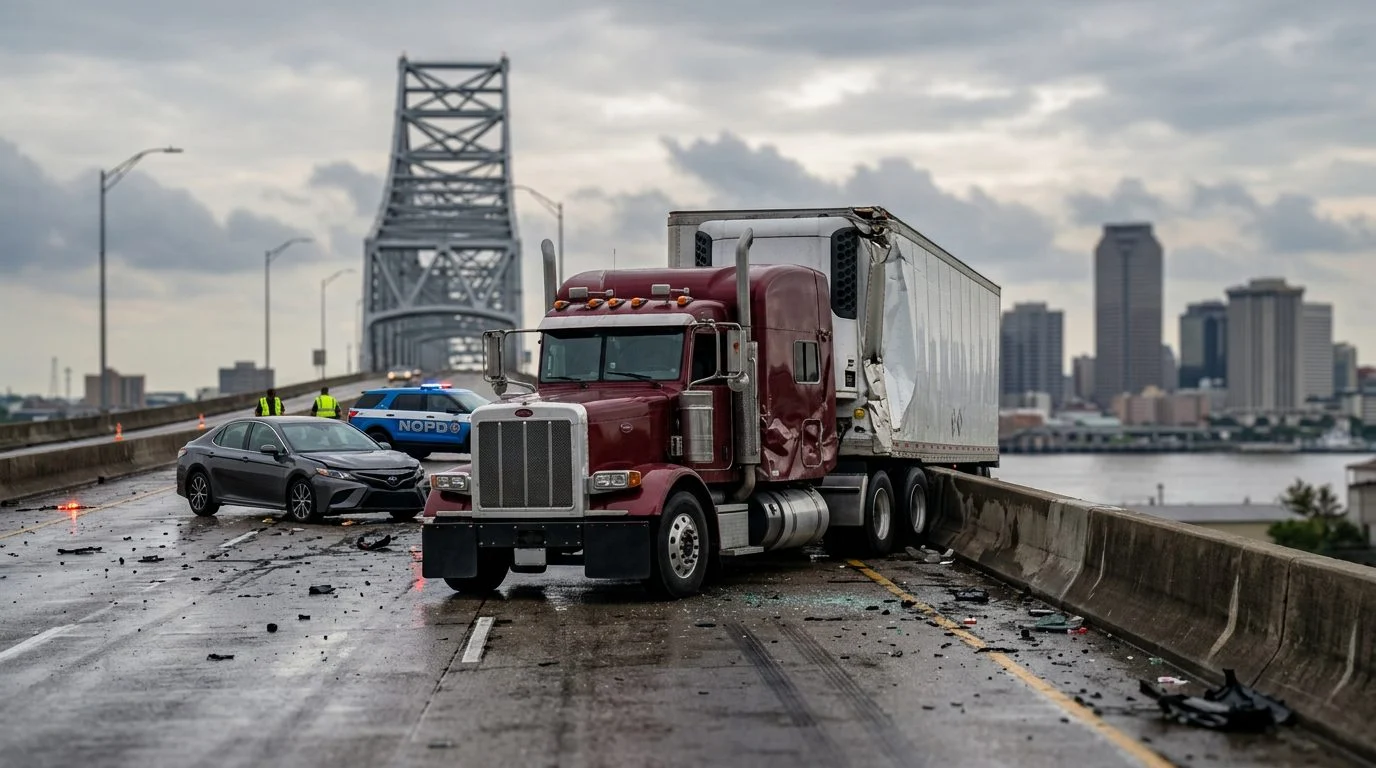
Tractor-Trailer Accidents | New Orleans, Louisiana
Hurt in a Tractor-Trailer Crash? Talk With a New Orleans Trial Lawyer
Przemek Lubecki represents people seriously injured in tractor-trailer and commercial vehicle crashes, and families in wrongful death cases, from our office in New Orleans. Your first consultation is free, confidential and without obligation. You may be responsible for case costs and expenses in addition to any fee.
By Przemek Lubecki · Published October 20, 2026
If you were hurt in a crash with an 18-wheeler, or lost a family member in one, a tractor-trailer accident lawyer New Orleans families can reach may help you understand your options. This page explains common crash causes, who may be responsible, what case work involves, and the deadlines that apply in Louisiana.
What a tractor-trailer accident lawyer handles, and who this page is for
A tractor-trailer accident lawyer handles claims for people hurt when a large commercial truck is involved. A tractor-trailer, also called an 18-wheeler, has a cab that pulls a trailer. These trucks carry freight on Louisiana highways, including through New Orleans.
This page is for adults injured in these crashes. It is also for family members in a wrongful death case after a fatal truck crash. The firm also handles car accidents, commercial vehicle accidents, and wrongful death matters.
American Trial Lawyer, LLC is the firm. Przemek Lubecki is the responsible lawyer for this page. The New Orleans office handles these matters for people in Orleans Parish and across Louisiana.

Not sure what your next step is?
Talk it through with our team — the first consultation is free, confidential, and carries no obligation.
Common causes of tractor-trailer crashes in New Orleans
Several crash patterns involve big trucks, and each one turns on the facts of the crash.
- Jackknife crashes. The cab brakes hard while the trailer keeps moving, so the trailer can swing into other lanes. Slick pavement can make a loss of traction more likely.
- Rollovers. A shifted load or a turn taken too fast can tip a trailer over, especially on ramps and curves.
- Blind spots. Large trucks have areas beside and behind the cab and trailer where a driver cannot see a passenger car. A car that stays there can disappear from view.
- Rear-end crashes. A loaded truck needs much more room to stop than a passenger car. Louisiana law says a driver may not follow another vehicle more closely than is reasonable and prudent (La. R.S. 32:81). Under La. R.S. 32:81, the driver of a motor truck traveling outside a business or residential area shall not follow another motor truck within four hundred feet, although one motor truck may overtake and pass another.
- Speed. Excessive speed increases the likelihood and severity of crashes, according to the Insurance Institute for Highway Safety.
Who may be responsible, and how Louisiana fault rules work
Responsibility can reach more than the truck driver. Louisiana law makes employers answerable for harm their workers cause while doing their jobs, but responsibility only attaches when the employer might have prevented the act and did not do it (La. Civ. Code art. 2320). Other parties, such as a company that loaded the cargo, may also be part of a claim, depending on what happened.
Equipment problems can also matter. An owner or custodian answers for a defect only if it knew or, in the exercise of reasonable care, should have known of the defect, the harm could have been prevented by reasonable care, and it failed to exercise such reasonable care, although nothing in this article precludes the court from applying the doctrine of res ipsa loquitur in an appropriate case (La. Civ. Code art. 2317.1).
Louisiana also uses a fault-sharing rule. Under La. Civ. Code art. 2323, as amended effective January 1, 2026, if the degree or percentage of negligence attributable to the person suffering injury, death, or loss is equal to or greater than fifty-one percent, that person shall not be entitled to recover damages. Under La. Civ. Code art. 2323, if the degree or percentage of negligence attributable to the person suffering injury, death, or loss is less than fifty-one percent, the amount of damages recoverable shall be reduced in proportion to that degree or percentage of negligence. Fault shares can change how much, or whether, a claim recovers, so the facts of each crash matter.
What the case work includes
Evidence comes first, because some truck records are time-sensitive. These steps focus on evidence that can change or disappear.
- Preservation requests ask the trucking company to keep the truck, its data, and its dispatch and maintenance records.
- Driver logs. Federal rules require each change of duty status to record the city, town, or village and the State (49 C.F.R. § 395.8). These logs can show where a driver was working.
- Post-accident testing. Federal rules set timing for drug and alcohol tests after certain truck crashes (49 C.F.R. § 382.303). Early requests help protect this evidence.
- Crash reports. The driver of a vehicle involved in a crash resulting in injury to or death of any person, or property damage in excess of five hundred dollars, must give such information and, upon request, exhibit such license or permit to any police officer at the scene of the crash or who is investigating the crash (La. R.S. 32:398). Under La. R.S. 32:398, when the officer investigating a crash involving injury, death, or property damage over five hundred dollars has reason to believe a driver has a medical condition that is cause for suspending or revoking a license under R.S. 32:414(E), the officer must notify the medical/conviction unit of the office of motor vehicles, “provided that the law enforcement officer first consults with his superior officer as to his specific observations and his superior officer concurs with the issuing officer’s belief.” Under La. R.S. 32:398(I)(1)(a), crash reports and the information in them are confidential and are made available only to specified persons, including the parties to the crash, their insurers, their healthcare providers, and their attorneys or succession representatives. New Orleans police reports can be requested, and released reports may be redacted (City of New Orleans police reports).
- Medical records. These document injuries such as broken bones, soft-tissue harm, and brain injury. Louisiana limits future medical costs to those directly related to a manifest physical or mental injury (La. Civ. Code art. 2315).
- Lost income and daily life. Records show time missed from work and how the injury affects routine tasks.
- Wrongful death work. For families, this includes documenting the loss and identifying which relatives Louisiana law allows to bring a claim.
What to expect: the step-by-step process
The process moves in five steps, and timelines vary by case.
- First call. You share the crash facts, your injuries, and any papers you have.
- Investigation. We request records, send preservation letters, and review medical files. Complex crashes take longer.
- Evaluation. We review fault, injuries, and insurance coverage, and explain them in plain terms.
- Demand and negotiation. A written demand goes to the insurers, followed by discussions.
- Lawsuit if needed. If talks do not resolve the claim, suit can be filed in the proper Louisiana court, followed by discovery and trial preparation.
Deadlines matter. Louisiana’s general rule gives two years from the day injury is sustained to bring a delictual (tort) action, but prescription does not run against minors or interdicts in actions involving permanent disability brought under the Louisiana Products Liability Act or state product liability law (La. Civ. Code art. 3493.1). For wrongful death, the time limit to sue is one year from death or two years from the injury, whichever is longer, but for medical malpractice actions it is one year from the death of the deceased (La. Civ. Code art. 2315.2). Early contact helps protect these deadlines.
Why American Trial Lawyer in New Orleans, and how fees and costs work
American Trial Lawyer is led by Przemek Lubecki, a trial lawyer working from the New Orleans office.
- Przemek Lubecki is the responsible lawyer for this content and leads each matter.
- Our office is in New Orleans, Louisiana.
- Support staff, including assistants and office staff, help with records and scheduling.
- The firm handles matters for people in Orleans Parish, the New Orleans metro, Metairie, Jefferson Parish, Kenner, St. Bernard Parish, Slidell, and across Louisiana, served from the New Orleans office.
- The first consultation is free, confidential, and carries no obligation to continue. You may owe case costs and expenses in addition to any fee.
- The firm may associate or refer a case to other law firms.
Our approach is plain and direct. We explain your options, the deadlines, and the next steps before you decide anything.
Have questions about what happened?
Ask our team directly. The first conversation is free, confidential, and there is no obligation to continue.
Frequently asked questions, and a next step after a tractor-trailer crash
Here are short answers to common questions about truck crashes.
Can you sue if a semi truck hits you?
Claims may be possible against the driver and the company. Whether a claim can go forward turns on the facts and on Louisiana’s time limits.
What should I avoid saying to an insurance adjuster?
Keep statements short and factual, and avoid guessing about fault or injuries. Talk with our office before giving a recorded statement.
Who is at fault in a rear-end collision?
Fault turns on following distance, braking, signals, and road conditions. Louisiana’s fault-sharing rule can lower recovery when the injured person shares fault.
What if the crash caused a death?
Louisiana law lists who may bring a wrongful death suit, starting with a surviving spouse and children, then parents, siblings, and grandparents, depending on who survives. Contact our New Orleans office to talk through what your family can do.
If a loaded truck pulled into your lane on I-10 and left you hurt, or a crash has left your family facing a loss, you don’t have to sort out the claim alone. Request a case evaluation or call 855-LUBECKI.
How Our Office Approaches Your Case
Trial-focused representation
Przemek Lubecki is a trial lawyer. Cases are prepared with the possibility of trial in mind from the start, so the investigation and documentation are built to hold up in court.
Early evidence preservation
Trucking companies keep driver logs, maintenance records, dispatch data and electronic control module information. Our team works to request and preserve these records before they are lost.
Clear, plain-language updates
We explain the legal process in everyday terms, so you understand where your case stands and what decisions are ahead.
Serving New Orleans and the metro area
Our office is in New Orleans. Bernard Parish, Slidell and throughout Louisiana.
Possible referral to other firms
Your case may be associated with or referred to other law firms. If that happens, we will tell you in advance and explain what it means for you.
Be Careful With the Trucking Company's Insurer
An insurance adjuster may call you soon after a crash and ask for a recorded statement. Keep any statement short and factual, avoid guessing about fault or injuries, and talk with our office before you give one.
Steps That Can Help Protect Your Claim
Get medical care right away
Even if you feel you can walk it off, a medical evaluation creates an important record of your injuries. Follow the treatment plan your doctors give you.
Document the scene
If you are able, take photos of the vehicles, the road, the weather and your injuries. Write down the names of witnesses and the trucking company and its DOT number, if you can see them.
Keep your records
Save police reports, medical bills, pay stubs and any letters from insurers. Keep a simple journal of pain, missed work and daily limitations.
Talk with a lawyer before you decide
Trucking claims often involve several parties and detailed federal and state rules.